


Digital transformation benefits example of ppt presentation





Try Before you Buy Download Free Sample Product
 Impress Your
 Audience
 100%
100% Editable
 Save Hours
 of Time


Business transformation is extremely important in today’s rapidly evolving and increasingly global economy. Keeping this view point in mind our team of designers have crafted this digital transformation benefits example of PPT PowerPoint template. Our digital transformation PPT slideshow has a pre-designed graphic of tree with professional icons which can help in aligning your people, processes and technology to your business strategy and vision. No matter what industry you are working in, you need to transform and plan your business activities to survive in the long run. This digital transformation benefits Presentation visual is fully modifiable so this can be altered as per the needs of your business organization. If you want to achieve your goals and targets in the changing business environment, you need to incorporate this digital transformation PPT slide design to capture the attention of your suppliers, stakeholders, customers, etc. Hurry up and download now. Hit the ground running with our Digital Transformation Benefits Example Of Ppt Presentation. You will begin with a great advantage.
People who downloaded this PowerPoint presentation also viewed the following :
Content of this Powerpoint Presentation
Description:
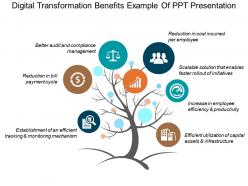
The image showcases a PowerPoint presentation slide titled "Digital Transformation Benefits Example". It features a stylized tree with leaves that represent various benefits of digital transformation in an organization. Each leaf has an icon and an associated benefit. Starting from the top clockwise, the benefits include:
1. "Reduction in cost incurred per employee" suggests cost savings due to efficiency improvements or automation reducing the overall cost associated with each employee.
2. "Scalable solution that enables faster rollout of initiatives" implies that digital solutions can be easily expanded or adapted, allowing for quicker implementation of new business strategies or processes.
3. "Increase in employee efficiency & productivity" indicates that digital transformation can help workers to perform their tasks more effectively, often through better tools or streamlined workflows.
4. "Efficient utilization of capital assets & infrastructure" means making the most of the physical and financial resources available to an organization through better management and allocation facilitated by digital technologies.
5. "Establishment of an efficient tracking & monitoring mechanism" points to the use of digital systems to oversee operations, track performance, and ensure accountability.
6. "Reduction in bill payment cycle" refers to speeding up financial transactions, such as the time taken to settle invoices, through automated systems.
7. "Better audit and compliance management" denotes that digital systems can enhance an organization's ability to conduct audits and maintain regulatory compliance more easily and accurately.
Use Cases:
Industries where this slide can be especially pertinent include:
1. Financial Services:
Use: To show how digital transformation can improve financial operations and compliance.
Presenter: CTO or Digital Transformation Officer
Audience: Company stakeholders, including investors and board members
2. Healthcare:
Use: To highlight the impact of digital technology on healthcare efficiency and patient care.
Presenter: Healthcare Administrator or IT Manager
Audience: Hospital management and medical staff
3. Retail:
Use: To discuss the benefits of adopting digital technologies in inventory tracking and customer service.
Presenter: Retail Operations Manager
Audience: Retail chain executives or store managers
4. Manufacturing:
Use: To illustrate how digital transformation streamlines production processes and supply chain management.
Presenter: Manufacturing Operations Director
Audience: Production managers and process engineers
5. Telecommunications:
Use: To demonstrate the advantages of digital solutions in managing networks and customer data.
Presenter: Chief Information Officer (CIO)
Audience: Network operation teams and customer service leadership
6. Education:
Use: For outlining the ways digital systems can enhance educational administration and learning experiences.
Presenter: Dean or Director of Educational Technology
Audience: Faculty members and administrative staff
7. Energy:
Use: To describe how digital systems can lead to more efficient resource management and predictive maintenance.
Presenter: Energy Company Executive
Audience: Engineers, technicians, and industry regulators
Digital transformation benefits example of ppt presentation with all 5 slides:
Our Digital Transformation Benefits Example Of Ppt Presentation get the forces of good into alignment. Get them fighting against evil.
FAQs for Digital transformation benefits example
Hey! So digital transformation basically gives you three big wins. First, you'll get way more efficient - automating boring tasks and streamlining how things work. Second, customers are happier because they get faster service and better experiences. The third thing is you can actually compete with the big guys now since you're using the same tools they have - cloud stuff, automation, analytics, whatever. Honestly, I think it's pretty transformative if you don't try to do everything at once. Just pick one thing, get good at it, then move on. Much less overwhelming that way.
Honestly, digital transformation is a game-changer for customer experience. You can predict what people want using data and AI before they even know it themselves. Chatbots handle support 24/7, and everything connects smoothly across different platforms. Retailers nail those personalized recommendations, banks go all-in on mobile apps, healthcare does virtual visits. The best part? You eliminate those super annoying moments where customers get stuck and frustrated. I'd start by looking at your customer journey - wherever people are hitting roadblocks, that's where you'll get the biggest wins from going digital.
Honestly, automation saves you money in ways that'll surprise you. Manual stuff like data entry and invoicing? That's where you're bleeding cash right now. Automated systems don't make typos, don't need lunch breaks, and work weekends without complaining. Your team can focus on actual strategy instead of mind-numbing repetitive work. The error reduction alone pays for itself - I've seen companies waste thousands fixing preventable mistakes. Start with whatever process makes your employees want to bang their heads against the wall. That's usually your goldmine.
Look, data analytics is what actually makes digital transformation work. You can't just throw tech at problems and hope for the best - I've watched companies burn money doing exactly that. Analytics shows you what's really happening with customers and operations, so you know where to focus your efforts. Think of it as your roadmap through all the digital chaos. Without good data, you're basically flying blind and will probably end up with shiny new systems that don't actually help your business. Figure out which metrics truly matter for your goals first, then build everything else around those insights.
Honestly, digital transformation is a game-changer for remote teams. You'll get tools like Slack or Teams for instant messaging, cloud docs where everyone can edit at once, and video calls that don't suck. Project management platforms keep everyone aligned - no more confusion about who's doing what. Everything works from anywhere, so your Tokyo team can jump in after New York signs off. I'd say start with whatever tool fixes your biggest pain point first. Don't try to overhaul everything at once or you'll drive yourself crazy.
Ugh, so many new attack surfaces when you add cloud stuff - that's the biggest pain. Your legacy systems weren't built for today's threats either. Plus half your team will probably ignore security protocols with shiny new tools (you know how people are). Start with a security assessment before touching anything though. Zero-trust architecture helps a ton, and do phased rollouts instead of changing everything at once. Regular training keeps everyone on track. Build security into the whole plan from the start - way easier than trying to bolt it on later.
Look, the biggest win is getting real-time data instead of waiting weeks for some useless report. You'll have live dashboards showing what's actually happening with customers and money stuff - way better than guessing or using those ancient spreadsheets we all hate. Automated workflows cut out so much email BS too, which honestly saves my sanity. When the market goes crazy, your team can actually react fast since everyone's seeing the same current info. Just make sure people know how to use the new tools or you're basically putting lipstick on a pig.
Honestly, digital transformation makes a huge difference for both productivity and keeping people happy at work. Automated stuff cuts out all that tedious busywork, and when your tools actually talk to each other properly, everything just flows better. People get way more engaged when they're not fighting with clunky systems all day - they can actually do meaningful work instead. Plus remote access is pretty much expected now. Oh, and collaboration tools that don't suck make a massive difference too. I'd say figure out what's driving your team crazy first, then tackle those problems. That's where you'll see results fast.
Track the obvious stuff first - cost savings, new revenue streams, operational cuts. But honestly? The real wins are harder to measure, like how much faster your team makes decisions now or whether customers actually like dealing with you more. Set your baselines before changing anything, then check in every quarter. Don't go crazy measuring everything though - pick maybe 3-5 things that actually move the needle for your business. I learned this the hard way trying to track like 15 different metrics. Start small, see what works.
Oh man, where do I start? Your team's gonna hate the changes at first - people really don't like learning new stuff. Budget's always tight too, and this stuff costs way more than anyone thinks. Legacy systems are honestly the worst part though, nothing wants to play nice together. Most places also don't have anyone who actually knows digital tools well. My advice? Don't try to change everything overnight, you'll just burn everyone out. Start with something small that actually works, get the bosses excited about it first. And definitely train people properly or they'll just go back to doing things the old way.
So digital transformation is basically amazing for cutting environmental waste. Automation kills the need for tons of paper - like, we're talking entire filing cabinets worth. Remote tools mean way less business travel too. Smart systems automatically dial down energy when you don't need it, which honestly should've been invented decades ago. Cloud computing beats running your own servers by miles - those big data centers are surprisingly eco-friendly. The coolest part? Analytics will show you waste you had no clue existed. Pick one manual process and digitize it first. You'll be blown away.
Honestly? Healthcare's your best bet - half these places still use fax machines which is wild in 2024. Manufacturing's solid too since they're always breaking expensive equipment that could've been prevented with some sensors. Retail's obvious but everyone's doing it. I'd hunt for anything that's still paper-based or totally manual. Those are quick wins that'll actually show ROI fast. Healthcare workflows are a mess, predictive maintenance prevents costly shutdowns, and inventory management always needs work. Just pick the sector you can actually stomach working in long-term.
Digital transformation lives or dies by change management, honestly. People won't just magically embrace new tech - you've got to show them what's in it for them. Training is huge, but so is actually listening to their worries. I can't tell you how many times I've watched projects crash because executives thought everyone would just... figure it out? Find your early adopters first - they'll do half the convincing for you. Oh, and don't skip the "why" part when you roll things out. Makes all the difference.
Honestly, cloud computing and AI are the big players right now. Remote patient monitoring through IoT devices is huge too - my cousin's company actually pivoted to that during COVID. Telemedicine exploded overnight, like literally pushed forward five years in five months. EHRs are getting way better at talking to each other finally. You'll see blockchain popping up for patient data security, plus mobile health apps are basically everywhere now. If I were you, I'd look hard at AI diagnostics and remote monitoring. That's where the money is right now.
So basically AI flips you from always reacting to actually predicting stuff before it happens. Your systems start spotting patterns and making calls automatically - like how Netflix knows what you'll binge next, but for your whole operation. You can personalize customer experiences without hiring an army, automate processes that used to need human decisions, optimize inventory and pricing on the fly. Here's the crazy part: it gets smarter as you feed it more data, so your business keeps improving itself. Don't go overboard though - just pick one data-heavy process and test something small first.
-
Content of slide is easy to understand and edit.
-
Illustrative design with editable content. Exceptional value for money. Highly pleased with the product.