

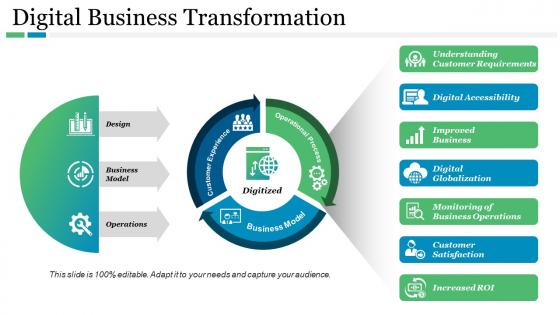
Digital business transformation ppt summary structure





Try Before you Buy Download Free Sample Product
 Impress Your
 Audience
 100%
100% Editable
 Save Hours
 of Time


Our Digital Business Transformation Ppt Summary Structure help you deal with the big boys. They add a lot to your demeanour.
People who downloaded this PowerPoint presentation also viewed the following :
Digital business transformation ppt summary structure with all 5 slides:
Do not let the excitement abate. Our Digital Business Transformation Ppt Summary Structure will keep the mood up.


FAQs for Digital business transformation
Honestly, it's mostly about what customers expect now - they want that Amazon-style experience everywhere they go. Competition's brutal too. If everyone else is going digital faster, you're screwed. Cost savings are massive since digital stuff cuts way down on operational headaches. Companies are also realizing they have tons of customer data just sitting there useless in old systems. COVID definitely sped things up with remote work becoming normal. Oh, and efficiency pressures never stop. Figure out which one of these is hitting your business the hardest first - that's where you should focus your energy.
Track the obvious stuff first - revenue growth, cost savings, how fast you're getting new customers. Those numbers don't lie. But here's the thing, employee adoption rates matter way more than people think. If your team isn't actually using whatever you implemented, you're screwed regardless of what the spreadsheets say. Customer satisfaction scores are gold too. Oh, and definitely measure your baseline before you start anything - learned that one the hard way. Check in quarterly to see if you're hitting your targets. Process automation and faster time-to-market are where you'll really see wins.
Look, data analytics is honestly what separates successful digital transformations from expensive disasters. Without it, you're basically guessing which tech investments will pay off - not fun when you're spending real money. Good analytics show you exactly where customers are struggling and which internal processes are bottlenecks. That's gold for prioritizing what to digitize first. I'd say start by looking at what data you're already sitting on but not actually using. Most companies collect way more than they realize. Those insights will guide your whole strategy and keep you from chasing every shiny new platform that comes along. Smart data use = smart spending decisions.
Don't just drop changes on people - get them involved from the start. Explain what's in it for them personally, like better tools or career growth opportunities. So many companies mess this up and then act shocked when everyone pushes back! Let people give real feedback that actually matters. Training shouldn't be just one boring workshop either. Celebrate the small wins as you go - it keeps everyone motivated. Oh, and your biggest advocates will be the employees who feel like they're part of shaping things, not just dealing with whatever gets handed down.
Honestly, the biggest pain points are usually your own employees fighting the changes and budget getting slashed halfway through. Technical skills are another headache - your current team probably doesn't know the new systems. Executives get excited until they see what it actually costs, then suddenly they're "reassessing priorities." Legacy systems are a nightmare to integrate with anything modern. Oh, and your IT team will lose sleep over security risks. Even amazing tech becomes useless if people refuse to actually use it. Start with small pilot programs first - prove it works before going all-in company-wide.
Digital transformation can totally change how customers interact with your business. Response times get way faster, and self-service actually becomes useful instead of frustrating. The best part? All your systems talk to each other, so customers don't have to explain their problem five times to different people. Some companies mess this up initially - they rush the rollout and things get worse before they get better, which is annoying. But done right, you'll see shorter wait times and more personalized experiences. I'd start by mapping out where customers currently struggle most and tackle those areas first.
Focus on cloud stuff first - that's your base layer. Data analytics and automation tools come next. API connections matter way more than people think (trust me, learned this when everything broke on my last gig). Customer experience platforms are solid investments too. Mobile solutions, obviously. Some AI/ML capability if it makes sense for your business. Honestly though? Don't just chase shiny new tech. Figure out what you actually need first. Do like a quick audit of where you're at digitally, then tackle your biggest pain points. Way smarter approach.
Honestly, digital transformation completely rewrites how your company operates day-to-day. Teams start sharing info way more freely, which naturally breaks down those annoying departmental walls. People become obsessed with data - like, everything becomes about what the numbers actually show. Risk-taking becomes normal instead of scary, and honestly that's probably the coolest part. Your whole hierarchy gets flatter because information isn't hoarded anymore. Plus everyone gets weirdly customer-obsessed since digital tools let you see exactly what users are doing. But here's the real kicker - your org becomes addicted to adapting. First step? Figure out what cultural roadblocks will trip you up.
Honestly, retail, healthcare, and finance absolutely killed it with going digital. Banking had no choice - fintech was eating their lunch. Retail couldn't ignore Amazon anymore. Healthcare was dragging behind until COVID forced telehealth and digital records overnight (thank god, right?). Manufacturing's been surprising me lately with all their IoT stuff preventing breakdowns. The pattern I've noticed? Industries either got disrupted hard or had obvious problems that tech could fix. They're seeing huge returns because they deal with customers constantly and have mountains of data to work with. You should look for those same pressure points in whatever industry you're thinking about.
Honestly, this is where small businesses can totally beat the big guys. Those huge companies are stuck with ancient systems that take forever to change. You get to move fast and try new stuff. I'd start with whatever eats up most of your time - maybe customer service bots or inventory tracking. Cloud tools are perfect since they won't break the bank and grow with you. Here's the thing: customers really don't care how big you are if everything works smoothly on their end. Pick one annoying process this week and just start googling automation tools for it. Master that first, then move on to the next headache.
Honestly, digital stuff and going green work together way better than most people realize. You're already cutting paper waste when you digitize things. Remote work = less commuting. Smart systems optimize energy use automatically. Data analytics is probably the biggest win though - it shows you exactly where you're burning money AND resources unnecessarily. Cloud computing means you don't need as much physical equipment sitting around. Even automation helps since it prevents those dumb human mistakes that waste materials. Most digital projects end up being environmentally friendly without even trying. I'd start by looking at what digital initiatives you've already got going - bet there's more sustainability overlap than you think.
Start by connecting your digital stuff directly to actual business goals. Like if you want 20% better customer retention, focus on tech that improves their experience - not whatever shiny new AI tool is trending this week. Honestly, I've seen so many teams chase buzzwords without any clear purpose. Every project should answer: "how does this actually help our bottom line?" Build a simple chart showing business goal → digital solution → expected results. When your boss inevitably asks why you need that expensive platform, you'll have real numbers to back it up instead of just tech speak.
Honestly, just talk to people constantly and tell them WHY you're doing this stuff, not just what's changing. Town halls, emails, random coffee chats - whatever works. I've watched so many projects crash because leadership just disappeared for like 6 months lol. Address their worries head-on and actually celebrate the small victories. People need to feel heard, so create ways for feedback. Stories work way better than spreadsheets for helping them picture where you're headed. Oh, and start with your most respected team members first - they'll do half the convincing for you.
Start with a solid risk assessment - map out all the cybersecurity gaps, data privacy headaches, and operational stuff that could blow up. Your biggest enemy? Staff pushback. People absolutely hate change, even the good kind. Combat this with proper training and actually explaining why you're doing it. Test everything with pilot programs first - seriously, don't go full scale right away. Always have backup plans ready to roll back if things get messy. Oh, and don't try changing everything at once. Phase it out so you can pivot quickly when (not if) something goes wrong.
Honestly, your leaders make or break this whole thing. They've got to set the vision and put money behind it, but here's what I've seen work - the best transformations happen when leadership actually uses the same tools they're pushing on everyone else. People smell BS from a mile away. Your leaders need to explain why this matters, not just dump new tech on people. Celebrate the small wins too. And look, if they don't know something about the new tech, just admit it! That vulnerability actually helps. Without leadership buying in completely, you'll hit resistance everywhere and things just stall out.
-
Enough space for editing and adding your own content.
-
Use of different colors is good. It's simple and attractive.