


How To Apply The Blue Ocean Strategy Four Action Framework




Try Before you Buy Download Free Sample Product
 Impress Your
 Audience
 100%
100% Editable
 Save Hours
 of Time


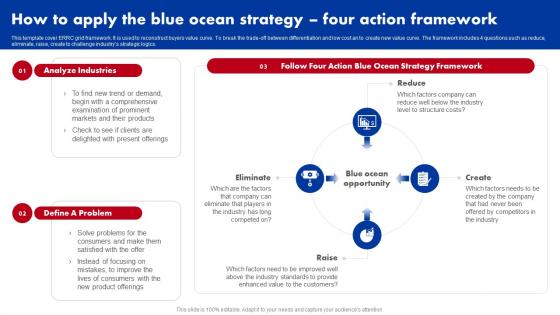
This template cover ERRC grid framework. It is used to reconstruct buyers value curve. To break the trade off between differentiation and low cost an to create new value curve. The framework includes 4 questions such as reduce, eliminate, raise, create to challenge industrys strategic logics.
People who downloaded this PowerPoint presentation also viewed the following :
How To Apply The Blue Ocean Strategy Four Action Framework with all 6 slides:
Use our How To Apply The Blue Ocean Strategy Four Action Framework to effectively help you save your valuable time. They are readymade to fit into any presentation structure.





FAQs for How To Apply The Blue Ocean Strategy
Blue Ocean Strategy's core principles include value innovation, focus-differentiation combination, creating uncontested market space, making competition irrelevant, and reconstructing market boundaries through strategic canvas analysis. Unlike traditional competitive strategies that fight for existing market share in "red oceans," this approach systematically creates new demand by simultaneously pursuing differentiation and low costs, with companies like Cirque du Soleil and Southwest Airlines demonstrating how these principles deliver sustainable competitive advantage.
Businesses identify blue oceans by analyzing customer pain points across industry boundaries, examining non-customer segments, and mapping value curves to find gaps where competition is irrelevant. Through systematic market research, value innovation frameworks, and cross-industry benchmarking, companies like Netflix and Uber discovered uncontested spaces, ultimately creating new demand while reducing costs and differentiation trade-offs.
Innovation serves as the fundamental engine for Blue Ocean Strategy development, enabling companies to reconstruct market boundaries, eliminate industry trade-offs, and create entirely new value propositions that render competition irrelevant. Through systematic innovation in product features, delivery methods, and customer experiences, organizations like Cirque du Soleil and Southwest Airlines have successfully carved out uncontested market spaces, ultimately delivering exceptional growth while reducing costs and differentiating from traditional competitors.
Netflix successfully transformed from DVD rentals to streaming, creating an uncontested market space by combining convenience, vast content libraries, and personalized recommendations. Tesla revolutionized automotive by merging luxury, sustainability, and cutting-edge technology, while Cirque du Soleil reinvented circus entertainment by blending theater with acrobatics, ultimately delivering new customer experiences and sustainable competitive advantages across industries.
Value innovation drives blue ocean creation by simultaneously pursuing differentiation and low cost, breaking the traditional trade-off between value and cost. Its key components include eliminating industry factors that add cost without value, reducing unnecessary features, raising elements that enhance buyer value, and creating new value dimensions that competitors don't offer, ultimately delivering uncontested market space and sustainable competitive advantage.
Companies can utilize the Four Actions Framework to reconstruct market boundaries by eliminating factors their industry takes for granted, reducing elements that don't create value, raising critical success factors, and creating entirely new value elements. Through this systematic approach, organizations across sectors like Southwest Airlines in aviation or Cirque du Soleil in entertainment successfully redefine competitive landscapes, ultimately delivering unique customer experiences while minimizing costs and establishing uncontested market spaces.
Common pitfalls include insufficient market research, inadequate resource allocation, resistance to organizational change, poor timing of market entry, and failure to communicate value propositions effectively. While these challenges present significant obstacles, organizations in healthcare, financial services, and retail increasingly find that strategic planning, cross-functional collaboration, and customer-centric innovation ultimately enable successful transitions, delivering competitive advantage and sustainable growth.
Organizations measure Blue Ocean success through customer acquisition rates, market share growth, profit margins, and competitive differentiation metrics. These initiatives deliver value by creating uncontested market spaces, reducing direct competition, and enhancing customer loyalty, with many companies finding that tracking innovation impact and cost structure improvements ultimately provides the clearest indicators of strategic breakthrough.
Essential Blue Ocean Strategy tools include the Strategy Canvas, Four Actions Framework, Six Paths Framework, Value Innovation analysis, and the Eliminate-Reduce-Raise-Create Grid. These frameworks enable organizations to systematically identify uncontested market spaces, redefine industry boundaries, and create compelling value propositions, with many companies finding that strategic application delivers sustainable competitive advantage and profitable growth.
Customer insight fuels new demand creation by revealing unmet needs, pain points, and desired outcomes that existing solutions don't address, enabling companies to design entirely new value propositions. Through deep understanding of customer frustrations and aspirations, organizations can eliminate industry trade-offs, create breakthrough benefits, and attract non-customers who previously avoided the market, ultimately expanding total demand.
Small businesses can leverage Blue Ocean strategies by identifying underserved customer segments, eliminating costly features that large competitors over-provide, and creating unique value propositions through personalized service, niche specialization, or innovative delivery methods. While larger firms focus on competitive benchmarking, smaller businesses can explore uncontested market spaces by combining affordability with differentiation, ultimately delivering customer experiences that established players cannot easily replicate due to their operational complexity.
Industry collaboration enhances Blue Ocean Strategy effectiveness by enabling shared resource pools, cross-sector innovation, and collective market creation that individual companies cannot achieve alone. Through strategic partnerships, organizations can combine complementary capabilities, reduce individual risk exposure, and accelerate uncontested market space development, with many finding that collaborative approaches deliver faster market penetration and sustainable competitive advantages.
Blue Ocean Strategy risks include market uncertainty, high development costs, competitive replication, consumer adoption challenges, and resource allocation pressures. While these present significant considerations, companies can mitigate them through phased implementation, continuous market research, and strategic patent protection, with many organizations finding that diversified approaches and agile response mechanisms ultimately deliver sustainable competitive advantage.
Companies ensure blue ocean sustainability by continuously innovating their value propositions, building strong brand loyalty, and creating operational capabilities that are difficult to replicate. While maintaining market leadership through ongoing differentiation, companies like Cirque du Soleil and Southwest Airlines demonstrate that strategic reinvention, coupled with deep customer understanding and agile business models, ultimately delivers lasting competitive advantage in increasingly dynamic markets.
Digital transformation significantly impacts Blue Ocean Strategy formulation by enabling data-driven market analysis, revealing untapped customer segments through analytics, and creating new value propositions through emerging technologies like AI, IoT, and automation. These digital tools help organizations identify uncontested market spaces more precisely, streamline innovation processes, and deliver enhanced customer experiences, ultimately enabling faster strategy execution and competitive differentiation in increasingly digital markets.
-
Thank you SlideTeam for such an excellent service.
-
Well-designed and informative templates. Absolutely brilliant!