


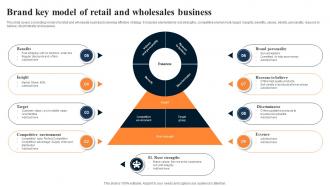
Brand Key Model Of Retail And Wholesales Business





Try Before you Buy Download Free Sample Product
 Impress Your
 Audience
 100%
100% Editable
 Save Hours
 of Time


This slide covers a branding model of a retail and wholesale business to develop effective strategy. It includes elements like root strengths, competitive environment, target, insights, benefits, values, beliefs, personality, reasons to believe, discriminator and essence.
People who downloaded this PowerPoint presentation also viewed the following :
Brand Key Model Of Retail And Wholesales Business with all 6 slides:
Use our Brand Key Model Of Retail And Wholesales Business to effectively help you save your valuable time. They are readymade to fit into any presentation structure.





FAQs for Brand Key Model Of Retail
So the Brand Key Model breaks down into four parts: competitive framework, target audience, brand benefits, and brand character. I'd honestly start with competitive framework first - it's like figuring out where you fit before anything else. Your target audience is who you're actually speaking to (definitely not "everyone" because that's useless). Brand benefits are the functional and emotional stuff customers get from you. Then brand character is basically your brand's vibe or personality. Oh, and they all work together - kind of like puzzle pieces where each one makes the others clearer.
So the Brand Key Model is basically this framework that makes you nail down four things: who you're targeting, who you're actually competing with, what benefit you offer, and why people should believe you. Think of it like... you can't just claim you're "premium" without proof, right? It forces you to be super specific about your positioning instead of being vague. Your whole team stays on the same page too, which is clutch. Honestly, I'd fill one out for your brand then see if everyone would answer the same way - that's usually where you find the gaps.
So the Brand Key Model basically helps you map out your competitive frame, target audience, benefits, and personality - which sounds boring but it's actually super useful. People start connecting with your brand emotionally when everything feels consistent. Like, they know what to expect from you every time. Short sentences build trust. Longer experiences that feel authentic make customers want to stick around because they're not getting mixed signals about who you are. I mean, think about brands you're loyal to - they probably nail this without you even realizing it. Just map yours out and check if your actual touchpoints match what you wrote down.
Yeah, totally works for both! New brands get to build everything from the ground up, which is honestly pretty fun. You're just using the model as your roadmap. Established brands are different though - you're more like doing a check-up on what's already there. What's your current positioning? Does your brand personality actually make sense? That kind of thing. The tricky part with older brands is you can't just ignore what people already think about you. New ones have way more room to play around. Oh, and regardless of which one you are, figure out your audience first. That's where I'd start anyway.
Honestly, consumer insight is everything when it comes to your Brand Key. You've got to really dig into what your audience thinks and feels - not just what they tell you in surveys, because people lie about their habits all the time. This insight shapes your competitive positioning and what makes you different. Can't stress this enough: without understanding your consumers' real motivations, you're basically throwing darts blindfolded. I learned this the hard way once. Do the research first, figure out those unmet needs, then build your brand positioning around that. Skip this step and you'll regret it.
Honestly, what I love about the Brand Key is how it flips everything - you start with your audience instead of your own company stuff. Makes total sense when you think about it. Other frameworks feel way too academic for my taste, but this one's actually practical. It flows really naturally from consumer insights down to personality traits. The visual setup is clutch too because you can immediately see where things don't line up. I'd definitely use it as your main framework, then maybe check it against others if you want. Way more straightforward than most branding tools out there.
So basically, start with whatever emotional thing your brand makes people feel - that's your foundation. Then figure out what your audience actually wants and connect your product benefits to those deeper feelings. The competitive part is honestly my favorite bit because it makes you really think about how you're different from everyone else. Make sure your brand personality and proof points all tell the same story across everything you do. Way better than just throwing random messages everywhere and hoping something sticks. Oh, and definitely audit what you're doing now against each piece of the model first - you'll probably find some weird gaps you didn't notice before.
So basically any industry where you need emotional connections - consumer goods, retail, hospitality. P&G and Unilever use it all the time for new products. Tech companies are obsessed with it, especially the B2C ones trying to stand out. Even B2B software is doing it now (weird but whatever). Works great if you can't just compete on features or price alone. I mean, if customer loyalty actually matters in your space, definitely try it. Oh, and avoid it if you're selling something purely functional - probably won't help much there.
So the Brand Key Model is all about hitting those emotional buttons through two main things - your brand's personality and the feelings people get from buying your stuff. First, figure out your character. Are you the trustworthy friend or the rebel who breaks rules? Then flip your benefits from boring functional stuff to emotional wins. Like instead of "cleans better," go with "you'll feel put-together." I swear this sounds obvious but most brands totally miss it. They get stuck in feature-land when people actually buy based on how something makes them feel. Just compare your current messaging to these two areas and you'll see where you're being way too logical.
Don't go generic with your brand promise - "we're innovative" means absolutely nothing when everyone says it. Get leadership bought in first or you're screwed, trust me. Keep the discriminator part simple (I see people overthink this constantly). Most teams treat it like a checkbox exercise instead of something that grows over time. Oh, and test with actual customers before you roll it out everywhere. Honestly? Start with language that's specific and actually sets you apart. Simple beats complicated every single time here.
Yeah, totally doable! Map each Brand Key piece to your digital stuff - competitive frame becomes your SEO game and social positioning. Your discriminator? That's your unique value props spread across channels. Take the emotional/rational benefits and turn them into content pillars for emails, influencer collabs, whatever. I actually think of it like having a roadmap that keeps everything from going sideways. Start with auditing where you are now against each element. You'll probably find some gaps where your online vibe doesn't match what you're going for brand-wise.
So basically, you gotta figure out who you're actually competing with - and trust me, it's not always obvious. Consumers see competition way differently than we think they do, which can be super frustrating. Map out your direct competitors first, then the sneaky indirect ones. This whole exercise feeds right into your Brand Key Model - helps you nail down what makes you different versus what's just expected nowadays. I'd start with your top 5 competitors and really dig into how they position themselves. You'll probably spot some gaps pretty fast. It's all about understanding why someone would pick you over them, you know?
Honestly, the Brand Key Model is pretty straightforward to measure. Survey your customers first - are they actually seeing you compete against the brands you think you're up against? For brand benefits, run some purchase intent studies. Values are where it gets tricky (but they matter way more than most people realize). Brand perception surveys work well here. Track your personality through social listening and sentiment stuff. Oh, and definitely establish baselines before you start changing things or you'll have no clue what's working. I'd check in quarterly on all four areas.
So there's a bunch of stuff that works great with the Brand Key. Customer journey mapping is probably your best bet - it shows how your brand promise actually lands at every touchpoint. Perceptual mapping helps you figure out where you stack up against competitors. The Brand Key can be kinda sterile by itself, so brand archetypes add some personality to it. Oh, and definitely do stakeholder interviews or focus groups to make sure you're not totally off base with your assumptions. Start with journey mapping though - it ties your strategy directly to what customers actually experience.
Use your Brand Key Model as a filter for diversification - it'll show you where your brand actually makes sense in new categories. Look at your consumer target and competitive frame to spot adjacent markets that feel natural. But honestly, don't try to force your way into spaces where you have zero credibility. That's just asking for trouble. Your brand's emotional benefits and character have to translate meaningfully to the new product area. Otherwise customers will be totally confused. Map out which parts of your Brand Key actually transfer over, then focus on opportunities where your brand equity stays intact. Start there and you'll be golden.
-
Awesomely designed templates, Easy to understand.
-
Great quality slides in rapid time.