


Kellers Customer Based Brand Equity Model




Try Before you Buy Download Free Sample Product
 Impress Your
 Audience
 100%
100% Editable
 Save Hours
 of Time


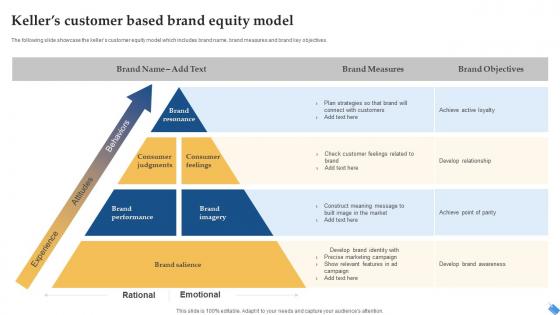
The following slide showcase the kellers customer equity model which includes brand name, brand measures and brand key objectives.
People who downloaded this PowerPoint presentation also viewed the following :
Kellers Customer Based Brand Equity Model with all 6 slides:
Use our Kellers Customer Based Brand Equity Model to effectively help you save your valuable time. They are readymade to fit into any presentation structure.






FAQs for Kellers Customer Based
Keller's Brand Equity Model includes brand salience, brand performance, brand imagery, brand judgments, brand feelings, and brand resonance, structured across four sequential levels. These components work by establishing brand identity through awareness and associations, building brand meaning through performance attributes and imagery perceptions, ultimately creating strong customer relationships and loyalty that deliver sustained competitive advantage.
Brand awareness influences consumer perceptions in Keller's framework by establishing the foundation for all subsequent brand equity building, creating familiarity that enhances credibility and consideration among target audiences. Through strategic awareness campaigns, companies like Apple and Nike develop recognition that shapes positive perceptions, builds trust, and ultimately drives purchase intent, with many organizations finding that consistent brand exposure significantly improves consumer receptivity to messaging.
Businesses leverage brand associations by connecting their brand with positive attributes, experiences, emotions, and values that resonate with target audiences. Through strategic partnerships, celebrity endorsements, cause marketing, and consistent messaging across touchpoints, companies like Apple with innovation or Nike with athletic excellence create powerful mental connections, ultimately driving customer preference, premium pricing power, and sustained competitive advantage in increasingly crowded markets.
Brand loyalty represents the pinnacle of Keller's Brand Equity Model, sitting at the top of the pyramid as the ultimate relationship between consumers and brands. It signifies that customers have moved beyond simple awareness and preference to become active advocates, with companies like Apple and Nike demonstrating how loyal customers drive sustained revenue growth and competitive advantage.
Marketers can measure brand authenticity within Keller's model through consumer perception surveys assessing brand promise consistency, trust metrics evaluating perceived honesty, and behavioral analysis tracking repeat purchases and advocacy. Financial services firms and healthcare organizations increasingly use authenticity scorecards combining emotional resonance data with performance indicators, ultimately revealing whether brands achieve genuine consumer connections that drive sustainable loyalty and competitive advantage.
Companies can build strong brand imagery through consistent visual identity, strategic storytelling, targeted customer experiences, authentic social responsibility initiatives, and premium positioning strategies. These approaches work together by creating memorable brand associations, fostering emotional connections with consumers, and differentiating from competitors, with many organizations finding that consistent imagery across touchpoints ultimately delivers enhanced customer loyalty and sustainable competitive advantage.
Brand resonance manifests through deep emotional connections where customers become brand advocates, actively defending and promoting the brand to others, making repeat purchases despite competitive alternatives, and willingly paying premium prices. These behaviors demonstrate intense loyalty, with customers in sectors like luxury retail and technology finding that strong brand relationships drive word-of-mouth marketing, ultimately creating sustainable competitive advantages.
Keller's Brand Equity Model adapts to digital marketing by leveraging social media engagement, personalized content delivery, influencer partnerships, and data analytics to build brand awareness and resonance. Through targeted digital campaigns, brands can create deeper customer connections across multiple touchpoints, while real-time feedback mechanisms enable continuous brand positioning refinement, ultimately delivering enhanced customer loyalty and competitive advantage in increasingly crowded digital marketplaces.
Keller's model implies that brand repositioning requires rebuilding consumer perceptions across all four pyramid levels, starting with salience and awareness, then performance associations, emotional resonance, and finally active loyalty. Organizations repositioning established brands must strategically address existing brand knowledge structures while creating new associations, with companies like McDonald's and IBM successfully demonstrating how systematic attention to each pyramid level enables effective transformation while maintaining customer relationships.
Cultural context significantly impacts Keller's model effectiveness by influencing brand awareness interpretation, performance expectations, imagery associations, and judgment criteria across different markets. While Western consumers might prioritize individual achievement and innovation resonance, collectivist cultures often emphasize community values and relationship-building, with many global brands finding that localized adaptations of the four-step pyramid deliver stronger emotional connections and sustainable competitive advantage.
Small businesses can implement Keller's principles through cost-effective digital marketing, consistent brand messaging across all touchpoints, targeted customer feedback collection, and strategic partnerships with complementary brands. These approaches enable smaller organizations to build brand salience through social media presence, establish performance associations via customer testimonials, create emotional connections through personalized service, and develop brand resonance through community engagement, ultimately delivering competitive differentiation without requiring substantial marketing budgets.
Customer feedback enhances brand equity by informing product improvements, refining brand messaging, addressing service gaps, and strengthening customer relationships through responsive communication. Companies like Apple and Amazon leverage feedback data to optimize user experiences, build brand loyalty, and maintain competitive positioning, while demonstrating genuine commitment to customer satisfaction, ultimately delivering stronger market reputation and increased customer lifetime value.
Brands face challenges including evolving consumer preferences, increased competition, market saturation, digital disruption, and maintaining consistent brand experiences across touchpoints according to Keller's model. These challenges require continuous brand monitoring, strategic repositioning, and investment in customer relationships, with many organizations finding that proactive brand management and adaptation to market dynamics ultimately deliver sustained competitive advantage and long-term customer loyalty.
Emotional branding directly strengthens Keller's Brand Equity Model by enhancing brand salience through memorable experiences, building performance and imagery associations that resonate personally, and fostering consumer judgments based on trust and credibility. Through strategic emotional connections, companies like Apple and Nike create deeper brand resonance, ultimately delivering stronger customer loyalty, premium pricing power, and sustainable competitive advantage in increasingly crowded markets.
Metrics for assessing Keller's Brand Equity Model include brand awareness surveys, brand association mapping, perceived quality ratings, brand loyalty measurements, and Net Promoter Score evaluations. These assessment tools enable organizations to measure each pyramid level systematically, with companies in retail, automotive, and technology sectors finding that comprehensive brand equity tracking delivers enhanced customer insights, strategic positioning advantages, and ultimately stronger competitive market performance.
-
I downloaded some of the presentations for work. They were simple to modify and saved me a lot of time and effort.
-
Unique research projects to present in meeting.