

Brand Positioning And Messaging Framework Strategic Toolkit To Manage Brand Identity




Try Before you Buy Download Free Sample Product
 Impress Your
 Audience
 100%
100% Editable
 Save Hours
 of Time


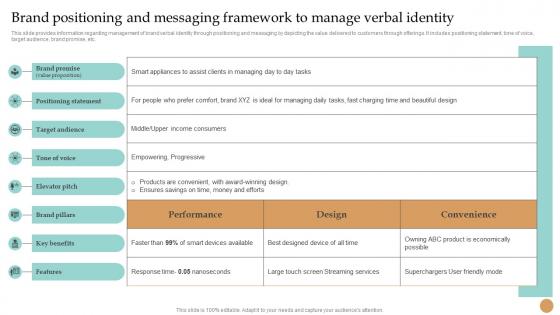
This slide provides information regarding management of brand verbal identity through positioning and messaging by depicting the value delivered to customers through offerings.It includes positioning statement, tone of voice, target audience, brand promise, etc.
People who downloaded this PowerPoint presentation also viewed the following :
Brand Positioning And Messaging Framework Strategic Toolkit To Manage Brand Identity with all 6 slides:
Use our Brand Positioning And Messaging Framework Strategic Toolkit To Manage Brand Identity to effectively help you save your valuable time. They are readymade to fit into any presentation structure.






FAQs for Brand Positioning And Messaging Framework Strategic Toolkit To
Honestly, it's all about finding what makes you different. Figure out who you're actually talking to - like really dig into what they care about and what's bugging them. Why would someone pick you over the other guys? That's your competitive edge right there. Your brand needs to have some personality and values that actually mean something. Oh and whatever you promise, you better be able to deliver it every single time. I always think the best positioning doesn't feel forced - it should click with what you're already good at. Map out those pieces and look for where they overlap. That's usually where the magic happens.
Start with your existing customers - who are they really? Look at demographics, buying patterns, what problems you're fixing for them. Surveys and interviews are clutch for building actual buyer personas instead of just guessing (which everyone does but shouldn't). Check out competitor audiences too for gaps you can exploit. Your social media and website analytics already show who's vibing with your brand, so mine that data. I'd create 2-3 solid personas max - any more gets messy. Then test your messaging with real people from those groups before you commit to anything major.
So basically, competitor analysis shows you where you can actually stand out instead of blending in with everyone else. Look at 3-5 direct competitors - their websites, ads, social stuff - and see what they're all saying. You'll start noticing patterns pretty quickly. Find the gaps where nobody's really talking about something important, then that's your opening. Don't just copy what works for them though (I see this mistake all the time). Figure out what makes you genuinely different and lean into that. It's like finding the perfect parking spot - you gotta know where everyone else is parked first.
You know how everyone claims they're "innovative"? Total snore. Stories actually prove it though - like sharing how you transformed a customer's business or why your founder started this whole thing. Facts and features just blur together, but people remember good stories. I mean, think about the brands that stick with you - they all have that narrative you can't shake. The trick is picking 2-3 stories that really nail what makes you different. Every story should circle back to the same core message about who you are. Makes your positioning feel real instead of just marketing fluff.
Ok so for brand positioning, that classic template works great: "For [target audience] who [need/problem], [brand] is the [category] that [key benefit] because [reasons to believe]." Super simple but it does the job. The Brand Positioning Canvas is cool too - maps everything visually with competitors and value props. Three Circles model shows what you do better than everyone else. My honest take? Don't overthink it. I've watched so many teams get stuck analyzing every framework instead of just picking one and running with it. Choose whatever clicks with your team and stick to it.
Oh man, culture impacts literally everything about how people see your brand. You can't just translate stuff and expect it to work - trust me on that one. Values, communication styles, what feels trustworthy... it all varies wildly. Some cultures love direct messaging while others find it rude. Even colors mean different things! What kills it in the US might totally bomb in Japan or Brazil. I always tell people to dig into local consumer habits first, then figure out how to tweak their positioning. It's honestly way more complex than most companies think.
Start with brand awareness stuff - aided/unaided recall, share of voice in your space. Pretty standard but you gotta know where you stand. Then look at perception metrics like brand attribute scores and consideration rates. NPS is solid too for seeing if your positioning actually clicks with people. Purchase intent matters obviously, but here's something people miss - track your pricing power. If positioning works, margins should improve over time. Social sentiment gives you real-time feedback on messaging, which is clutch. I'd do quarterly brand tracking studies for baselines, then monthly social listening and web analytics to catch changes early. Honestly the quarterly stuff can get expensive but it's worth it.
Your digital marketing stuff is basically how people see your brand online - every post, email, ad, whatever. If you're going for that premium vibe, don't mess it up with crappy Instagram photos that look ancient. Everything needs to match up though, or you'll just confuse people. Your website, social media voice, even the keywords you target - they all send a message about who you are. Honestly, I'd start by looking at what you've got right now and see if it actually makes sense together. Mixed messages are brand death.
Honestly, social media flipped brand control upside down. Your customers are basically running the show now through reviews and posts - whether you're involved or not. But here's the thing: direct engagement beats old-school advertising every time. You'll get instant feedback on what's working (or totally bombing). The trick is actually participating in conversations instead of just shouting your message into the void. I mean, nobody wants to talk to a corporate robot, right? Quick pivots become way easier when you're listening to what people are actually saying about you.
Honestly, first thing I'd do is figure out what's actually shifted with your customers and competitors. Test small tweaks to your messaging before doing anything drastic - I made that mistake years ago and it was brutal. Focus groups or quick surveys will tell you what still hits versus what feels stale now. Your visual stuff might be fine while your messaging needs work, or vice versa. Short sentences help here. The trick is adapting without throwing away what already works for you. Don't rush into a full rebrand until you've validated the changes make sense.
Honestly, the worst thing you can do is try appealing to everyone - you just become generic noise. I've watched so many brands do this! Copying competitors is equally useless since you blend into the background. Skip the corporate buzzwords too; they sound fancy but mean absolutely nothing to real people. Oh, and here's something I see all the time - positioning around what YOU think is exciting instead of what customers actually care about. Big mistake. Whatever you promise, you better be able to deliver consistently. Nothing kills trust faster than overpromising.
Honestly, emotional branding is like your cheat code for positioning. Instead of just making people think about your brand, you're making them *feel* something. Nike doesn't just sell shoes - they make you feel like you can conquer anything. Apple? Pure innovation vibes. The cool thing is emotions create these mental shortcuts in people's heads. They instantly get what you're about without you having to explain a bunch of features (which is boring anyway). You want to pick one specific emotion to own in your space, then just... put it everywhere. Your messaging, visuals, the whole deal. Trust me, it sticks way better than rattling off specs.
Honestly, customer feedback is like a mirror for your brand - shows you what's really happening vs what you think is happening. Your surveys, reviews, social media comments? That's where the truth lives. I've watched brands convince themselves they're "innovative" while customers are like "uh, you're confusing and outdated." Ouch. The gap between what you're trying to say and what people actually hear can be huge. So collect that feedback through conversations, surveys, whatever works. Then actually use it to tweak your messaging or completely change direction. Test everything with real people first though - saves you from looking silly later.
Your visual identity is basically your positioning made visible through colors, fonts, and design. If you're going premium, everything needs to look polished and sophisticated. Going for friendly and accessible? Make it warm and approachable instead. The logo and overall aesthetic should instantly tell people what you're about - honestly, most brands mess this up by not staying consistent. Short audit time: do your current visuals actually match how you want to be seen? Because if there's a disconnect, people won't get what you stand for.
Don't try to beat them at their own game - you'll go broke. Instead, find the weird corners they're ignoring because they're too big to care. Small companies actually have this unfair advantage (sounds backwards, I know) - you can pivot fast and actually talk to customers like humans. Pick one specific thing you do differently and just... own it completely. Forget trying to be the "best" at something crowded. Ask yourself: what can I be *first* at? That's where the magic happens. The big guys are usually too slow or corporate to chase you there anyway.
-
You can rely on SlideTeam whenever you run out of designs for your presentation. Thank you so much SlideTeam!
-
Top Quality presentations that are easily editable.