

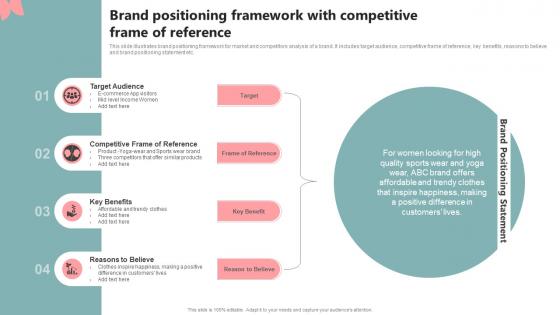
Brand Positioning Framework With Competitive Frame Of Reference




Try Before you Buy Download Free Sample Product
 Impress Your
 Audience
 100%
100% Editable
 Save Hours
 of Time


This slide illustrates brand positioning framework for market and competitors analysis of a brand.It includes target audience, competitive frame of reference, key benefits, reasons to believe and brand positioning statement etc.
People who downloaded this PowerPoint presentation also viewed the following :
Brand Positioning Framework With Competitive Frame Of Reference with all 6 slides:
Use our Brand Positioning Framework With Competitive Frame Of Reference to effectively help you save your valuable time. They are readymade to fit into any presentation structure.






FAQs for Brand Positioning Framework With Competitive
So basically you need three things: who you're targeting, what makes you different, and what value you actually give people. Brand personality matters too - like how you talk to customers. Most companies screw this up by trying to appeal to literally everyone (which never works). Your positioning should be specific enough that some people go "eh, not for me" - that's actually a win. Oh and consistent messaging that hits people emotionally, not just rationally. The real test? Someone should be able to explain your brand in one sentence after seeing your stuff.
Honestly, start with checking out what your top competitors are saying - like their main selling points. Then dig into your customer reviews and support messages to see what people actually care about with your product. The sweet spot? Finding something your customers already love that your competitors aren't even mentioning (or straight up can't do). I've seen people overthink this so much when the answer's literally sitting in their testimonials. Once you find that gap, just test some messaging with a smaller group first. Way easier than trying to nail it perfectly right out the gate.
Look, consumer perception IS your brand positioning - forget what you wrote in your strategy doc. If people think you're overpriced instead of premium quality, congrats, you're now the overpriced brand. That's just reality. Your real position lives in customers' heads, not your marketing plan. I learned this the hard way at my last job actually. The disconnect between what you intend and what people actually think? That's where you need to focus. Do the research first. Find out how people see you now, then figure out if that works or needs fixing.
Dude, start by surveying customers about what they actually think your brand represents. Compare that to what you're trying to say - bet there's some wild differences. Social media comments are pure gold for this stuff. People complain or get confused? That's where the real insights hide, honestly. Sometimes customers will rave about benefits you never even thought to highlight. I'd literally go read your last 50 reviews right now. Look for patterns in how they describe you versus your marketing. Then adjust your messaging to match what's actually resonating. It's kinda backwards but it works.
Honestly, the worst thing you can do is try appealing to everyone - makes you instantly forgettable. Most companies are terrified of narrowing down but that's exactly what works. I see brands copying successful competitors all the time instead of finding their own thing, which... yeah, never ends well. Oh and here's what kills me - positioning based on gut feelings instead of actually talking to customers first. You'll just end up way off base. Start with who you DON'T want as customers, then work backwards from there.
Honestly, storytelling is a game-changer for brand positioning because people remember stories way better than random facts. Like, instead of claiming you're "innovative," tell them about your founder fixing the problem at 2am in their garage (yeah it's cliché but whatever, it works). Your customers start seeing themselves in your brand's journey, which builds that emotional connection you want. Plus it makes explaining your positioning to your team so much easier. I'd say pick one solid story that captures your main brand promise and just work it into everything you do.
Honestly, digital marketing is such a game changer because you can actually target who sees what. Instead of throwing one ad everywhere and crossing your fingers, you craft different messages for different people on social, email, search - wherever they hang out. The best part though? You get instant data on what's working. No waiting around for some expensive research study that takes forever. Just tweak your message on the spot when something isn't hitting right. My take: pick one platform first, get really good at your messaging there, then expand from that foundation. Way less overwhelming that way.
Start with brand awareness stuff - unaided recall and share of voice in your space. Get perception data through surveys too, measuring brand attributes and how you compare to competitors. NPS is huge, honestly tells you everything about whether people actually get your positioning. Track your ability to charge premium prices and watch market share changes over time. Oh, and set benchmarks before changing anything, then check quarterly. Stick to like 3-4 key metrics initially so you don't get overwhelmed - you can add more later once you've got the hang of it.
Honestly, you've gotta keep your eyes open and watch everything happening around you. Your competitors, what customers are actually saying, cultural stuff that might mess with how people see your brand. I've watched way too many companies get stuck doing the same old thing while everything changes around them - it's painful to see. Test small changes first though. Maybe tweak your messaging or highlight different parts of what makes you special that people care about now. Short version: look at where you stand today versus what's actually going down in your market right now.
So positioning is basically where you want to live in people's heads compared to your competition. Messaging is the actual words and tone you use to get there. Like, your position might be "most reliable for busy professionals" - that's your stake in the ground. Then your messaging is all the headlines, copy, whatever that makes people *feel* that reliability. I swear half the marketing teams I know get these mixed up and can't figure out why everything feels all over the place. Your position should pretty much stay put, but you can totally switch up messaging for different crowds. Figure out positioning first though - it'll make the rest way easier.
Look, your visual stuff is basically your positioning strategy but visible, you know? Colors, fonts, all that design work together to show where you sit in the market. Apple's clean look screams premium innovation. Dollar General goes bold and simple for accessible value. Pretty crazy how much a logo actually says about you. I always think consistency is key though - your visuals gotta reinforce your position everywhere people see you. Start by checking if your current design elements actually support what you're trying to be in the market.
Honestly? Go niche if you can swing it. You'll make way more money per customer and they actually give a damn about what you're selling. Mass market is just... ugh, everyone's fighting over scraps and cutting prices until nobody's making anything. When you're the niche expert, people pay premium because you get their exact problem. Mass market means you're basically a commodity - good luck standing out there. I mean, unless you desperately need huge volume right away, niche is where the real profits are. Way less stressful too.
Oh man, cultural stuff is huge for brand positioning - honestly can't stress this enough. What works in one place might totally bomb somewhere else. Take colors - red screams luck in China but spells danger here in the West. Values, communication styles, religious considerations... all of it matters. Your whole vibe needs to match what locals expect. Sometimes I think brands forget how different markets really are. Do serious research on each region first. Don't just wing it with messaging and visuals - you'll regret it later when nothing lands right.
Pick one super specific thing and absolutely nail it. Don't try being everything to everyone - that's startup suicide. Like instead of "project management software," go with "project management for remote design teams only." Way clearer, right? Your founder story matters tons for authenticity. Content marketing and social media won't cost you much upfront. Oh, and definitely partner with brands that complement yours - free exposure is golden. The constraint actually helps because it forces you to get crystal clear on what you're offering. Bottom line: nail your value prop in one sentence that people instantly understand.
Dude, collaborations can totally change how people see your brand - you're basically borrowing credibility from whoever you partner with. Look at Target's designer partnerships - suddenly they felt way more high-end. But here's the thing: mess up the match and you'll just confuse people about what you actually are. Short answer? Pick partners whose vibe aligns with where you want to go, not necessarily where you're at right now. I've seen brands completely reinvent themselves this way. Just don't go for the flashy name if it doesn't make sense, you know?
-
Fantastic collection. Loved how we can personalize these templates as per the requirements.
-
Based on my personal experience, I would recommend other people to subscribe to SlideTeam. No one can be disappointed here!