


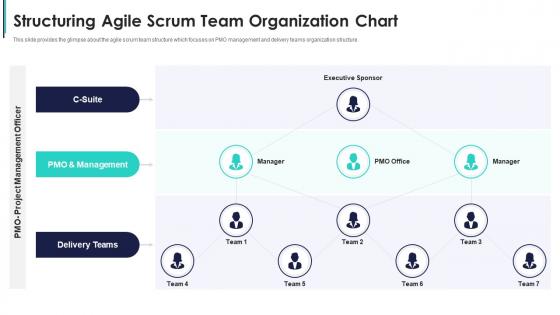
Build a scrum team structure scrum team organization chart




Try Before you Buy Download Free Sample Product
 Impress Your
 Audience
 100%
100% Editable
 Save Hours
 of Time


This slide provides the glimpse about the agile scrum team structure which focuses on PMO management and delivery teams organization structure.
People who downloaded this PowerPoint presentation also viewed the following :
Build a scrum team structure scrum team organization chart with all 6 slides:
Use our Build A Scrum Team Structure Scrum Team Organization Chart to effectively help you save your valuable time. They are readymade to fit into any presentation structure.





FAQs for Build a scrum team structure scrum
So there's three main roles you'll deal with. Product Owner is like the customer's voice - they decide what gets built and rank everything by priority. Scrum Master keeps things moving and clears roadblocks (more coach than boss, honestly). Developers do the actual building. Nobody's above anyone else though, which is kinda refreshing compared to traditional setups. It works best when your Product Owner communicates clearly, Scrum Master handles the process stuff, and Developers can just focus on cranking out code. Everyone should know their lane but don't be afraid to jump in and help each other out.
Your Scrum Master is basically the team's communication wingman. They run those sprint ceremonies - planning, standups, retros - and make sure people actually talk instead of just sitting there awkwardly. When teammates clash or someone's being weird, they jump in to smooth things over. Honestly, they're pretty good at spotting when the vibe is off before it gets messy. They'll also hunt down whatever's blocking your work so you can actually collaborate. But here's the thing - they're not your boss, just there to make teamwork less painful. If your sprints feel weird communication-wise, definitely bug them about it.
Honestly, start with business value - what's gonna actually move the needle for users and revenue? MoSCoW method works great (Must have, Should have, etc.) or just score things on value vs effort. Stakeholders will always say their thing is "urgent" but don't let that derail you - learned that one the hard way! User story mapping is clutch for seeing the bigger picture. I'd review your backlog weekly and be ruthless about cutting stuff that doesn't matter. Saying no to scope creep feels awful but it's necessary. Bottom line: focus on what actually drives your key metrics forward.
Cross-functional teams are honestly game-changers for Scrum. Having devs, testers, designers - basically everyone you need - right there eliminates those annoying waits for "the database person" or whatever. Your team becomes self-sufficient during sprints, which means you'll actually hit your commitments instead of getting blocked by other departments. I used to hate that stuff. Start by figuring out what skills your product actually needs. Then get those people dedicated to your team full-time, not stretched across a million other projects.
Oh man, communication is your biggest enemy here. Stakeholders want updates 24/7 but then ghost you when you actually need their feedback - super annoying. They'll also go around the Product Owner straight to your devs, which screws everything up. Most don't get Scrum at all, so they expect you to pivot mid-sprint like it's no big deal. I learned the hard way to set boundaries early about how they can engage. Your Product Owner needs to actually guard that gate too, otherwise chaos.
Oh man, team composition is HUGE. You really need that cross-functional mix where everyone can handle design, testing, deployment - the whole thing. No sitting around waiting for other departments, you know? Those T-shaped people are perfect - deep skills in one area but can jump in elsewhere when stuff hits the fan. But honestly? Personality matters way more than I used to think. I've seen brilliant devs completely tank projects because they couldn't work together. Build trust first - you can always teach someone new frameworks, but getting people to actually collaborate takes forever.
Start with velocity - that's your bread and butter for seeing how many story points your team knocks out each sprint. Burndown charts are solid too, though they can make you anxious if you check them obsessively (guilty as charged). Track your sprint goal success rate so you know if you're actually delivering what you promised. Cycle time's another good one - measures how long stories take from kickoff to done. Oh, and don't sleep on tracking whether you complete those retrospective action items. Honestly, velocity and burndowns will get you 80% of the way there.
Honestly, Daily Standups are perfect for catching these dependency issues early. Someone hits a blocker? Flag it right away and get the right people talking. Don't just sit there hoping it magically fixes itself - we both know that never works lol. Your Scrum Master should jump in to help connect you with other teams or stakeholders. Sometimes you need workarounds, sometimes you gotta reprioritize stuff. The main thing is speaking up fast. Waiting until the Sprint Review to mention dependencies? That's basically sprint suicide at that point.
Honestly? Most retrospectives are total waste-of-time meetings where people complain but nothing actually gets fixed. Pick ONE tiny thing to improve each sprint and actually track if it helped. Let your team try weird stuff without freaking out when it doesn't work - I've watched so many good ideas die because managers get all defensive about change. Rotate who runs the meetings too, gets different voices in there. The real trick is going from "yeah we should probably do that" to "let's test this for two weeks and see what happens." Oh, and celebrate the experiments that bomb - at least you learned something, right?
Honestly, most team conflicts boil down to unclear expectations - so start there. Clarify who's doing what and your Definition of Done. Don't let things fester though; bring it up during retros or just have a dedicated chat about it. Keep conversations focused on the work itself, not calling people out personally. Ask "how can we improve this?" instead of pointing fingers. If you're the Scrum Master, guide the discussion but let them figure out solutions. I'd probably kick off your next retro with something like "what's creating friction for us right now?" Gets people talking without being too confrontational.
Honestly, stable Scrum teams crush it compared to random project groups. You'll build actual trust when people stick around - everyone figures out each other's strengths and weird habits. Planning gets way better too since you know your team's real velocity. Those constantly shuffled teams? They spend forever just learning how to work together, which is such a waste. I've seen it happen so many times. If you're stuck with rotating people, at least fight for a core group that doesn't change between sprints. Makes a huge difference.
Honestly, remote Scrum is all about nailing the communication part. Get solid video calls set up for standups, planning, retros - the whole thing. Your sprint board needs to be visible 24/7 (we use Jira but whatever). Time zones are gonna be painful though. Maybe rotate meeting times so it's not always the same people getting screwed over? Also, beef up your async game - write better user stories, document everything. Sometimes people record quick updates when they can't make meetings. Oh, and start with shorter sprints. Helps everyone get into the groove faster.
Dude, team autonomy is make-or-break for Scrum. Your developers know the technical stuff way better than management anyway, so let them figure out the "how" while you handle the "what" and deadlines. When teams can actually make decisions, they own their work instead of just going through the motions. Quick pivots become possible. Without it? You're basically doing waterfall with extra meetings - which honestly sounds like hell. Set clear boundaries but trust their expertise. The productivity difference is night and day once people stop micromanaging every little decision.
Here's the thing - you gotta build innovation right into your sprint planning instead of treating it like some side project. I usually tell teams to set aside 10-20% of capacity for experimenting, tech debt, whatever. Don't expect it to just happen naturally because it never does. Look for stories during refinement where you can try different approaches without screwing up the main deliverable. Be upfront with stakeholders about this balance - they need to get why you're not just a feature factory pumping stuff out. Oh, and definitely timebox that innovation work or it'll eat your whole sprint.
Start with the basics - ceremonies, artifacts, roles, all that foundational stuff. Your PO really needs to nail backlog management and how to talk to stakeholders. Scrum Master should focus on coaching and facilitation skills. But here's the thing - soft skills are honestly just as crucial as knowing the framework itself. The whole team benefits from Agile mindset training plus technical stuff like story writing and estimation. Oh, and don't just do some one-day workshop and think you're set. You'll need ongoing coaching sessions, maybe quarterly check-ins to keep everyone on track and catch any bad habits before they stick.
-
Excellent Designs.
-
Awesome presentation, really professional and easy to edit.