


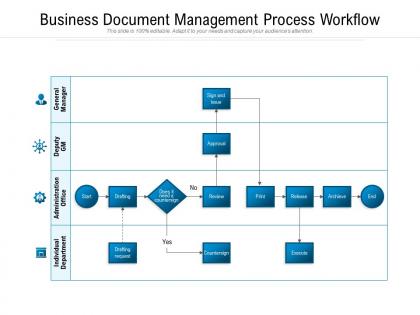
Business document management process workflow




Try Before you Buy Download Free Sample Product
 Impress Your
 Audience
 100%
100% Editable
 Save Hours
 of Time


Our Business Document Management Process Workflow are topically designed to provide an attractive backdrop to any subject. Use them to look like a presentation pro.
People who downloaded this PowerPoint presentation also viewed the following :
Business document management process workflow with all 2 slides:
Use our Business Document Management Process Workflow to effectively help you save your valuable time. They are readymade to fit into any presentation structure.

FAQs for Business document
Key benefits of implementing a business document management system include enhanced security, streamlined workflows, improved compliance tracking, reduced storage costs, and faster document retrieval. These systems revolutionize organizational efficiency by automating approval processes, minimizing manual errors, and enabling remote access, with many companies finding that digitization ultimately delivers significant cost savings and competitive advantage.
Document management improves collaboration by centralizing file access, enabling real-time editing, tracking version histories, and streamlining approval workflows across departments. These systems enhance team productivity by eliminating email chains, reducing document conflicts, and ensuring everyone accesses current versions, with many organizations finding significantly faster project completion times and improved accountability.
When choosing document management software, consider security features, integration capabilities, user interface design, scalability options, and compliance requirements. These factors work together to streamline operations and enhance productivity, with many organizations finding that the right combination delivers improved collaboration, reduced storage costs, and better regulatory adherence, ultimately providing competitive advantage in document-intensive industries.
A document management system enhances compliance and security by automating audit trails, enforcing access controls, and maintaining version histories across all business documents. Through encryption protocols and user authentication, organizations streamline regulatory reporting, minimize data breach risks, and ensure document integrity, with financial institutions and healthcare providers finding significantly reduced compliance costs and enhanced operational transparency.
Common document digitization challenges include poor image quality from aging documents, inconsistent file formats, data extraction errors, version control issues, and integration difficulties with existing systems. These obstacles can significantly impact accuracy and workflow efficiency, with many organizations finding that investing in quality scanning equipment, standardized processes, and robust metadata systems ultimately delivers faster retrieval times and enhanced operational productivity.
Businesses can effectively organize documents through hierarchical folder structures, standardized naming conventions, metadata tagging, version control systems, and automated classification tools. These approaches streamline document retrieval by creating searchable databases, establishing clear access permissions, and implementing retention policies, with many organizations finding that structured systems reduce search time by up to 75% while enhancing compliance and operational efficiency.
Metadata and tagging serve as the organizational backbone of document management systems, enabling automated categorization, enhanced searchability, version control, compliance tracking, and workflow automation. These classification systems streamline document retrieval, improve regulatory compliance, and facilitate seamless collaboration across departments, with many organizations finding that strategic tagging reduces search time by up to 75%.
Automated workflows streamline document approval processes by eliminating manual routing, reducing approval times, and providing real-time visibility into document status. Through digital approval chains, organizations in sectors like finance and healthcare accelerate contract reviews, minimize bottlenecks, and ensure compliance tracking, ultimately delivering faster decision-making and enhanced operational efficiency.
Data accuracy strategies include automated validation rules, version control systems, regular audits, standardized templates, and role-based access controls that prevent unauthorized modifications. These approaches streamline document integrity by minimizing human error, establishing clear approval workflows, and maintaining audit trails, with many organizations finding that combining automated checks with periodic reviews ultimately delivers enhanced compliance and operational efficiency.
Businesses can measure document management ROI through time savings analysis, storage cost reductions, compliance risk mitigation, and productivity improvements across departments. By tracking metrics like reduced document retrieval times, eliminated physical storage expenses, and streamlined approval workflows, organizations typically find significant operational efficiencies that deliver measurable competitive advantages.
Best practices for maintaining data privacy in document storage include end-to-end encryption, role-based access controls, regular security audits, automated backup systems, and compliance with regulatory frameworks like GDPR or HIPAA. These security measures streamline operations by minimizing breach risks, ensuring regulatory compliance, and building customer trust, with many financial services and healthcare organizations finding that robust privacy protocols ultimately deliver competitive advantage and operational efficiency.
Cloud-based document management systems benefit remote teams by enabling real-time collaboration, centralized file access, and seamless version control from any location. These platforms streamline workflows through automated backup, enhanced security protocols, and integrated communication tools, with many distributed organizations finding that cloud solutions reduce operational costs while improving productivity and team coordination.
Future document management trends include AI-powered automation, cloud-native platforms, intelligent content analytics, blockchain security protocols, and seamless API integrations. These technologies streamline workflows by automating classification, enhancing searchability, and enabling real-time collaboration, with organizations across healthcare, finance, and legal sectors finding significantly improved compliance tracking and operational efficiency.
Businesses can handle legacy documents by implementing phased digitization strategies, prioritizing high-value content, establishing consistent metadata standards, and creating hybrid workflows that accommodate both formats. Through systematic scanning, automated indexing, and strategic storage solutions, organizations streamline document retrieval, reduce physical storage costs, and maintain compliance requirements, while ensuring seamless access across teams during the transition period.
Organizations should provide comprehensive training covering digital filing systems, version control protocols, security best practices, collaboration tools, and regulatory compliance requirements. Through hands-on workshops and ongoing support programs, employees master document workflows, reduce retrieval times, and maintain data integrity, with many companies finding that structured training ultimately enhances operational efficiency and minimizes compliance risks.
No Reviews