


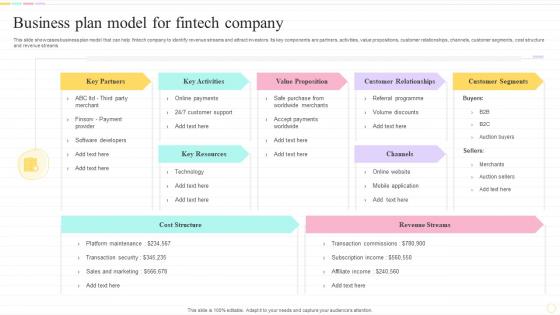
Business Plan Model For Fintech Company




Try Before you Buy Download Free Sample Product
 Impress Your
 Audience
 100%
100% Editable
 Save Hours
 of Time


This slide showcases business plan model that can help fintech company to identify revenue streams and attract investors. Its key components are partners, activities, value propositions, customer relationships, channels, customer segments, cost structure and revenue streams
People who downloaded this PowerPoint presentation also viewed the following :
Business Plan Model For Fintech Company with all 6 slides:
Use our Business Plan Model For Fintech Company to effectively help you save your valuable time. They are readymade to fit into any presentation structure.





FAQs for Business Plan Model
So for your fintech plan, start with the obvious stuff - what problem you're actually fixing and who's gonna pay for it. Revenue model matters too (subscriptions vs transaction fees, whatever works). Tech architecture needs to be solid, but here's the thing that kills most people: compliance. Seriously, regulations in fintech are insane and if you don't show investors you get it, you're dead. Also throw in competitor analysis and financial projections. Oh and your launch strategy - how you'll actually get customers. I'd honestly spend like 60% of your time on the regulatory stuff since that's where startups usually crash and burn.
Look, market research is gonna save you from building something nobody wants. Talk to actual people first - I learned this the hard way. You'll figure out who's really gonna buy your fintech product (hint: usually not your initial guess), what features matter most, and realistic pricing. Plus you'll see what competitors are already doing so you don't waste time recreating the wheel. Honestly, just 20 user interviews can flip your entire roadmap. Way better than burning cash on assumptions that turn out wrong. Surveys work too, but conversations give you the real insights you need.
Dude, start with licensing requirements - they're wildly different depending on where you are and what services you're doing. Banking partnerships are essential. So is data protection stuff like GDPR and CCPA. Anti-money laundering regs will absolutely destroy your timeline if you mess them up. PCI DSS for payments gets pricey quick, trust me. Don't sleep on consumer protection laws either, especially with lending products. Capital requirements too. Honestly? Get a regulatory consultant now - I know it sounds boring but missing one thing here tanks everything. Better safe than scrambling later.
Get way more specific about who you're helping - think "millennials trying to build credit" not just "young people need money." That broad "everyone needs financial help" thing is a total trap. Figure out their actual habits first. Where do they bank now? What pisses them off most about current apps? How much would they actually pay? Make 2-3 fake personas with real names and backstories - sounds cheesy but it works. Then here's the key part: go interview at least 20 people who match those profiles before you build anything. I know it's tempting to just start coding, but those conversations will save you months of building the wrong thing.
Okay so you'll need three main things: revenue forecasts, customer acquisition costs, and cash flow projections. Revenue should break down your different streams - transaction fees, subscriptions, whatever you're doing. CAC is critical because fintech companies usually bleed money early on getting users (trust me on this one). Build in your burn rate and runway calcs too. Oh and regulatory costs - they're way higher than you think. Show unit economics so investors see when customers actually turn profitable. Honestly, start conservative and create multiple scenarios. They always want to see you've planned for things going sideways.
Honestly, tech trends are everything in fintech - they literally dictate your whole strategy. You can't just follow what's hot right now though. AI handles risk stuff and customer service pretty well, blockchain could cut your transaction costs (or create new revenue, depending). Open banking APIs are kind of a game-changer for integrating with regular banks. But here's the thing - don't get distracted by every new tech that pops up or you'll spread yourself too thin. Just pick 2-3 technologies that actually fix real problems your customers have and go all in on those.
Dude, bank partnerships are honestly a game-changer for fintech growth. You'll get instant credibility plus all their regulatory stuff handled for you - which normally takes forever to build yourself. Their customer base is massive, and they've got the funding you need. Here's the thing though - banks are kinda scrambling to modernize right now, so they actually need your tech as much as you need their infrastructure. The licensing alone makes it worth it since they already have relationships with regulators. I'd start by finding banks that are actively doing fintech deals and pitch them on solving real problems for their customers.
Honestly, referral programs are gold in fintech - people trust their friends way more than ads. Content marketing works great too, especially educational stuff about money management. Partnerships with banks can open doors fast. Trust is everything though. Nobody's handing over their credit card info without feeling safe, so be super transparent about security. User testimonials are clutch for social proof. Digital channels like targeted social and SEO crush traditional advertising every time. My advice? Pick two channels max and track everything obsessively. Once you see what's actually converting, go all-in on that instead of spreading yourself thin across ten different strategies.
Dude, build security right into your plan from the start - don't slap it on later. Get your SOC 2 or PCI compliance sorted, whatever applies to your fintech thing. End-to-end encryption, multi-factor auth, regular audits - the whole nine yards. Seriously, one data breach and you're toast. Users will bail so fast it'll make your head spin. Budget for actual security people too, not just some intern who took a cybersecurity class. Oh, and be super transparent about your privacy stuff. People want to know their money's safe, you know?
Dude, UX will literally make or break your fintech app. People are trusting you with their actual money - if your interface is confusing or slow, they're gone. Done. Financial stuff is stressful enough without your app being a nightmare to navigate. Fast loading, clear layout, intuitive flow - that's non-negotiable. Users need to feel like they're in control the whole time. Honestly, I'd rather have a basic app that works perfectly than some flashy thing that crashes when I'm trying to transfer money. Spend the money upfront on user testing. Way cheaper than watching customers flee to your competitors later.
Honestly, you've gotta bake scalability into your projections and ops plan from the start. Figure out how your tech can handle 10x users without imploding. Map out customer acquisition costs at different scales too. The balancing act is brutal - investors want massive growth but realistic timelines. Nobody likes pie-in-the-sky numbers. Break down specific milestones for new markets, product features, different customer segments. Oh and definitely nail down hiring plans plus funding needs for each phase. Trust me, you don't want to be scrambling for resources when you're actually hitting those growth targets.
Okay so you've got a few solid paths here. Angel investors are probably your best starting point - they're way more flexible than VCs. Speaking of VCs, the fintech-focused ones are where the real money is, but they want to see serious growth potential. Crowdfunding could work too, though honestly it's a bit of a crapshoot. Government grants and accelerators are worth checking out - free money is free money, right? Banks are actually getting into fintech partnerships now which is kinda wild. Revenue-based financing might work if you're already making some cash. First though, figure out exactly how much you need and when you need it by.
Don't try to be "better payments" - that's way too broad. Pick something super specific like "instant payments for freelancers who are sick of waiting 3 days." The fintechs that actually work obsess over one tiny user group first. Hunt for regulatory gaps or demographics everyone's ignoring. Also look for experiences so clunky they make people want to chuck their phone across the room. Talk to like 100 potential users about what genuinely pisses them off - not what you think should annoy them. Master that one pain point, then expand later.
Honestly, start with the basics - CAC, LTV, monthly recurring revenue, and burn rate. Those will tell you if you're actually making money or just bleeding cash. User engagement stuff matters too: daily active users, transaction volume, conversion rates. Oh, and track your Net Promoter Score because trust is everything in fintech. Compliance metrics are boring but you'll thank me later when audit time comes around. I'd pick maybe 5-7 core ones that actually fit your business model first. You can always add more weird metrics later once you've got the fundamentals down.
Trust is everything with fintech - people get super nervous about their money. Be upfront about compliance, security, all that boring but crucial stuff. Educational content kills it here too, like breaking down complex financial stuff into normal human language. Customer testimonials are gold since nobody wants to be the guinea pig. Honestly, drop the whole "we're disrupting banking" thing - everyone's over it. Just focus on making their current financial headaches disappear. Oh and figure out your exact niche first, then speak directly to those specific problems. Way more effective than trying to be everything to everyone.
-
I can always count on your designs for my professional needs. I believe I found a one-stop-shop for PPTs.
-
“Ample and amazing variety of templates available, really helpful for making professional PPT for day to day workings.”