


Business STP Strategy Marketing Model For Consumer Targeting




Try Before you Buy Download Free Sample Product
 Impress Your
 Audience
 100%
100% Editable
 Save Hours
 of Time


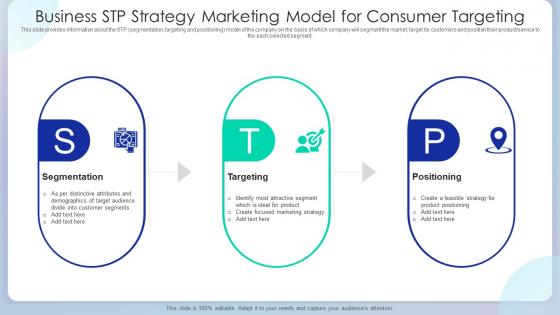
This slide provides information about the STP segmentation, targeting and positioning model of the company on the basis of which company will segment the market, target its customers and position their product service to the each selected segment.
People who downloaded this PowerPoint presentation also viewed the following :
Business STP Strategy Marketing Model For Consumer Targeting with all 6 slides:
Use our Business STP Strategy Marketing Model For Consumer Targeting to effectively help you save your valuable time. They are readymade to fit into any presentation structure.





FAQs for Business STP Strategy Marketing Model
The STP Marketing Model comprises three core components: Segmentation (dividing markets into distinct customer groups), Targeting (selecting specific segments to focus on), and Positioning (creating unique brand perception in customers' minds). This strategic framework enables companies to streamline marketing efforts, enhance customer engagement, and deliver more personalized experiences, ultimately achieving competitive advantage through focused resource allocation.
Segmentation in the STP model enhances targeting strategies by dividing broader markets into distinct customer groups based on demographics, psychographics, behavioral patterns, and geographic locations, enabling more precise audience identification. This strategic approach allows businesses to develop tailored marketing messages, optimize resource allocation, and deliver personalized experiences that resonate with specific segments, ultimately improving conversion rates and competitive positioning.
Effective market segmentation criteria include demographic factors like age and income, geographic location, psychographic elements such as lifestyle and values, and behavioral patterns including purchase frequency and brand loyalty. These criteria enable companies to create targeted campaigns, with retailers using demographic data for product placement, banks leveraging behavioral patterns for personalized services, and hospitality brands applying psychographic insights to enhance customer experiences and drive higher conversion rates.
Demographic segmentation serves as the foundation for effective STP marketing by dividing markets based on age, income, education, gender, and family size, enabling precise targeting strategies. This approach helps businesses like financial services tailor retirement planning for different age groups and retail brands customize messaging for specific income brackets, ultimately delivering more relevant customer experiences and improved conversion rates.
Psychographic segmentation improves customer targeting by analyzing lifestyle preferences, values, attitudes, interests, and personality traits rather than just demographics. This approach enables marketers to create highly personalized campaigns that resonate with specific mindsets, ultimately delivering stronger emotional connections, higher engagement rates, and improved conversion rates across diverse customer segments.
**INPUT**: What tools are commonly used to analyze market segments in the STP approach? **OUTPUT**: Market segmentation analysis tools include demographic surveys, psychographic profiling, behavioral analytics, competitive mapping, and customer journey analysis platforms. These strategic approaches streamline targeting by identifying distinct customer clusters, evaluating segment viability, and measuring competitive positioning, with many organizations finding that comprehensive segmentation delivers more personalized campaigns and significantly higher conversion rates. **Word count: 53 words**
The STP model adapts to digital marketing by leveraging data analytics for precise segmentation, utilizing social media platforms and search engines for targeted positioning, and employing personalized content delivery systems. Through digital tools, marketers can segment audiences using behavioral data, target micro-segments with customized messaging, and measure positioning effectiveness in real-time, ultimately delivering more relevant customer experiences and improved campaign ROI.
**INPUT**: What are the potential challenges in implementing the STP Marketing Model? **OUTPUT**: STP Marketing Model implementation challenges include data collection complexity, resource allocation constraints, market segmentation accuracy, positioning differentiation difficulties, and maintaining consistency across channels. These obstacles can be overcome through strategic planning, comprehensive market research, and phased implementation, with many organizations finding that systematic approaches ultimately deliver enhanced customer targeting, improved campaign effectiveness, and stronger competitive positioning. [Word count: 58]
Companies can test and validate market segments through surveys, focus groups, A/B testing campaigns, pilot programs, and data analytics platforms that measure customer behavior and response rates. These validation methods enable organizations to refine targeting strategies, optimize resource allocation, and enhance campaign effectiveness, with many retail and financial services companies finding that systematic testing ultimately delivers higher conversion rates and stronger customer engagement.
A strong positioning statement in STP defines how your brand distinctively occupies customer minds versus competitors, communicating unique value propositions that resonate with targeted segments. This strategic clarity enables consistent messaging across marketing channels, enhances customer recognition, and drives purchase decisions, with many organizations finding that clear positioning significantly improves campaign effectiveness and market share.
Competitive analysis influences targeting by revealing market gaps, underserved segments, and competitor weaknesses that organizations can exploit strategically. Through comprehensive competitor research, businesses identify positioning opportunities that differentiate their offerings, enable premium pricing strategies, and capture market share, with many companies finding that competitive insights ultimately drive more focused targeting and stronger brand positioning in increasingly crowded markets.
STP strategy effectiveness can be measured through market share growth, customer acquisition costs, conversion rates, brand awareness levels, and customer lifetime value metrics. These indicators help businesses assess whether their segmentation accurately identifies profitable targets, positioning resonates with intended audiences, and targeting strategies deliver sustainable competitive advantage across different market segments.
STP marketing model directly informs the 4 Ps by providing strategic foundation for tactical execution, with segmentation and targeting guiding product development, pricing strategies, and promotional approaches. Through effective positioning, companies align their product features, competitive pricing, distribution channels, and messaging strategies, ultimately delivering cohesive marketing campaigns that resonate with specific customer segments and drive measurable business results.
Common pitfalls include insufficient market research leading to poor segmentation, targeting too broad or narrow audiences, weak differentiation from competitors, and inconsistent messaging across channels. Many companies also struggle with over-segmentation that spreads resources thin, while others fail to adapt their positioning as market conditions evolve, ultimately undermining their competitive advantage.
Cultural factors significantly impact global segmentation by influencing consumer values, purchasing behaviors, communication preferences, and product expectations across different regions. Companies must adapt their positioning strategies to resonate with local cultural norms, with many multinational brands finding that standardized approaches often fail, requiring culturally-sensitive messaging and product modifications to achieve competitive advantage internationally.
-
Editable templates with innovative design and color combination.
-
Use of icon with content is very relateable, informative and appealing.