


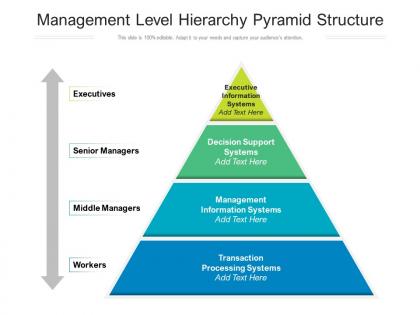
Management level hierarchy pyramid structure




Try Before you Buy Download Free Sample Product
 Impress Your
 Audience
 100%
100% Editable
 Save Hours
 of Time


Our Management Level Hierarchy Pyramid Structure are topically designed to provide an attractive backdrop to any subject. Use them to look like a presentation pro.
Management level hierarchy pyramid structure with all 2 slides:
Use our Management Level Hierarchy Pyramid Structure to effectively help you save your valuable time. They are readymade to fit into any presentation structure.
FAQs for Management level
So basically every company has the same three layers. You've got the big shots at the top - CEOs, VPs, whoever's making the huge decisions. Then middle management in between, which honestly is where most stuff actually gets done - department heads and regional managers turning those big ideas into real plans. Front-line managers are your team leads and supervisors dealing with daily chaos. I used to think middle management was just bureaucracy, but they're basically translators between executive vision and ground-level reality. Knowing this structure helps you figure out who to bug when something's broken.
So basically, the higher up someone is, the bigger decisions they get to make. Lower levels deal with the everyday stuff. But here's what's annoying - too many management layers just bog everything down since decisions have to bounce around forever. That's why you see companies going flatter now. Smart move, honestly. The trick is figuring out what you can actually decide yourself versus what needs approval. Don't waste time asking permission for stuff that's already in your wheelhouse - I've seen people do that and it just creates unnecessary delays.
Honestly, flat structures are pretty great for quick decisions - no more waiting around for five different managers to sign off on stuff. Your team definitely feels more empowered too. But here's the thing: once you start growing, it becomes a total mess. Nobody knows who's actually in charge of what anymore, and some people (let's be real) just need that clear hierarchy to do their best work. Startups love this approach, and creative teams usually thrive with it. Bigger companies? Not so much. I'd say test it out with just one department first - see how your people handle the freedom before you go crazy and restructure everything.
Dude, middle managers are basically human translators. You're taking whatever crazy strategy the executives dreamed up and figuring out how your team can actually DO it day-to-day. Plus you're constantly shuttling feedback both ways - telling leadership what's really going down with their people. Honestly, it's kind of exhausting being stuck in the middle like that. But here's the thing: without solid middle management, companies fall apart fast. Those big picture plans just die somewhere between the boardroom and reality. So if that's your role, own being that bridge. You're more crucial than people think.
Oh totally, companies shape their hierarchies around what they actually need to get done. Tech places stay super flat so they can pivot fast and innovate. Manufacturing? Way more traditional because safety protocols can't be messy. Healthcare is crazy hierarchical - makes sense when someone's life depends on clear communication. Startups barely have structure at first (honestly kind of chaotic but it works). Finance and pharma though? They need those formal chains for all the regulatory stuff. When you're figuring out your structure, just think about your biggest daily challenges first. Speed vs safety vs compliance - that'll tell you everything.
Ugh, rigid hierarchies are the worst when you need to move fast. Your front-line people have great ideas but they're stuck waiting for approval from like three different managers. Meanwhile your competitors are already making moves. Decisions just get bottlenecked in these endless approval chains - honestly it drives everyone crazy. Information gets all twisted as it bounces up and down through layers too. If your industry moves quickly (which most do these days), you should probably flatten some of those layers. Give teams permission to make smaller decisions without the whole bureaucratic dance.
Slack or Teams work pretty well - set up channels for different management levels plus some cross-functional ones. Real-time dashboards are clutch for sharing KPIs so people aren't constantly asking for updates. But honestly? Pick ONE platform and force everyone to stick with it, otherwise info gets scattered everywhere and it's a mess. Video calls are still needed for the heavier conversations though. Oh, and start by figuring out where your communication is currently broken - like, what meetings could you kill? Then find tools that fix those specific pain points instead of just adding more tech for the sake of it.
Honestly, you've got to break down those invisible walls between departments. Set up cross-tier meetings where ideas actually flow upward, not just down. Skip-level meetings are gold - sometimes the best stuff comes when you bypass middle management entirely. Watch out for managers who hoard information like it's their personal treasure or something. Mentorship programs help too, plus rotating people through different teams so they get the bigger picture. Joint projects force collaboration naturally. But here's the thing - if you're not rewarding this behavior in reviews, people won't bother. You can't just hope it happens.
Look, culture totally determines whether your management structure actually functions or just exists on paper. When there's real trust, feedback flows both ways and people aren't afraid to speak up. But toxic environments? The hierarchy turns into this ridiculous game where everything gets lost in translation. I've watched companies with decent org charts completely fall apart because nobody talks to each other - just endless politics and ass-covering. You can tell pretty quickly if people at different levels have genuine conversations or if they're all just protecting themselves.
Yeah, your leadership style totally changes as you move up. Front-line managers are super hands-on because they're putting out fires all day. Middle management? That's where coaching matters most - you're getting squeezed from both directions, which honestly sucks. Once you hit senior levels, it's all about vision and big-picture stuff. The crazy thing is what works great as a supervisor can actually backfire when you're an executive. I've seen people struggle with that transition. You gotta adapt your approach or you'll plateau hard.
Honestly, you'll know it's working when people aren't constantly asking "wait, who handles this?" Communication should flow pretty naturally - no messages getting lost or stuck somewhere in the middle. Decisions happen at a reasonable pace instead of dragging on forever. Clear reporting lines help a ton too. Nobody's confused about who their actual boss is or who makes what calls. And here's the thing - if managers are breathing down everyone's necks constantly, that's usually because they don't trust the structure they've built. Good setups also give people room to grow and advance without hitting weird roadblocks.
Honestly, you've gotta bake flexibility right into the setup from day one. Make roles adaptable instead of super rigid boxes. I do quarterly reviews to catch when teams get too siloed or when something new needs its own leader. So many companies I know just stick with whatever org chart they've had forever - drives me crazy. Cross-functional project teams are your friend here. If they're crushing it, make them permanent. Add layers when you actually need them, flatten when you don't. Oh and ignore what looks pretty on paper. Focus on what actually works for your business day-to-day.
So here's the thing - flat hierarchies only work if people actually have power to make decisions. Otherwise you're just creating chaos. Give your team real authority over their stuff, not fake "empowerment" where you still approve everything (been there, it's painful). Start small though. Pick decisions that don't need to go through three managers first. Once people can solve problems without waiting for permission, everything moves way faster. Trust me, removing those approval bottlenecks changes everything. You'll be shocked how much gets done when smart people don't have to ask mommy before acting.
Honestly, most big companies just adapt their management style to whatever region they're in instead of forcing the same structure everywhere. Like in Scandinavia, they'll go with flatter hierarchies since people there expect more equality. But somewhere like Japan or Germany? They keep those strict chains of command because that's what works there. Train your managers to pick up on these cultural expectations and switch up their leadership style - seriously, it makes a huge difference. Oh, and map out the cultural norms for each location first. Trust me, it'll save you so many headaches down the road.
Yeah so remote work totally changes the power structure at companies. Can't do the whole corner office intimidation thing anymore, you know? Everything becomes about actual results instead of who shows up earliest or stays latest. Middle managers are kinda scrambling because their whole "I need to see you working" thing doesn't fly. Trust matters way more now than your job title. Communication has to be super clear since you can't just walk over to someone's desk. Honestly the whole face-time politics BS is mostly dead. Focus on setting clear goals rather than hovering over people's shoulders all day.
-
Attractive design and informative presentation.
-
Use of icon with content is very relateable, informative and appealing.
-
Helpful product design for delivering presentation.