

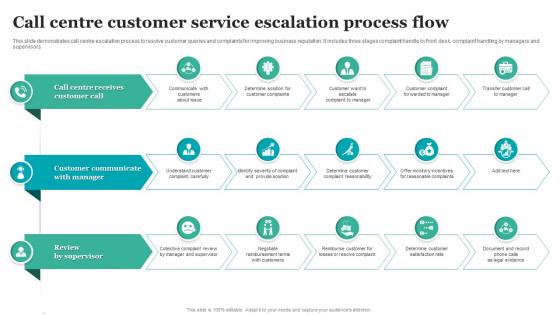
Call Centre Customer Service Escalation Process Flow




Try Before you Buy Download Free Sample Product
 Impress Your
 Audience
 100%
100% Editable
 Save Hours
 of Time


This slide demonstrates call centre escalation process to resolve customer queries and complaints for improving business reputation. It includes three stages complaint handle by front desk, complaint handling by managers and supervisors.
People who downloaded this PowerPoint presentation also viewed the following :
Call Centre Customer Service Escalation Process Flow with all 6 slides:
Use our Call Centre Customer Service Escalation Process Flow to effectively help you save your valuable time. They are readymade to fit into any presentation structure.





FAQs for Call Centre Customer Service
Honestly, the biggest thing is having crystal clear triggers - like when exactly do you escalate? Set specific timeframes for each level too. Your team needs to know the exact chain of command, otherwise stuff just sits in limbo forever (which drives me crazy). Document everything as it happens and use templates so info stays consistent. Oh, and communication - keep everyone in the loop about status updates. The whole point is making it foolproof so your team won't hesitate or waste time overthinking the process. They should feel confident jumping to the next level when needed.
Look, if something's hitting multiple customers or breaking core business stuff, escalate immediately. Security breaches? Absolutely escalate. Legal issues or pissed-off executives complaining? Yeah, those go straight up the chain too. When your team can't fix it within SLA deadlines, that's another red flag. I'd rather escalate too much than let problems snowball - learned that the hard way once. Document clear triggers so your team doesn't have to guess. Makes everything smoother when people know exactly when to hit the panic button.
Think of communication channels as your game plan for who to hit up when things go sideways. Map out your contacts beforehand - maybe Slack your manager first, then email the director if they ghost you for 2 hours. For critical stuff? Just call immediately. I've watched escalations completely bomb because someone emailed about a system outage instead of picking up the phone - honestly such a rookie move. Match your urgency level to the right channel. Always have backup contacts ready when people are unreachable. Oh, and document everything as you work your way up the chain.
Oh totally! Healthcare moves super fast because patient safety is everything - you can't mess around with that stuff. Finance is similar when fraud pops up; nobody wants the SEC breathing down their necks. Tech companies usually do the whole collaborative thing with different teams jumping in. Manufacturing focuses more on safety issues and keeping production running smoothly. Honestly, I think the trick is just figuring out what'll get people in your industry fired if it goes wrong, then building your escalation speed around that. Each sector has its own nightmare scenarios, you know?
Honestly, most people either jump the gun or wait way too long. Don't go straight to your boss's boss when your manager could fix it in minutes - that's just messy. But also? Don't sit on something critical for days hoping it magically disappears. Write everything down first, figure out your escalation triggers ahead of time, and bring in the right people early. I learned this the hard way at my last job. If you're even wondering whether to escalate, just do it.
So I'd start by mapping out what you're doing now, then find tools that automate the boring stuff. Workflow software can route tickets by priority and send alerts to the right people automatically. Honestly, this saves your sanity when everyone's stuck in meetings all day. AI tools are getting pretty good at sorting issues and suggesting who should handle what based on old cases. Oh, and get a dashboard where everyone can see what's escalated - no more "I didn't know this was urgent" excuses. The key is automating those manual steps that eat up your time.
Track your escalation volume and resolution times first - those are your bread and butter metrics. Customer satisfaction scores matter too, obviously. How long from escalation to closure? That's critical. Check if issues go to the right people (escalation accuracy) and watch for ping-ponging - honestly, there's nothing more infuriating than getting bounced around departments. Re-escalation rates tell that story. First-call resolution and agent confidence scores help if you've got them. Monthly dashboard works well for spotting trends. When volume or resolution times spike, something's broken and you'll need to dig in.
Look, escalation processes work because customers hate feeling stuck with no way out. Once they know there's someone higher up they can talk to, they relax a bit - even if they never actually escalate. The trick is having clear rules about when and how fast things get bumped up. You don't want people waiting around forever while their problem sits in some queue. Make sure whoever handles escalated cases actually has the power to fix stuff the first person couldn't. Honestly, just having the option there does half the work for you.
So first thing - get everyone clear on when to actually escalate and who they're supposed to call. Like, create a proper matrix so people aren't just guessing. Then drill the communication part - what info to include, how to hand things off smoothly. Role-playing helps a ton since these situations get messy fast. I'd also throw in some conflict resolution training because honestly, most escalations involve upset people. The handoff process is usually where things fall apart, so practice that part until it's second nature. Oh, and make sure everyone knows their decision-making limits.
Honestly, start with a decent ticketing system that auto-assigns priority levels and deadlines. Each escalation needs one person owning it - not "the team" because that's where things die. Set up automated reminders so stuff doesn't disappear into the void. I'd audit your current mess first to see where things typically get stuck, then build around those specific problems. Regular check-ins help catch bottlenecks before they explode. Everyone should see real-time updates though - transparency prevents the "I thought you were handling it" disasters.
Make your escalation docs super clear about when to actually escalate - none of that "when things seem rough" nonsense. List specific people with their contact info and roles. Set timeframes so nothing gets stuck forever. Here's the thing though - most companies bury these docs where nobody can find them during a crisis. Don't do that. Keep yours somewhere obvious and update the contact list regularly. I've seen people try escalating to managers who quit months ago, which is just awkward. Test it quarterly to spot problems before they matter.
Your leaders need to make escalation feel safe, not career-ending. When someone raises an issue appropriately, celebrate it! Even if it causes temporary headaches. I've watched too many companies destroy good escalation with that toxic "don't bring problems, bring solutions" attitude. Quick responses matter when issues surface. Never shoot the messenger. Leaders should tell stories about times escalation actually helped - oh, and they better escalate upward themselves when they're stuck. Otherwise nobody believes the whole "speak up" thing. Start simple: ask your leadership straight up how they want to hear about problems early.
Honestly, escalation can totally mess with team dynamics if you're not careful about it. Done right though? Your team will actually trust you more because they know you've got their back. I've definitely seen it go both ways - escalate too much or handle it badly and suddenly everyone thinks you don't trust them to do their jobs. Which sucks for morale. The trick is being super transparent about why you're doing it and what you're trying to fix. Oh, and always circle back with your team afterward so they can see it was worth it and maybe learn something for next time.
Build in checkpoints at every stage where you loop back to whoever reported the issue. People absolutely hate radio silence, so tell them what's happening and what comes next. After you resolve things, follow up to see if your solution actually worked - this part gets forgotten way too often. Make these touchpoints automatic by baking them right into your escalation process. Otherwise you'll only remember like half the time. Short updates work fine, but consistency matters more than being detailed. Trust me, even a quick "still working on it" text beats nothing.
Honestly, catch problems before they turn into disasters - that's like 80% of it. Get your team a decent knowledge base where they can actually find answers instead of guessing. I'd do weekly check-ins too, nothing fancy. Sometimes people just need to complain for a minute before they calm down, weird but it works. Train everyone to ask the right questions upfront. Give them clear limits on what they can fix themselves - nobody wants to escalate over stupid stuff they could've handled. Bottom line is empowering people early saves you headaches later.
-
Easy to use and customize templates. Helped me give a last minute presentation.
-
A library of engaging, customizable and content-ready templates.