


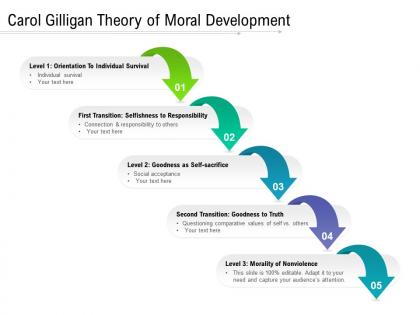
Carol gilligan theory of moral development




Try Before you Buy Download Free Sample Product
 Impress Your
 Audience
 100%
100% Editable
 Save Hours
 of Time


Our Carol Gilligan Theory Of Moral Development are topically designed to provide an attractive backdrop to any subject. Use them to look like a presentation pro.
People who downloaded this PowerPoint presentation also viewed the following :
Carol gilligan theory of moral development with all 2 slides:
Use our Carol Gilligan Theory Of Moral Development to effectively help you save your valuable time. They are readymade to fit into any presentation structure.

FAQs for Carol gilligan theory
So Gilligan basically said Kohlberg missed half the picture when studying moral reasoning. Where he focused on justice and abstract rules, she noticed women often think more about relationships and caring for people - like, how will this affect everyone involved? It's not that either approach is wrong, but you need both perspectives to really get how people make ethical choices. Context matters just as much as universal principles sometimes. Definitely worth considering when you're looking at moral conflicts in your research - gives you a more complete view of what's actually happening.
Okay so basically Kohlberg was all about universal rules and justice - like everyone follows the same moral stages. But Gilligan was like "wait, that's not how tons of people actually think." She found that many folks (especially women) make moral choices based on relationships and care instead. So instead of "what's the right principle here," it's more "who gets hurt and how do we keep connections intact?" Honestly, Kohlberg's approach missed a huge piece of the puzzle. When you're looking at someone's moral reasoning, you gotta figure out if they're using justice thinking or care thinking - it totally changes everything.
So Gilligan basically called out Kohlberg for studying mostly guys and then acting like that's how everyone thinks morally. Men tend to focus on rules and justice - what's fair according to some universal principle. Women are more likely to think about relationships and how their choices affect people they care about. It's not that one way is better (though honestly, considering context seems pretty smart to me). Your female coworkers probably do weigh the relationship stuff more heavily. The takeaway? You'll get better results if you account for both perspectives when you're dealing with ethics stuff.
So basically you want to make relationships the center of everything. Get kids working together on real group projects - not the fake ones where they just split up tasks. Have weekly discussions about how choices affect other people, because honestly that's way more interesting than memorizing rules. Let them share different viewpoints and talk about feelings when problem-solving. Oh and create space for students to actually care about each other - like peer support stuff. I'd start small with maybe one care-focused discussion each week. Trust me, it's so much better than traditional methods that just focus on individual achievement.
So Gilligan's thing is basically that people approach empathy totally differently depending on their moral style. Care-focused people (she thought mostly women, though that's kinda outdated now) will prioritize keeping relationships intact and understanding the whole situation. Justice-focused folks lean more on rules and individual rights instead. I've definitely seen this play out at work - some people want to talk through problems while others just want clear policies. When someone's empathy seems weird to you, they're probably just operating from the opposite framework. Makes communication way easier once you figure out which camp they're in.
So Gilligan basically said "hold up, women don't think about ethics wrong - they just think about it differently." Traditional moral theory was all about abstract rules and justice stuff. But she noticed women focus more on relationships and context instead. Like, instead of asking "what's the universal right answer," it's more "how do I handle this without damaging important connections?" Her "ethics of care" was pretty groundbreaking back then. Both approaches are useful though - sometimes you need that justice perspective, other times the care angle makes way more sense for whatever situation you're dealing with.
Oh totally! Gilligan's care ethics is perfect for dissecting current issues. Her whole thing about relationships and context works great on healthcare policy or workplace inequality. What's cool is how she shows women approach moral problems differently - super obvious during pandemic caregiving debates or environmental justice stuff. I mean, the relational angle helps you see past those rigid rights-based arguments everyone defaults to. Next time you're analyzing policy, try her care vs. justice lens. You'll catch dynamics that would've flown right under the radar otherwise.
Yeah, so Gilligan's whole thing is that context matters way more than people think. She basically says you can't just apply universal rules to every situation - you've got to look at the specific relationships and circumstances first. Like, who's involved? What are their actual needs? How are people connected to each other? I honestly think this makes so much sense. Instead of having some rigid moral checklist, her care ethics approach is more about understanding everyone's vulnerabilities in that particular moment. So next time you're stuck on something ethical, map out all those messy human details before deciding anything.
So Gilligan totally flipped feminist ethics on its head. She was like "why are we obsessing over abstract rights and justice when care and relationships matter just as much?" Her whole "ethics of care" thing validated how women often think about moral stuff - you know, considering context and emotional connections instead of just cold logic. Before her, that approach got dismissed as inferior. Now feminist philosophy is all about balancing care ethics with justice ethics. Honestly, once you read her work you'll spot her influence everywhere in the field.
So Gilligan basically flipped psychology on its head by proving women approach morality differently - we focus more on relationships and care rather than just rigid justice rules. Her "ethics of care" thing is everywhere now in gender studies and developmental research. Schools totally changed how they teach because of her work too. Before her, everyone just assumed male thinking was the standard (which is honestly pretty messed up when you think about it). Her book "In a Different Voice" is still super relevant - especially if you're working with different types of people, it'll completely change how you understand their moral choices.
So with Gilligan's approach, you'd skip the whole "who's right" thing and focus on fixing relationships instead. Like, what does everyone actually need here? I've actually seen this work pretty well at my old job - instead of just following rules, we'd dig into each person's side of things. The goal becomes keeping connections intact while still dealing with whatever went wrong. You know? Ask stuff like "how do we keep working together after this?" rather than "who screwed up the policy." People usually buy in more because they feel like their perspective matters, which honestly makes the whole resolution stick better long-term.
So basically, her research gets called out for pretty weak methodology - tiny sample sizes, no diversity, interviewer bias, the whole deal. Critics say she just reinforces stereotypes by claiming women are naturally more caring, which... yeah, feels kinda backwards. Her theories about moral development stages are supposedly oversimplified too, and she ignored cultural stuff. Oh, and definitely mention these problems if you're using her work. Pair it with newer research that's actually rigorous - there's way better gender and ethics studies out there now.
Gilligan's care ethics totally changes how you think about corporate stuff. Instead of just "is this legal?" you're asking "who actually gets screwed over here?" Way more focus on relationships and real impact than just following rules. Honestly way better than the usual number-crunching approach most companies do. When your team's making decisions, you can push back with her framework - like yeah this might be profitable but what about employees or the community? Sometimes feels awkward bringing it up but it catches things other ethical models miss. Really good for spotting blind spots.
So care ethics is perfect for healthcare because it backs up what you're probably already doing - that whole empathetic, relationship-focused thing. Gilligan's framework says forget the rigid rules for a sec and focus on each patient's actual situation and connections. Pretty refreshing honestly, especially when everything else is so protocol-heavy. You're looking at how decisions ripple through their whole support network, not just treating symptoms in isolation. One thing that really works? Ask patients about their relationships and who's helping them at home. It gives you way more context than just the medical stuff.
So Gilligan's theory has this major blind spot - she basically only studied white middle-class American women. Different cultures have totally different ideas about care and relationships. Some collectivist societies might actually fit her approach better, but others have completely different moral systems. It's weird how complex it gets when you look at the cross-cultural stuff (I went down this rabbit hole last semester). Don't assume her care vs justice thing works everywhere. You've gotta think about where your participants are coming from culturally.
No Reviews