


Walt and gilsons policy triangle framework




Try Before you Buy Download Free Sample Product
 Impress Your
 Audience
 100%
100% Editable
 Save Hours
 of Time


Our Walt And Gilsons Policy Triangle Framework are topically designed to provide an attractive backdrop to any subject. Use them to look like a presentation pro.
People who downloaded this PowerPoint presentation also viewed the following :
Walt and gilsons policy triangle framework with all 2 slides:
Use our Walt And Gilsons Policy Triangle Framework to effectively help you save your valuable time. They are readymade to fit into any presentation structure.

FAQs for Walt and gilsons
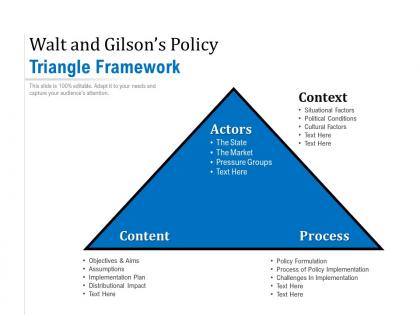
So the Policy Triangle breaks down into three parts: **actors**, **content**, and **context**. Actors are basically everyone involved - politicians, bureaucrats, interest groups, you name it. Content's just the actual policy stuff and what it's supposed to accomplish. Context is trickier though - it's all the background forces like political climate, economic conditions, institutional rules. Once you get it, it's super useful for breaking down any policy situation. Just ask yourself who's involved, what they want, and what's influencing them. I'd honestly start there with whatever you're working on right now.
So the Policy Triangle breaks policy stuff into three parts: context, content, and actors. Context is basically the political/economic situation happening around it. Content is the actual policy details - like what it actually does. Actors are the people pushing for it or against it. Honestly, once you start looking at policies this way, it's pretty useful. You can figure out why some policies work and others just crash and burn by seeing how these three pieces fit together. Or don't fit together, which happens more than you'd think. Just go through each part when you're trying to make sense of some random policy decision.
So basically the Policy Triangle is all about how context, content, and actors are constantly messing with each other. Like, you can't just look at one piece - the political/economic stuff shapes what's actually doable, while the policy details determine if it'll work, and then all the players (politicians, bureaucrats, whoever) are pushing things around. Real life gets super messy with this stuff. When you're breaking down any policy, just follow how a change in one area screws with the others. Honestly, I'd start by figuring out who your main actors are first, then trace backwards to see how everything else is influencing their decisions.
Yeah totally! The Policy Triangle works for pretty much anything. Health policies? Look at clinical evidence vs political pressure vs what actually happens in hospitals. Education's the same deal - research on kids' learning, political fights over funding, plus what teachers deal with day-to-day. The three corners don't change, you just swap in different stuff for each sector. Honestly, I'd start by figuring out who the main players are and what they actually want. That's usually way more revealing than you'd think. Works every time.
So basically everyone's tugging the triangle in different directions. Politicians handle the politics angle - campaigns, building coalitions, staying electable. Policy nerds and think tanks work the actual content side with their research and recommendations. The problem piece? That's where advocacy groups, media, and random news events come in - honestly sometimes it's just whatever catches fire that week. Super messy in real life! Your window opens when all three line up, so you've got to figure out who's moving what and start building those relationships early. Way easier said than done though.
Look, evidence is what makes your policy ideas actually matter in the content corner of the Policy Triangle. Without solid data backing you up, you're basically just sharing opinions (and nobody cares about those in policy work, trust me). You'll need real research - academic studies, pilot results, demographic info, whatever connects to your problem. Start collecting this stuff early though, because finding credible sources takes forever. The key is making sure your evidence directly supports the solution you're pushing for. Otherwise you just look unprepared when someone challenges you.
So the Policy Triangle Framework basically breaks things down into three parts - content (what the policy actually says), context (the political/social stuff happening around it), and process (how they made and rolled it out). Pretty useful honestly. Instead of just staring at whether something worked or not, you can figure out which of these three areas went wrong. Like maybe the policy itself was solid but the timing sucked, you know? Just map whatever policy you're looking at against each piece and you'll spot where the problems are. Way better than guessing.
Yeah, the Policy Triangle definitely has issues you'll run into. Everything gets crammed into three boxes - actors, context, content - but real policy stuff is way messier than that. The boundaries blur constantly, which is annoying when you're trying to analyze something. It also misses power dynamics and those behind-the-scenes networks that actually matter (honestly, sometimes the informal stuff drives everything). Plus it treats policy like it's static when it's constantly shifting. I'd say start with it since it's a decent framework, but be ready to throw in other tools or just wing it when things get complicated. Don't let it box you in.
So the Policy Triangle is just way more useful than other policy models, honestly. You get three simple angles - politics, policy, and problems - instead of drowning in some complicated theory. Most models pretend policymaking happens in neat steps, but this one actually gets how chaotic it really is. What I love about it is how it shows all three parts working together at once. That's usually what decides if policies actually succeed or totally bomb. The policy cycle model is more structured, sure, but this triangle thing? It's messier and way more realistic about political BS. Perfect for figuring out why something isn't working.
Don't work in silos - you've gotta get all three streams talking to each other. Map out your key players first, then set up regular check-ins with them. Windows close stupid fast, so watch for when everything might actually line up. Honestly, the relationship building is probably the hardest part but do it before you're desperate. Political champions are gold. Frame your solutions so they make sense for both the problem you're solving and whatever politicians care about right now. That's really where it clicks.
So basically this Framework thing creates a common language where everyone can actually understand what's going on. You map out the politics, policy details, and processes together - suddenly people see how their part connects to everything else. Pretty cool when the lightbulb goes off and they realize it's all interconnected. Use it to spot where groups are fighting versus where they might actually agree (makes negotiations way less painful). The visual part is clutch since you're literally drawing out how actors, institutions, and ideas relate. Oh and definitely try a collaborative mapping session early on - it'll surface all those hidden assumptions people have and gets everyone bought in from the start.
Honestly, the Policy Triangle thing is pretty genius because it forces you to map out actors, content, and context all at once. You can't just wave your hands around with vague explanations anymore. It's basically a reality check - who's involved, what you're actually proposing, and why now? Makes your whole argument way clearer. Others can follow your logic better too, which means they'll call you out if you're being sloppy (not always fun but whatever). Try it on your next policy brief. The structure alone will make your reasoning so much tighter.
So look at GDPR and California's AB5 law - perfect examples of this Policy Triangle thing in action. GDPR had to balance privacy advocates screaming for change, create actual comprehensive rules, then somehow coordinate across 27 countries (which was honestly a mess). AB5 did the same dance with worker rights pressure, the technical stuff of reclassifying contractors, and enforcement across totally different industries. The key is mapping out all three angles early in your own projects. You'll catch the friction points before they completely blow up your timeline. Makes sense?
Look, the Policy Triangle thing works because you're not just checking boxes once and calling it done. You cycle through problem definition, policy options, and political feasibility over and over. New data might totally reframe your problem, or suddenly the political landscape shifts (honestly happens way more than it should). It's basically like GPS constantly recalculating when traffic changes. Figure out which piece is changing most in your situation right now. Then set up regular check-ins to revisit that corner more often than the others.
Skip any one of these and you're basically screwed. Political stuff gets ignored? Your brilliant policy dies because you didn't think about who actually has power. The institutional side matters too - I've seen so many good ideas crash because nobody considered how organizations actually work. Problem definition is huge though. Get that wrong and you solve something nobody cares about. It's like a three-legged stool, honestly. Take away one leg and the whole thing falls over. You need all three working together or your analysis is pretty much useless.
No Reviews