

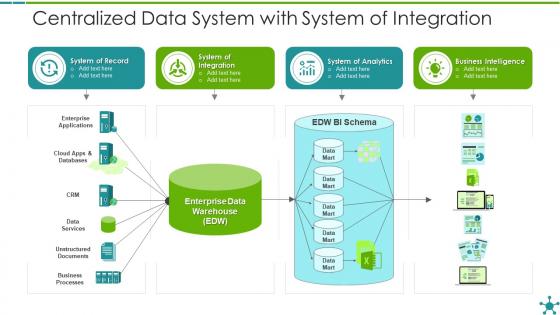
Centralized data system with system of integration




Try Before you Buy Download Free Sample Product
 Impress Your
 Audience
 100%
100% Editable
 Save Hours
 of Time


Our Centralized Data System With System Of Integration are topically designed to provide an attractive backdrop to any subject. Use them to look like a presentation pro.
People who downloaded this PowerPoint presentation also viewed the following :
Centralized data system with system of integration with all 9 slides:
Use our Centralized Data System With System Of Integration to effectively help you save your valuable time. They are readymade to fit into any presentation structure.








FAQs for Centralized data system with
Dude, centralized data integration is a game changer - you finally get one version of the truth instead of five different departments showing you five different numbers. Your teams stop wasting hours pulling data from random systems manually. Quality goes way up too since you're not dealing with weird formats and duplicate records everywhere. Honestly, I've seen companies cut their reporting time in half. Decision-making gets so much smoother when everyone's looking at the same info. Oh, and start with your most important data sources first - you don't need to boil the ocean right away.
Basically, everyone pulls from the same system instead of having marketing say you've got 500 customers while sales claims 600. No more of those awkward meeting moments where people are like "that's weird, my numbers are totally different." Data formats stay consistent across departments too. Manual entry mistakes drop way down since there's just one place to update everything. Honestly, it's kind of a game-changer - your teams actually make decisions using identical info instead of everyone working off their own random spreadsheets or whatever.
Oh man, data quality is gonna be your biggest headache for sure. Plus dealing with legacy systems that don't want to play nice together. Getting teams to agree on standards? Good luck with that one lol. IT will definitely lowball the timeline - this stuff drags on forever. Security gets messy too when you're pulling from different sources with their own access rules. Honestly, governance becomes chaos when everyone formats things differently. Start with just one or two data sources though. Get that working smoothly first, then add more later. Way less painful that way.
So you know how you're always digging through like 5 different systems trying to find the right numbers? Centralized integration fixes that mess. Everything flows into one spot in real-time - no more waiting for overnight batch updates or getting different answers from different databases. Your dashboards stay current, alerts hit when stuff actually changes, and honestly, your analysts will thank you. The trick is nailing those data pipelines from the start. Yeah, it's extra work upfront, but you'll save yourself tons of manual cleanup later. Trust me on this one.
Honestly, cloud tech is like having a universal translator for all your messy data sources. Your scattered info can finally sync up on one platform without those awful compatibility headaches we've all dealt with. Pre-built connectors and APIs handle the heavy lifting. When data spikes happen, scaling's automatic - plus you get security and backups baked in. Your team accesses everything from anywhere, which is clutch. I'd say start by figuring out which platform plays nicest with whatever data sources you're already stuck with. Makes the whole integration thing way less painful.
Start with encryption - both when data's moving around and when it's just sitting there. Role-based access is clutch too, so people can't see stuff they shouldn't. MFA is annoying but honestly worth it. Network segmentation creates these security bubbles around your integration stuff which helps a ton. Oh and definitely run regular security audits - way better to find problems early than deal with a breach later (learned that one the hard way). Log everything for compliance. I'd tackle encryption and access controls first since they'll give you the most protection right off the bat.
Honestly, centralized integration is a game-changer for compliance stuff. You've got everything in one spot with consistent formatting instead of juggling five different systems like a circus act. Audit trails? Easy. Regulatory reports? Done from your single source of truth. Your data lineage actually makes sense, access controls are standardized, and - this is huge - you can trust the numbers you're submitting. When regulations shift (and they always do), you only update once rather than hunting down every disconnected system. My advice? Map out which compliance reports you need most often first. Those should be your starting point for integration priorities.
Honestly, start with scalability - can it handle your current data AND whatever you'll throw at it later? Compatibility with your existing setup is huge too. Performance-wise, slow syncing will drive everyone crazy. Here's what I learned the hard way: test their support quality first. When stuff breaks at 2am (and it will), you want actual humans answering. Open-source tools are solid if your team can maintain them, but that's more work than people think. Definitely run a small pilot before committing to anything big. Way easier to pivot early than after you've integrated everything.
Track both the obvious savings and the productivity stuff - that's where you'll really see results. Consolidating systems cuts IT costs, real-time data speeds up decisions, and you're not doing manual entry anymore. Honestly, the time savings can be insane - I've watched teams go from taking days on reports to knocking them out in hours. Better data quality means fewer expensive screw-ups too. Revenue growth from actual insights is the cherry on top. Before you implement anything though, spend a couple months documenting your current data headaches and costs. You'll need those baseline numbers.
Honestly, having all your data in one place is such a lifesaver. No more endless meetings arguing over which spreadsheet has the "real" numbers - we've all been there, right? Your team can actually spend time figuring out what the data means instead of just collecting it from five different systems. The coolest part? You'll catch problems and opportunities as they happen, not months later when it's too late. Plus decisions happen way faster when everyone's looking at the same info. I'd start by picking your biggest decisions and working backwards to see what data feeds into them.
So basically, centralized data integration puts all your messy data sources into one spot where they can actually talk to each other. No more having marketing's customer info trapped in one system while sales uses something completely different - honestly, it's such a pain when teams can't access the same info. Picture it like syncing all your apps to the cloud instead of each device doing its own thing. Your teams won't have to jump between a million systems anymore or waste time tracking down who has what data. I'd start by figuring out where your most important stuff lives right now.
So data governance is like your referee for when you're pulling data from everywhere into one place. You set up who gets access to what, plus the formatting rules everyone has to follow. Otherwise you'll end up with a hot mess nobody trusts - been there before with a project that went sideways fast. The trick is figuring out data ownership first. Who owns which pieces? Then nail down your quality standards before you start the actual integration work. Trust me, doing this backwards is way more painful than getting it right upfront.
APIs are like connectors that let your main system grab data from everywhere else automatically. Way better than doing it by hand - that'd take forever. They can pull stuff in real-time or whenever you schedule it, so everything stays updated without you babysitting it. The formatting gets handled for you too, which is nice. Honestly, I'd start by figuring out what data sources you have first. Then see which ones already have solid APIs - those are gonna be your quick wins. Build from there since the API ones are way less of a headache to set up.
Honestly, you're basically putting all your eggs in one basket here. Your biggest headaches will be single points of failure and security issues - if that central system crashes, everything goes down with it. Hackers love this setup too since all your good stuff is sitting in one place. I'd say start with solid backups and disaster recovery (boring but necessary). Encrypt everything, set up load balancing across multiple servers if you can swing it. Oh, and don't forget proper access controls - you'd be surprised how many people skip that part. Monitor it all closely because things will break when you least expect it.
Honestly, stakeholders don't give a damn about your fancy data architecture if they can't see what's in it for them. Figure out what's actually bugging each group - their real problems, not the theoretical stuff you think they should care about. I've watched so many of these projects crash because IT nerds out over the tech while business users feel completely left out. Quick wins are everything here. Run some pilot projects that show actual results in like 30-60 days, then ride that momentum. Oh, and definitely get key people involved in designing this thing - nobody wants something shoved down their throat.
-
Professional and unique presentations.