


Challenges faced by zomato zomato investor funding elevator ppt slides




Try Before you Buy Download Free Sample Product
 Impress Your
 Audience
 100%
100% Editable
 Save Hours
 of Time


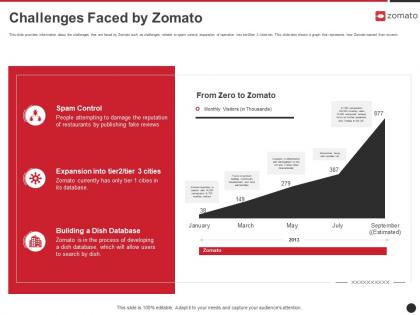
This slide provides information about the challenges that are faced by Zomato such as challenges related to spam control, expansion of operation into tier2 tier 3 cities etc. This slide also shows a graph that represents how Zomato started from scratch.
People who downloaded this PowerPoint presentation also viewed the following :
Challenges faced by zomato zomato investor funding elevator ppt slides with all 2 slides:
Use our Challenges Faced By Zomato Zomato Investor Funding Elevator Ppt Slides to effectively help you save your valuable time. They are readymade to fit into any presentation structure.

FAQs for Challenges faced by zomato zomato investor funding
Zomato's investor funding challenges stem from increasing competition in food delivery, persistent profitability concerns, regulatory pressures in key markets, and shifting investor sentiment toward tech valuations. While these factors present obstacles, many food-tech companies are addressing similar issues by diversifying revenue streams, optimizing operational efficiency, and expanding into adjacent markets like grocery delivery, ultimately positioning themselves for sustainable growth in an increasingly competitive landscape.
Zomato's valuation has experienced significant volatility, declining from its IPO peak of approximately $13 billion to current levels around $6-8 billion due to profitability concerns, competitive pressures, and broader tech market corrections. These fluctuations reflect investor sentiment shifts toward sustainable growth models, with food delivery platforms increasingly focusing on operational efficiency and diversification strategies to stabilize valuations.
Competition from platforms like Swiggy, Uber Eats, and DoorDash significantly impacts Zomato's investor confidence by intensifying market share battles, pricing pressures, and customer acquisition costs. While this creates challenges in demonstrating sustainable profitability, it also drives innovation and market expansion, with many investors recognizing that competitive dynamics ultimately strengthen market leaders through operational efficiency and strategic differentiation.
Geopolitical factors can significantly impact Zomato's foreign investment attraction through regulatory changes, currency fluctuations, trade policies, and investor sentiment shifts across different markets. These dynamics create both challenges and opportunities, with many food delivery companies finding that diversifying investor bases across stable regions, maintaining transparent governance practices, and demonstrating strong local market penetration ultimately enhances resilience and attracts patient capital.
Changing consumer behavior presents both challenges and opportunities for Zomato's funding prospects, with shifts toward value-conscious dining, health preferences, and delivery convenience requiring strategic adaptation. While evolving habits like increased price sensitivity and sustainability focus may pressure margins, they also create new revenue streams through premium health-focused offerings, ultimately positioning Zomato for sustainable growth if properly leveraged.
Zomato's financial performance has significantly influenced investor confidence, with the company's path to profitability and revenue diversification beyond food delivery serving as key factors in funding negotiations. While initial public market volatility and operational losses created challenges, Zomato's strategic expansion into grocery delivery, cloud kitchens, and B2B services has demonstrated resilience, with institutional investors increasingly recognizing the platform's potential for long-term market leadership in India's growing digital food ecosystem.
Zomato could explore revenue-based financing, strategic partnerships with payment platforms like Razorpay, crowdfunding from loyal customers, convertible debt instruments, and asset-backed securities using delivery infrastructure. These innovative approaches enable diversified capital sources, reduced equity dilution, and enhanced stakeholder engagement, with many food-tech companies finding that alternative funding structures ultimately deliver greater financial flexibility and operational resilience.
Regulatory scrutiny creates mixed investor sentiment towards Zomato by introducing compliance costs, operational uncertainties, and market entry barriers, while also demonstrating the platform's resilience and adaptability. Through navigating data privacy regulations, labor laws, and competition policies across India, UAE, and other markets, Zomato showcases operational maturity and regulatory compliance capabilities, ultimately strengthening long-term investor confidence.
Zomato's expansion into new verticals like grocery delivery, cloud kitchens, and fintech creates funding challenges by increasing capital requirements, diluting focus from core operations, and demanding specialized expertise across multiple business models. While diversification reduces dependency on restaurant delivery, it also heightens investor scrutiny regarding resource allocation and profitability timelines, with many venture capitalists preferring focused growth strategies over broad market approaches.
Investing in Zomato amid funding challenges presents both significant opportunities and considerable risks, including market volatility, competitive pressures, regulatory uncertainties, and potential valuation corrections. However, investors may find compelling rewards through Zomato's dominant market position, diversified revenue streams, and expansion into profitable sectors like quick commerce, ultimately delivering long-term growth potential in India's expanding digital food ecosystem.
The economic climate has significantly tightened Zomato's funding environment, with rising interest rates increasing capital costs and inflation pressuring operational expenses, while investors increasingly scrutinize unit economics and profitability timelines. These conditions compel food delivery platforms to demonstrate sustainable growth models and operational efficiency, with many finding that strategic cost optimization and market consolidation present competitive advantages in securing investment.
Zomato can learn from competitors' funding challenges by diversifying revenue streams beyond food delivery, maintaining realistic growth projections, and focusing on sustainable unit economics rather than aggressive expansion. Companies like Deliveroo and DoorDash found that demonstrating clear paths to profitability, optimizing operational efficiency, and building stronger market positions in core geographies ultimately delivers investor confidence and long-term competitive advantage.
Demographic shifts significantly enhance Zomato's funding appeal by expanding addressable markets through younger, tech-savvy consumers who prioritize convenience, aging populations seeking delivery services, and urbanization trends driving demand. These shifts enable investors to recognize scalable revenue opportunities across diverse consumer segments, with millennials and Gen Z demonstrating higher engagement rates, ultimately delivering sustained growth potential and competitive market positioning.
Partnerships and collaborations significantly enhance Zomato's funding opportunities by diversifying revenue streams, expanding market reach, validating business models, and attracting strategic investors who bring both capital and industry expertise. These strategic alliances enable access to new customer segments, operational synergies, and co-investment opportunities, ultimately strengthening Zomato's market position while reducing investor risk perceptions.
Zomato could leverage AI-powered demand forecasting, automated inventory management systems, blockchain for supply chain transparency, advanced analytics for customer segmentation, and machine learning for delivery optimization. These technologies streamline operations by reducing food waste, enhancing delivery efficiency, and improving customer experiences, while ultimately delivering cost reductions and operational scalability that demonstrates sustainable growth potential to investors.
-
Great experience, I would definitely use your services further.