


Chatbots For Customer Service Edu Ppt




Try Before you Buy Download Free Sample Product
 Impress Your
 Audience
 100%
100% Editable
 Save Hours
 of Time


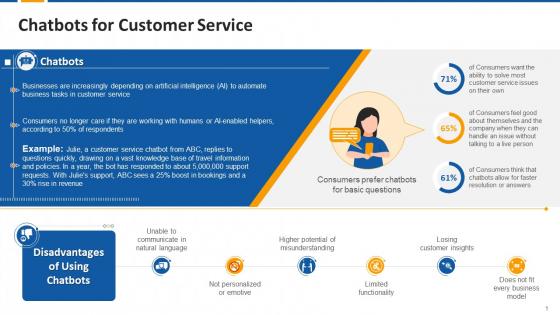
This slide covers information regarding dependency of businesses on chatbots to automate business tasks in customer service.
People who downloaded this PowerPoint presentation also viewed the following :
Chatbots For Customer Service Edu Ppt with all 17 slides:
Use our Chatbots For Customer Service Edu Ppt to effectively help you save your valuable time. They are readymade to fit into any presentation structure.







FAQs for Chatbots For Customer
Dude, chatbots are honestly a game changer. Your customers get help instantly instead of waiting forever, and you're not paying staff to work nights and weekends. They handle all the boring stuff - order tracking, basic FAQs, whatever. That frees up your real people for complicated issues that actually matter. Plus they don't have off days like humans do, so service stays consistent. Oh, and you get tons of data on what people are asking about most. I'd start small though - maybe just basic questions first, then build from there once you see what works.
Honestly, chatbots are pretty clutch for customer service. Your customers get instant help 24/7 instead of sitting on hold forever or waiting days for email replies. The bot handles all the basic stuff - order status, FAQ answers, that kind of thing - which frees up your actual team for calls that need real problem-solving. People love being able to get answers at weird hours too (like when they're up late overthinking their return policy lol). Just make sure the bot's smart enough to pass tricky questions to humans. That combo works really well.
Chatbots work great for basic stuff - FAQ questions, checking order status, password resets, that kind of thing. They're perfect for those random 3am "what time do you close?" messages (honestly saves so much headache). You can also use them to grab customer info before passing things along to your team. But don't rely on them for complicated problems or when someone's actually upset about something. I learned that the hard way at my last job. Keep humans around for anything that needs real problem-solving. Best approach? Let bots handle the repetitive questions so your people can focus on stuff that actually matters.
Honestly, AI and ML are what turn chatbots from basically fancy flowcharts into something actually helpful. Your bot gets way better at understanding when someone asks "where's my stuff?" instead of needing perfect keywords. Machine learning picks up patterns from conversations - it's wild how much they improve over time. They can even predict what customers want before they finish typing, which is pretty neat. Plus they route tricky stuff to real humans faster and remember chat history for better responses. Oh, and definitely track where your bot fails most - that's where you'll see the biggest wins from AI upgrades.
So here's what I track for my chatbot - response time and how many issues actually get solved are obvious ones. Customer satisfaction scores matter too, but honestly the escalation rate is where you really see what's broken. Like if tons of chats keep getting bumped to humans, your bot sucks at those topics. Don't just measure speed though - I learned that the hard way. People might get fast answers that are totally useless. Check if users actually stick around or bounce right away. Oh and definitely review real conversations regularly, not just the dashboards.
Honestly, the biggest pain points are accuracy issues and pissed off customers. People hate getting trapped in bot hell when they just want to talk to someone real. NLP is still weirdly unpredictable - like, it'll nail complex stuff then completely whiff on simple questions. Integration with your current systems is another headache. Oh, and training it on your actual products takes forever. I'd say start basic, always give people a clear way out to human support, and budget way more time for training data than seems reasonable. Trust me on that last part.
So basically, chatbots get better by analyzing all their past conversations - like which responses worked and what totally flopped. They store all that data to spot patterns in customer questions. Pretty smart, right? Each chat makes them understand context better. You'll need to check your bot's performance logs regularly though - that's where you'll see if it's bombing on certain topics. Then just update the training data to fix those weak spots. It's kinda like training a coworker who has perfect memory but still needs guidance sometimes.
Definitely be upfront that it's a bot - people hate feeling deceived about that stuff. Keep the language super simple and conversational, like they're texting someone who actually gets it. Quick reply buttons are clutch for common questions. But here's the thing - always give them an escape hatch to talk to a real person when the bot inevitably can't help. Test it with actual users before you go live, not just your team (they'll be way too nice about obvious problems). The whole experience should feel more like messaging a friend than dealing with some corporate phone tree nightmare.
So most chatbots hook up to CRMs through APIs or connectors that sync everything in real-time. When customers chat, the bot automatically grabs their history and preferences from your CRM. Works the other way too - conversation data gets pushed back to customer profiles so your team sees the whole story. Salesforce, HubSpot, Zendesk all have native integrations (though honestly HubSpot's is probably the smoothest I've seen). I'd check what your CRM already offers first - you might get lucky and find it's basically ready to go.
So basically, good chatbots pull from your customer data - stuff like what they've bought before, past conversations, browsing habits. They'll greet people by name and reference old issues. Pretty smart ones even switch up their tone depending on who they're talking to. Like being super casual with Gen Z customers but formal with business clients. The key thing though? Your bot needs CRM access or it's useless. Nothing's more annoying than having to repeat your whole story because the system "forgot" you exist. Oh, and the best ones actually learn as they go, which is kinda cool.
Yeah, privacy stuff is a massive roadblock for chatbots. People just don't trust them with personal data - and honestly, can you blame them after all these hacks? Most customers won't share account numbers or sensitive complaints through chat. Your best bet is being super upfront about what data you're collecting and how it's stored. Make sure you're following GDPR rules too. Oh, and definitely offer a way to switch to a human agent when things get sensitive - that alone helps build trust.
Oh man, e-commerce companies are killing it with chatbots right now. They handle all that boring stuff - order tracking, returns, basic questions. Banking's huge too since people need account help at like 2am. Telecom works well because honestly, who wants to sit on hold just to check data usage? Healthcare's picking up steam for scheduling appointments and basic symptoms stuff. The thing is, these industries all get bombarded with the same repetitive questions that don't really need a human. Just look at what customers ask you most - if it's straightforward and happens constantly, you're probably good to go.
Dude, multilingual chatbots are honestly a lifesaver if you're trying to go global. Instead of hiring native speakers for every language, your bot handles Spanish, French, Mandarin - whatever your customers speak. Available 24/7 too, which is clutch. Nobody wants to fumble through customer service in broken English, you know? Plus you're not turning away potential customers just because of language barriers. Though heads up - make sure it gets cultural stuff right, not just word-for-word translations. I've seen some pretty cringy bot fails when companies cheap out on that part.
Honestly, chatbots are getting crazy good at actually understanding what people mean - no more of that "I don't understand" nonsense. They're picking up on emotions now and know when to loop in a real person. Voice is huge too, so customers can just talk instead of typing everything out. The personalization aspect is wild - bots will instantly know your whole history and what you usually order. My take? Start playing around with some basic AI bots now, even simple ones. There's definitely a learning curve, and I'd bet your competition is already testing this stuff out.
Honestly, just treat it like updating any other software - feed it new stuff regularly. I usually dump in fresh customer chats, policy changes, whatever's new every month or so. Most platforms make this pretty straightforward now, thank god. Keep an eye on where it's screwing up though. Those failed conversations are gold for your next training round. Set yourself a reminder to review monthly - trust me, you don't want customers getting last year's pricing because you forgot to update the thing. Oh, and don't wait too long between updates or you'll have a massive backlog to deal with.
-
“Detailed and great to save your time.”
-
Out of the box and creative design.