

Clinical Trial Phases Review And Approval Process




Try Before you Buy Download Free Sample Product
 Impress Your
 Audience
 100%
100% Editable
 Save Hours
 of Time


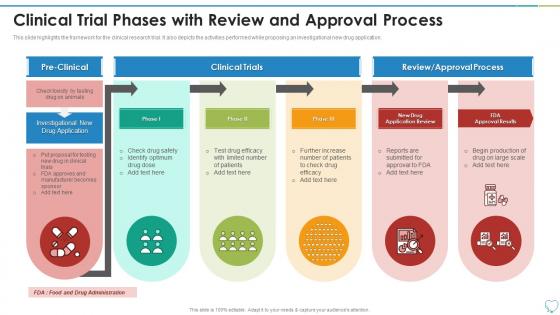
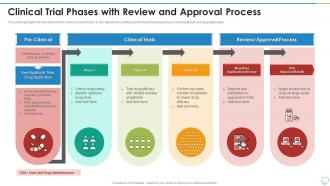
This slide highlights the framework for the clinical research trial. It also depicts the activities performed while proposing an investigational new drug application.
People who downloaded this PowerPoint presentation also viewed the following :
Clinical Trial Phases Review And Approval Process with all 6 slides:
Use our Clinical Trial Phases Review And Approval Process to effectively help you save your valuable time. They are readymade to fit into any presentation structure.





FAQs for Clinical Trial Phases Review
Phase I focuses on safety, dosage determination, and identifying side effects in small patient groups, while Phase II evaluates treatment effectiveness and further monitors safety in larger populations. Phase III compares new treatments against standard care through large-scale studies, and Phase IV conducts post-market surveillance, with pharmaceutical companies and research institutions finding these structured phases ultimately streamline regulatory approval and ensure patient safety.
Phase I clinical trials ensure drug safety through rigorous dose-escalation protocols, continuous patient monitoring, and comprehensive adverse event tracking using small participant groups. These studies systematically test increasing dosages while closely observing biomarkers, side effects, and drug metabolism, enabling researchers to establish maximum tolerated doses and identify potential risks before larger-scale testing begins.
Phase II trials typically involve 100-300 participants and focus on evaluating treatment efficacy and optimal dosing, while Phase III trials scale to 1,000-3,000 participants across multiple sites to confirm effectiveness against standard treatments. These phases enable pharmaceutical companies to systematically validate drug safety and commercial viability, with Phase III trials ultimately delivering the comprehensive data required for regulatory approval and market access.
Patient recruitment strategies vary significantly across clinical trial phases, with Phase I focusing on small cohorts of healthy volunteers or severely ill patients, Phase II targeting specific patient populations with the condition, and Phase III requiring large, diverse groups across multiple sites. These recruitment approaches become increasingly complex and resource-intensive as trials progress, with many pharmaceutical companies partnering with specialized recruitment firms and leveraging digital platforms to streamline enrollment, ultimately delivering faster patient access and more robust data collection.
Regulatory agencies oversee clinical trial safety, efficacy standards, and approval processes across all phases, requiring detailed protocols, safety data, and interim reports before trials can proceed. Through rigorous review mechanisms, agencies like FDA and EMA enable pharmaceutical companies to streamline drug development timelines while ensuring patient protection, ultimately delivering safer medications and faster market access for breakthrough therapies.
Adverse events are monitored through systematic data collection, real-time reporting protocols, regular safety assessments, and continuous regulatory oversight throughout all trial phases. Healthcare teams use standardized documentation systems, electronic monitoring platforms, and scheduled safety reviews to track participant reactions, with pharmaceutical companies and regulatory bodies like the FDA requiring immediate reporting of serious events, ultimately ensuring participant safety while maintaining trial integrity.
Clinical trial ethics involve informed consent, risk-benefit assessment, vulnerable population protection, independent oversight, and data integrity standards. Phase I trials present heightened ethical challenges since they test first-in-human safety with unknown risks, requiring enhanced participant protection protocols, rigorous safety monitoring, and transparent communication about potential adverse outcomes, with many research institutions finding that robust ethical frameworks ultimately enhance trial credibility and participant trust.
Clinical trial design significantly influences outcomes and regulatory approval by determining participant selection criteria, endpoint measurements, control group comparisons, and data collection protocols. Well-structured trials with clear primary endpoints, appropriate sample sizes, and robust randomization enable more reliable results, streamline regulatory reviews, and reduce approval timelines, with many pharmaceutical companies finding that strategic design choices ultimately determine whether promising treatments successfully navigate the complex approval process.
Randomization and control groups eliminate bias, ensure statistical validity, and enable accurate assessment of treatment efficacy across all clinical trial phases. Through random assignment and controlled comparisons, researchers can distinguish true therapeutic effects from placebo responses, confounding variables, and natural disease progression, with Phase II and III trials particularly relying on these methods to deliver reliable safety profiles and efficacy data for regulatory approval.
Phase II trials determine treatment efficacy by testing the intervention in 100-300 participants with the target condition, measuring primary endpoints like tumor shrinkage, symptom improvement, or biomarker changes. These studies employ randomized controlled designs, often comparing the experimental treatment against placebos or standard care, with pharmaceutical companies and research institutions finding that successful Phase II results significantly enhance drug development timelines and regulatory approval prospects.
Clinical trial phase duration depends on participant recruitment speed, regulatory approval timelines, data collection complexity, safety monitoring requirements, and study endpoint achievement rates. Patient enrollment challenges, especially in specialized conditions, often extend timelines significantly, while streamlined protocols and experienced research centers can accelerate progress, ultimately delivering faster drug development and improved patient access to treatments.
Clinical trial data undergoes rigorous statistical analysis to evaluate safety, efficacy, and risk-benefit profiles through endpoints like progression-free survival, adverse event rates, and biomarker responses. Regulatory agencies like the FDA and EMA scrutinize these analyses alongside real-world evidence, ultimately determining whether benefits outweigh risks for specific patient populations, enabling life-saving treatments to reach markets.
Patient diversity significantly enhances clinical trial validity by ensuring treatments work across varied genetic backgrounds, comorbidities, age groups, and demographics throughout all phases. This comprehensive approach enables pharmaceutical companies to identify differential responses, reduce adverse events in underrepresented populations, and ultimately deliver safer, more effective therapies with broader market applicability and regulatory approval confidence.
Adaptive trial designs streamline phase transitions by allowing real-time modifications based on interim data, enabling seamless progression from Phase I to Phase II or combined Phase II/III studies. These flexible approaches reduce development timelines, optimize resource allocation, and enhance decision-making speed, with pharmaceutical companies finding that adaptive designs deliver faster drug approvals and improved operational efficiency.
Sponsors transitioning from Phase II to Phase III face significant challenges including larger patient recruitment requirements, substantially increased costs, more complex regulatory protocols, and heightened risk of late-stage failures. These trials demand strategic resource allocation, global site management, and comprehensive safety monitoring, with many pharmaceutical companies finding that early stakeholder engagement and robust operational planning ultimately determine competitive advantage in bringing therapies to market.
-
SlideTeam just saved my project! Thank you so much. The variety of templates helped me showcase multiple perspectives easily.
-
Excellent template with unique design.