


Clinical Trial Phases Timeline With Nda Review




Try Before you Buy Download Free Sample Product
 Impress Your
 Audience
 100%
100% Editable
 Save Hours
 of Time


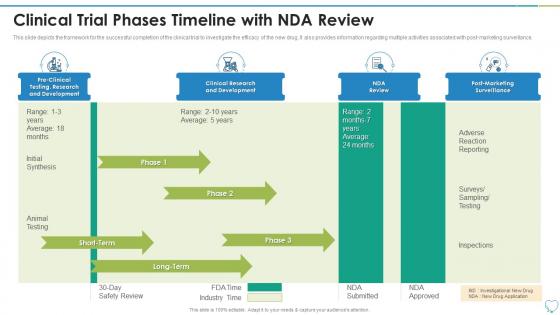
This slide depicts the framework for the successful completion of the clinical trial to investigate the efficacy of the new drug. It also provides information regarding multiple activities associated with post-marketing surveillance.
People who downloaded this PowerPoint presentation also viewed the following :
Clinical Trial Phases Timeline With Nda Review with all 6 slides:
Use our Clinical Trial Phases Timeline With Nda Review to effectively help you save your valuable time. They are readymade to fit into any presentation structure.





FAQs for Clinical Trial Phases Timeline
Clinical trials include Phase I (safety and dosage testing), Phase II (efficacy evaluation), Phase III (large-scale comparative studies), and Phase IV (post-market surveillance). These phases progress systematically from small safety assessments to comprehensive effectiveness studies, with pharmaceutical companies and research institutions finding that this structured approach streamlines drug development while ensuring patient safety and regulatory compliance.
Clinical trials ensure participant safety through rigorous protocols including informed consent procedures, independent ethics committee reviews, continuous safety monitoring, and strict inclusion/exclusion criteria. These safeguards enable researchers to minimize risks while maintaining scientific integrity, with many medical institutions finding that comprehensive oversight protocols ultimately deliver both participant protection and reliable data outcomes.
Placebos serve as control mechanisms in clinical trials, enabling researchers to isolate treatment effects, minimize bias, reduce psychological influences, and establish statistical significance through blinded comparisons. Through placebo-controlled studies, pharmaceutical companies and research institutions can demonstrate true drug efficacy, meet regulatory requirements, and accelerate approval processes, while ultimately delivering more reliable treatments and enhanced patient safety outcomes.
Patient recruitment for clinical trials involves targeted outreach through healthcare providers, patient databases, digital advertising, community partnerships, and specialized recruitment firms. These methods streamline participant identification by leveraging electronic health records, social media platforms, and physician referrals, while challenges include strict eligibility criteria, patient retention concerns, and geographic limitations, with many pharmaceutical companies finding that strategic combinations of digital and traditional approaches ultimately deliver faster enrollment and more diverse participant pools.
Regulatory bodies overseeing clinical trials include the FDA in the United States, EMA in Europe, Health Canada, Japan's PMDA, and China's NMPA. These agencies streamline drug development by establishing safety protocols, reviewing trial designs, and monitoring data integrity, with many pharmaceutical companies finding that early regulatory engagement accelerates approval timelines while ensuring patient protection and market access.
Clinical trials contribute to drug approval by systematically testing safety, efficacy, and optimal dosing through four distinct phases, providing regulatory agencies like the FDA with comprehensive scientific evidence required for market authorization. These rigorous studies enable pharmaceutical companies to demonstrate therapeutic benefits while identifying potential side effects, ultimately delivering safer treatments to patients and competitive advantages to organizations that successfully navigate the approval process.
Diversity and inclusion significantly enhance clinical trial outcomes by improving data quality, increasing enrollment rates, and ensuring broader population representation across different demographics, ethnicities, and socioeconomic backgrounds. These approaches enable pharmaceutical companies and research institutions to develop more effective treatments, reduce health disparities, and accelerate regulatory approvals, ultimately delivering safer medications and better patient outcomes across diverse populations.
Data monitoring committees ensure clinical trial data integrity by conducting independent reviews of safety and efficacy data, implementing predefined stopping rules, and monitoring for protocol deviations throughout the study duration. These expert committees enhance participant safety, maintain scientific rigor, and preserve study credibility by providing unbiased oversight, with many pharmaceutical companies finding that DMC recommendations ultimately accelerate regulatory approvals while minimizing risks.
Common statistical methods used in analyzing clinical trial results include descriptive statistics, t-tests, chi-square tests, ANOVA, regression analysis, and survival analysis methods like Kaplan-Meier curves. These analytical approaches enable researchers to determine treatment efficacy, assess safety profiles, and identify significant differences between groups, ultimately delivering robust evidence for regulatory approvals and clinical decision-making across pharmaceutical development.
Real-world evidence and clinical trial data influence healthcare decisions by providing comprehensive safety profiles, demonstrating treatment effectiveness across diverse populations, and guiding regulatory approvals for new therapies. These data sources enable healthcare providers, pharmaceutical companies, and regulatory agencies to make informed decisions about treatment protocols, drug approvals, and patient care strategies, ultimately delivering safer therapies and improved patient outcomes.
RCTs involve researchers actively assigning participants to treatment or control groups with random allocation, while observational studies monitor participants without intervention, tracking natural behaviors and outcomes. These approaches deliver complementary insights, with RCTs providing controlled evidence for regulatory approvals and observational studies offering real-world effectiveness data across diverse patient populations, ultimately enhancing clinical decision-making.
Patient-initiated trials empower participants to propose research questions, select endpoints, and influence study design, contrasting with traditional investigator-led frameworks where researchers control all aspects. This patient-centric approach enhances recruitment, improves retention rates, and delivers more relevant outcomes, with many healthcare organizations finding that patient involvement accelerates enrollment and produces more meaningful real-world evidence.
Clinical trials that fail to meet primary endpoints present both challenges and opportunities, requiring careful analysis of secondary endpoints, safety profiles, patient subgroups, and dose-response relationships. These results often reveal valuable insights about patient selection criteria, biomarker identification, and treatment optimization, with many pharmaceutical companies finding that failed trials provide critical data for redesigning studies, repositioning therapies for different indications, and ultimately delivering more targeted treatments.
Technology enhances clinical trials by streamlining patient recruitment, automating data collection, and improving safety monitoring through real-time analytics. AI algorithms accelerate drug discovery and identify optimal patient cohorts, while wearables enable continuous health tracking, ultimately delivering faster trial completion, reduced costs, and more accurate results for pharmaceutical companies.
Ethical concerns include inadequate informed consent processes, vulnerable population exploitation, data breaches, unauthorized data sharing, and insufficient patient control over personal information. These challenges present both regulatory compliance requirements and trust-building opportunities, with many healthcare institutions finding that transparent consent protocols, robust cybersecurity measures, and patient-centric data governance ultimately enhance participant retention and research credibility.
-
I am so thankful for all of the templates I've found on your site. They have saved me hours every week and helped make my presentations come alive. Keep up with these amazing product releases!
-
I am really satisfied with their XYZ products. Used their slides for my business presentations and now I am taking their help for my son's high-school assignments. Super satisfied!!