


Clinical Trial Phases Timeline With NDA Review Research Design For Clinical Trials




Try Before you Buy Download Free Sample Product
 Impress Your
 Audience
 100%
100% Editable
 Save Hours
 of Time


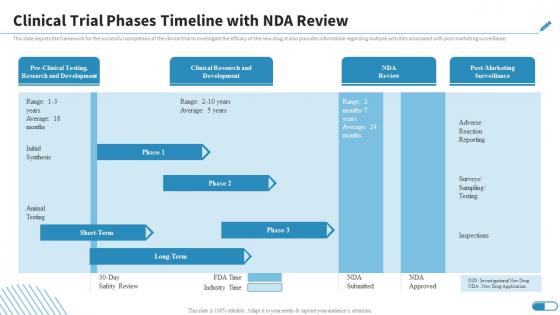
This slide depicts the framework for the successful completion of the clinical trial to investigate the efficacy of the new drug. It also provides information regarding multiple activities associated with post marketing surveillance.
People who downloaded this PowerPoint presentation also viewed the following :
Clinical Trial Phases Timeline With NDA Review Research Design For Clinical Trials with all 6 slides:
Use our Clinical Trial Phases Timeline With NDA Review Research Design For Clinical Trials to effectively help you save your valuable time. They are readymade to fit into any presentation structure.





FAQs for Clinical Trial Phases Timeline With NDA Review Research Design
So clinical trials have four phases and they drag on forever, honestly. First up is Phase I - just 20-100 people testing if it's safe, takes like 6-18 months. Then Phase II checks if it actually works with 100-300 folks, usually 6 months to 2 years. Phase III is massive though - 300-3,000 people comparing your treatment to whatever's standard, and that's 1-4 years right there. Phase IV happens after FDA approval to catch long-term issues. The whole thing? 10-15 years total. No wonder drugs cost a fortune. Oh and definitely pad your timeline - recruiting participants always takes way longer than anyone thinks it will.
Ugh, regulatory approvals are honestly the worst bottleneck you'll hit. FDA reviews take forever - 30 days minimum for an IND, but complex stuff? We're talking 6-12 months easy. Your trial design and how weird your treatment is definitely matters for timing. And don't even get me started on when they send back questions or want changes - that's months more right there. I learned this the hard way on my last project. Start early with pre-submission meetings so you're not blindsided. Buffer time is your best friend here, trust me.
Ugh, recruitment is the worst part honestly. Your criteria might be too strict - casting a wider net usually helps. Bad site choices will kill you, and if investigators aren't properly trained, forget it. Competition is brutal too since everyone's going after the same patients. Doctors don't always know about your study, which is frustrating. Patients worry about safety stuff and whether they'll have to travel constantly. Time commitment scares people off more than you'd think. I'd say plan for way longer than you expect and have backup sites lined up just in case.
Complex diseases are such a pain for trial timelines. You'll need way more participants and longer follow-up periods to get decent data. Like, an infection study wraps up in months, but Alzheimer's or cancer trials? Years. The disease moves slowly so you're stuck waiting to see if people's cognition improves or they survive longer. Sample sizes have to be huge too since there's so much biological variability to cut through. Honestly, whatever timeline you're thinking for your next complex disease study - just double it. I learned this the hard way.
Your ethics committee will probably add 2-6 weeks to the timeline, but honestly you can't skip it. They have to approve everything before you enroll anyone - your protocol, consent forms, all that stuff. Monthly meetings are pretty common (seriously annoying if you just miss one). Rolling reviews exist too though. Here's the thing - submit everything complete from the start because incomplete apps basically reset your wait time. Oh, and definitely contact their coordinator early to figure out their specific requirements and meeting dates. Trust me, that planning ahead will save you so much hassle later.
Look, trial duration is basically where your budget goes to die. Every extra month means paying for sites, staff, patient monitoring - all that overhead just keeps piling up. A 3-year trial that stretches to 5? You're looking at potentially double the costs, which honestly makes me wonder why more companies don't invest harder in patient recruitment upfront. Then there's the market timing issue - delays mean you're losing revenue while competitors might be gaining ground. The worst part is when everything falls apart in late-stage trials after you've already burned through years of investment.
Adaptive trials are your best friend - you can tweak protocols mid-study instead of starting over. Also start manufacturing during Phase II, don't wait around. Rolling submissions let the FDA review pieces as you finish them rather than dumping everything at once. Patient recruitment always kills timelines though, so digital outreach and decentralized trials are worth the investment. Master protocols testing multiple treatments simultaneously save tons of time too. Oh and honestly? Map out your regulatory strategy super early and get those pre-submission meetings scheduled. Saves you from nasty surprises down the road.
So AI is basically revolutionizing how clinical trials work right now. Patient recruitment used to take forever, but now you can scan electronic health records automatically to find eligible people. Remote monitoring is a game changer too - patients wear devices that track everything, so way fewer clinic visits. The real-time data thing is probably my favorite part though, because you're getting insights as they happen instead of waiting around for months. Oh, and you can actually tweak protocols mid-study when you spot issues early. Definitely check out some digital engagement platforms if you're planning anything soon.
Data quality problems are the absolute worst - missing info, protocol mess-ups, inconsistent entries that need fixing before you can even touch the analysis. Plus all those regulatory hoops and endless revisions to stat plans (seriously, weeks down the drain). Getting biostats, clinical, and regulatory on the same page? Good luck with that. Oh, and software crashes at the worst times obviously. Resource constraints don't help either. Honestly, just pad your timeline like crazy from the start and get your data management rock solid early. Trust me on this one.
Ugh, global expansion? Yeah, that's gonna tack on like 6-12 months easy. Different countries = different approval hoops to jump through. You're basically starting over with local ethics committees in each spot. Plus translated docs, local investigators, region-specific safety stuff - it never ends. Honestly the paperwork will crush your soul, but the patient pool makes it worth it once you get rolling. Oh and enrollment speeds up too. Start your regulatory stuff early though, and maybe grab some local CROs who actually know what they're doing in each region.
Honestly, it's brutal how long this stuff takes. Patients are literally waiting years while better treatments exist but can't get approved yet. Phase III trials drag on for 2-4 years if you're lucky - and let's be real, nothing ever goes smoothly in clinical research. Then the FDA tacks on another 6-12 months minimum just for review. Meanwhile your patients are stuck with whatever standard treatment exists today. It sucks, but compassionate use programs are sometimes the only way to get access early. Worth pushing for when it makes sense.
Look, it's all about keeping people actually invested in your study instead of just showing up because they have to. Regular check-ins and updates make a huge difference - nobody wants to feel forgotten. Set up reminder systems and maybe patient portals so they can stay in the loop. Honestly, convenience is everything here. If you make participation feel worthwhile rather than like a chore, dropout rates plummet. Communication is key though. When people feel heard and valued, they'll stick around and actually show up on schedule, which keeps your whole timeline from going sideways.
Look, diverse patient groups totally change your trial timeline and data quality. You'll get way better results showing how treatments actually work across different populations - regulators love seeing that. The downside? Recruiting takes forever since you're casting a wider net, and some groups drop out more often. I learned this the hard way on my last study. But skipping diversity bites you later when the FDA wants more data or additional studies. Better to plan that outreach strategy from day one. Short-term pain, long-term gain kind of thing.
Drug trials are such a pain - you're looking at 10-15 years vs maybe 3-7 for devices. The whole Phase I, II, III thing drags everything out, plus all that pharmacokinetic data collection. Devices are more straightforward since they don't get metabolized (implants are different obviously). Honestly, drug trials hit way more regulatory roadblocks and manufacturing gets complicated fast. My advice? Start those planning conversations super early. Oh, and combination products that mix both? Those'll make your head spin with the timeline complexity.
Hey! So there's actually some pretty cool stuff happening with trials right now. Decentralized trials are huge - patients don't have to trek to sites constantly, which speeds up recruitment like crazy. AI's getting scary good at finding the right patients and predicting which sites will actually deliver (some of these tools honestly blow my mind). Adaptive designs are probably the biggest win though - you can tweak protocols mid-study instead of being locked in. Oh, and regulators are way more open to real-world evidence now, so you might not need those monster Phase III studies. Definitely worth exploring for your next trials since the old-school approach is looking pretty dated.
-
I was mind-blown by the services that SlideTeam provided me. Thanks a ton!
-
I am a big fan of their newsletters because that is how I found my perfect requirement at the time of urgency. Thank God, I kept opening those.