


Clinical Trial Phases Powerpoint Presentation Slides




Try Before you Buy Download Free Sample Product
 Impress Your
 Audience
 100%
100% Editable
 Save Hours
 of Time


Clinical trial phases involve various steps that are followed to ensure the safety and efficacy of the newly developed drug by testing it on targeted individuals in a controlled environment. Check out our efficiently designed Clinical Trial Phases PowerPoint template. In this presentation, we have covered the process flow of clinical trial phases along with significant milestones. It also includes primary and secondary goals, number and type of patients, dosage details, and outcomes of each corresponding phase of the clinical trial. This PPT also covers graphs through which the success rate of the trial and the cost involved in each phase can be visually represented. Build a powerful template like this for yourself and book a free demo with our research team now.
People who downloaded this PowerPoint presentation also viewed the following :
Content of this Powerpoint Presentation
Medicine that you and I take are made by businesses that have to ensure phased-clinical trials of these before launch into the market. The aim of the clinical, over multiple phases, is to ensure safe and data-based clearance of a new treatment, drug or surgical device. These trials test whether the new solutions are safe and effective.
The clinical trials, however, are meant to test the drug over the long haul and human health is involved. The drug is, thus, first tested in the lab, then on a small group of people, and eventually on a larger group. The whole process can take years and cost a lot of money.
As part of the research team, you may need to present data on different aspects of the trial. For example, all the people involved need to know the goals, processes, and tests that will be conducted throughout the clinical trial. This is where our clinical trial phase PPT comes into the picture.
Our pre-designed and content-ready clinical trial templates can be used at any stage of the trial. For example, you can use the PPT to provide sponsors with progress reports. Or you can use it to share findings with the authorities. It can also help potential participants make informed decisions.
If you are looking to secure funding for your clinical trial, consider using our customizable communication and budget slide in your PPT. You can present budget and communication details for each clinical trial stage.
Clinical Trial Phases Template
Our clinical trial template can be used at any stage of the trial. We have used a mix of tables, pie charts, funnels, bar charts, and sequential flows to keep the findings organized while maintaining audience engagement. You can add or remove slides, edit the color scheme and graphics, and include relevant content.
If you want to help your peers in the medical sector who wish to learn more or participate in such research studies, use our clinical trial guidelines template. The slide includes instructions using which you can personalize it to your area of study.
Let’s explore!
Template 1: Milestones
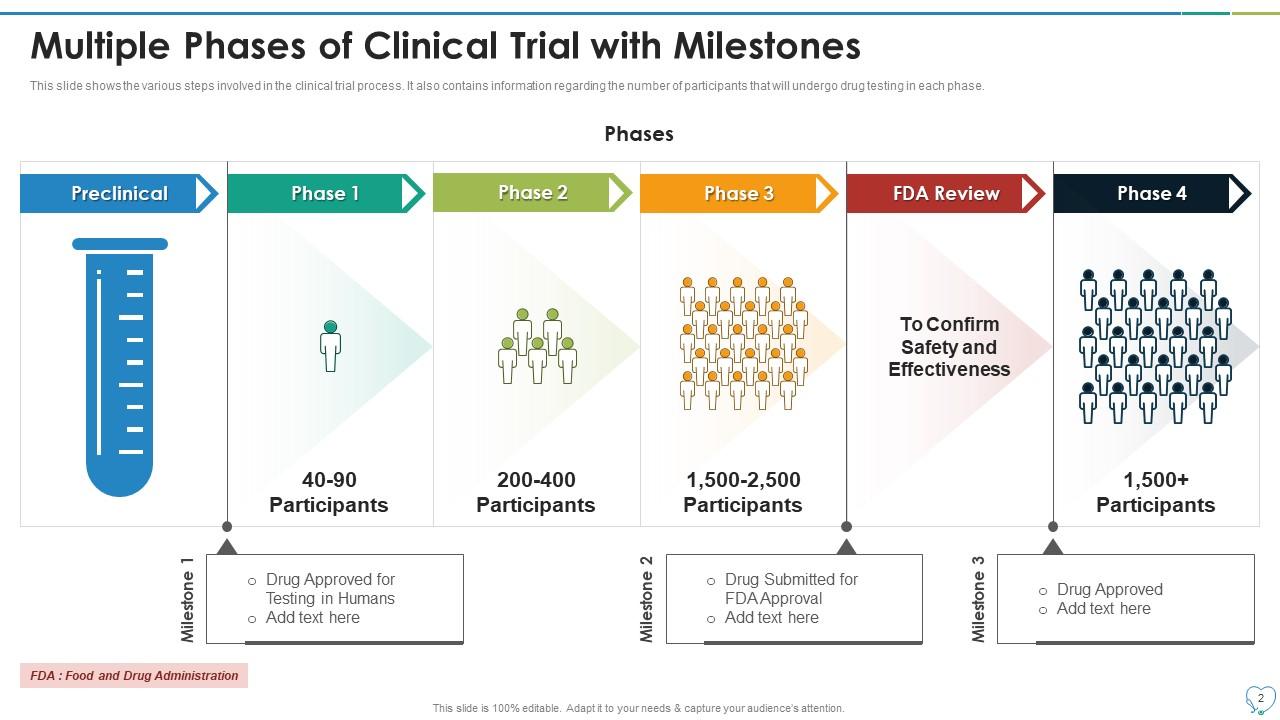
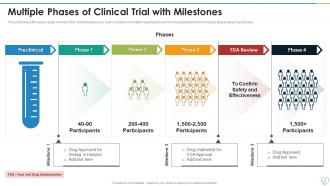
The milestones slide provides a high-level view of the clinical trial process and milestones. The slide uses a timeline design to present the stages in the trial. These stages are preclinical, phase 1, 2, and 3, FDA review, and phase 4. You can add the number of participants involved in each phase. Lastly, you can add specific milestones at the end of a phase. For example, we have mentioned milestones like drug approved for human testing and FDA approval. The content is kept to a minimum. The emphasis is one the milestones which can present with lists.
Template 2: Process Flow
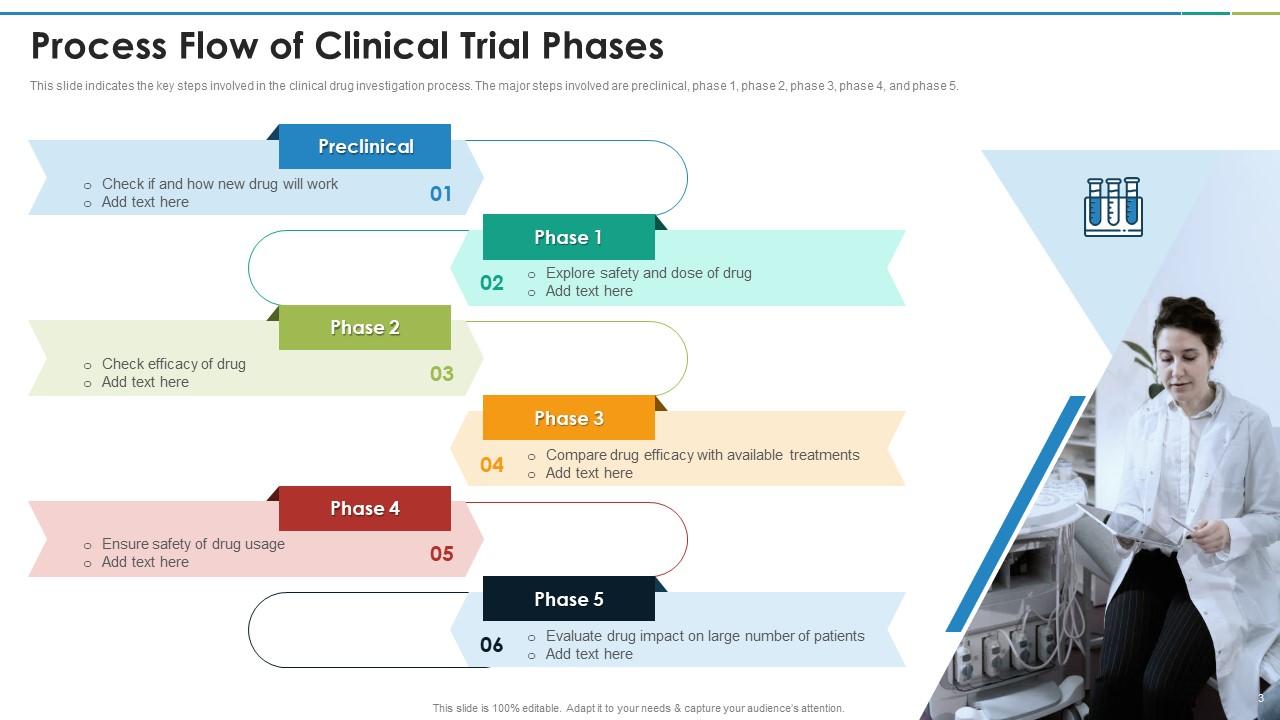
The process flow slide is where you can start elaborating on the clinical trial phases. For example, you can add the tests you will be conducting and the strategy and outcome. The slide uses a vertical roadmap design to present the phases. Each phase has a different color for easier distinction and understanding. You can add the content in a bulleted format list. The milestone slide is all about achieving goals, and the process flow slide tells the audience how you plan to achieve those goals.
Template 3: Objective and Timeline
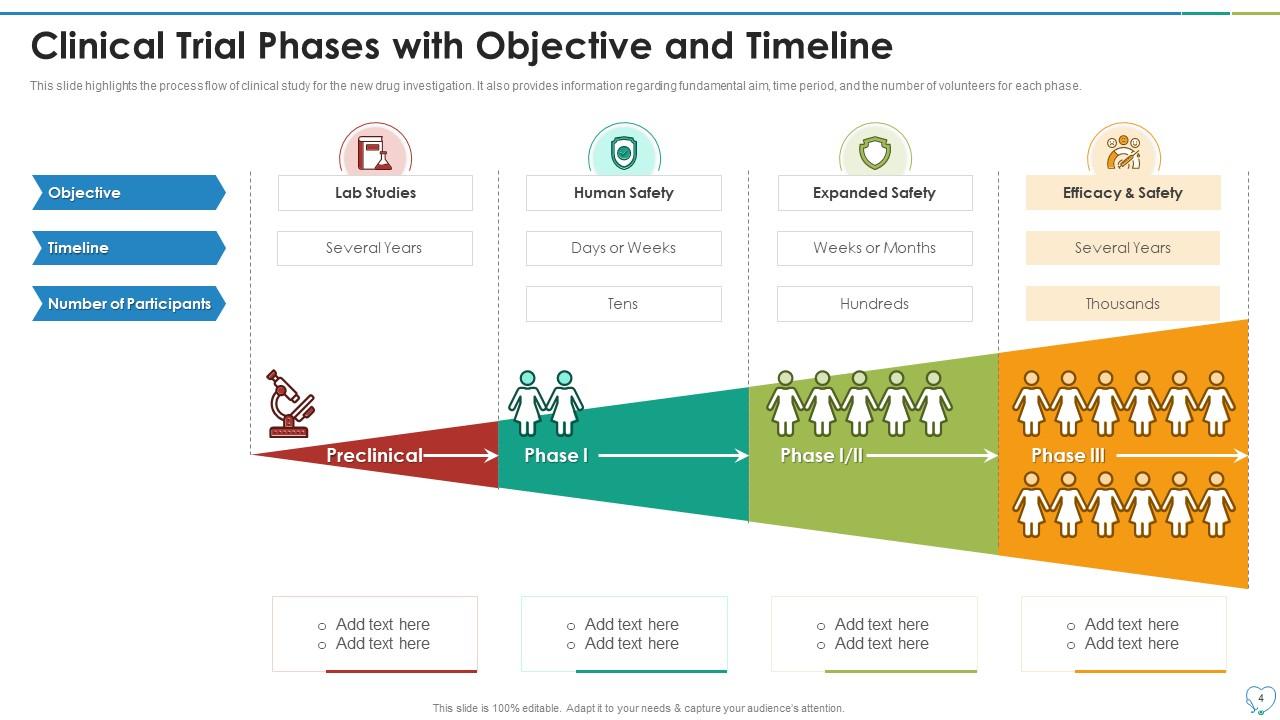
The slide focuses on three attributes of each phase. They are objective, timeline, and number of participants. The design lets the viewers know the later phases will take longer to complete. There are text boxes available at the bottom of the slide which you can use to add relevant details.
Template 4: Outcomes

As the name suggests, the slide lets you list the outcome of each clinical trial phase. For example, the percentage of drugs moving to the next phase or the rate of efficacy achieved. The milestone and outcome slides answer the same question in their own ways.
The milestones provide a high-level view, the outcome slide is more descriptive. We have used four vertical text boxes with labels, colors, and icons for the phases. The text boxes take up most of the slide, so you have enough space to present your findings.
Template 5: Review and Approval Process
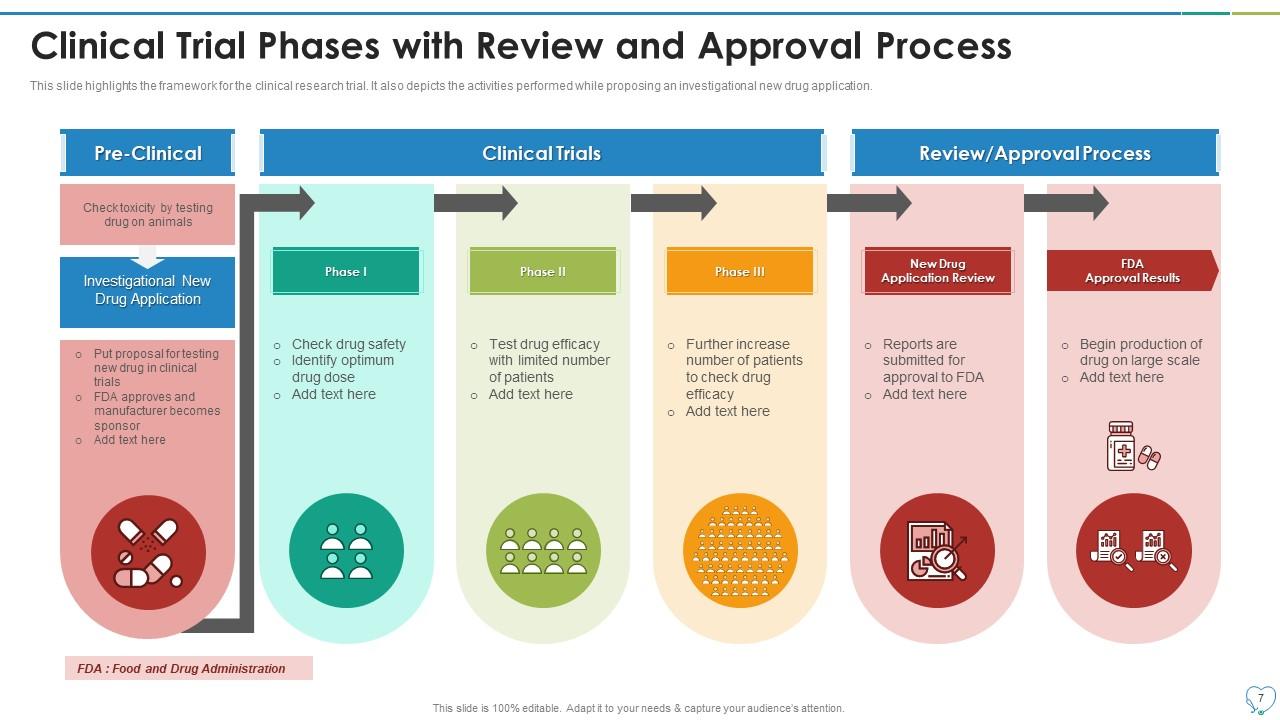
New drugs and treatments are reviewed by regulatory bodies and ethics committees. The exact process may differ from one country to another. You can use this slide to provide details about the approval process. We have used a sequential flow design to show the process. The three main sections are preclinical, clinical trials, and review. You can add content about the type of testing and results expected. We have used graphics to show the number of participants, review process and reports to make the viewing experience interesting. You can customize the content and graphics to suit your research results.
Template 6: Discovery Science
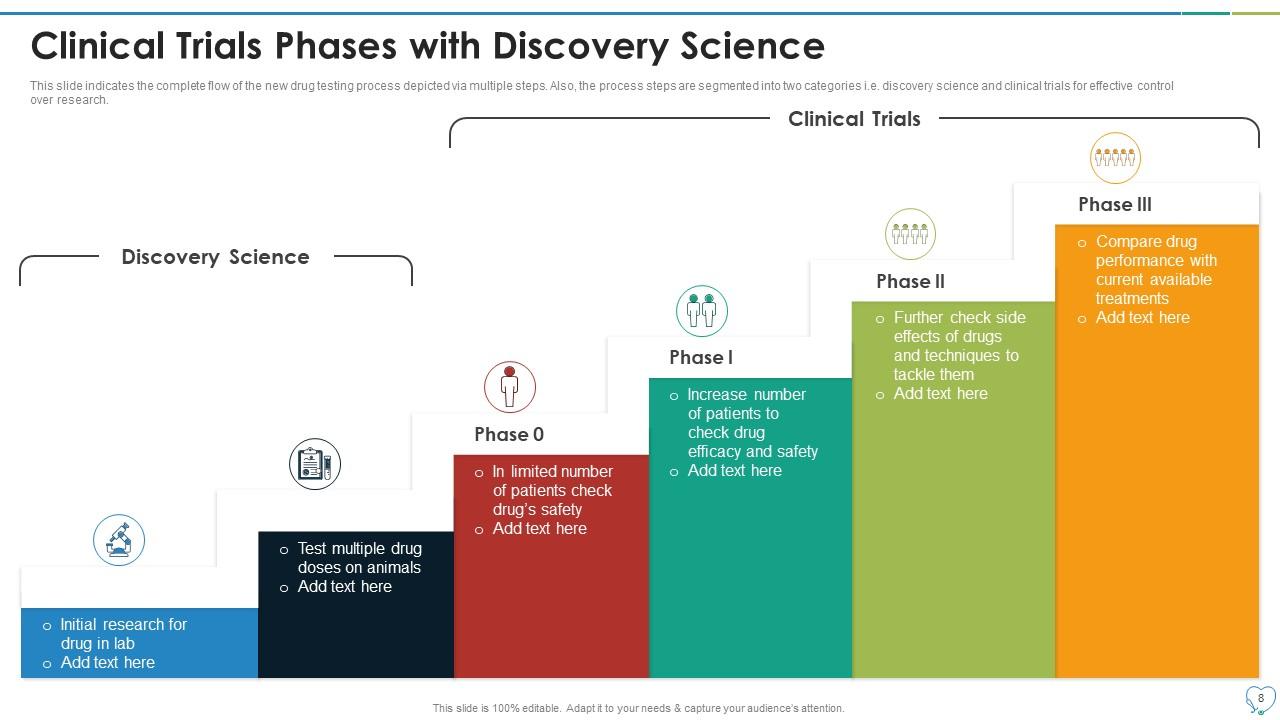
Discovery science is the process of finding new information through experimental data. For example, the initial phases of drug testing will be carried out in a lab and then on animals before it will be approved for human testing. In medicine, these discoveries can help uncover new treatments for critical illnesses and reduce health costs. The slide lets you revisit the clinical trial phases along with discovery science. The phases are denoted by an ordered bar chart design with icons and headings. The individual bars double up as text boxes for your content.
Template 7: Participants Type
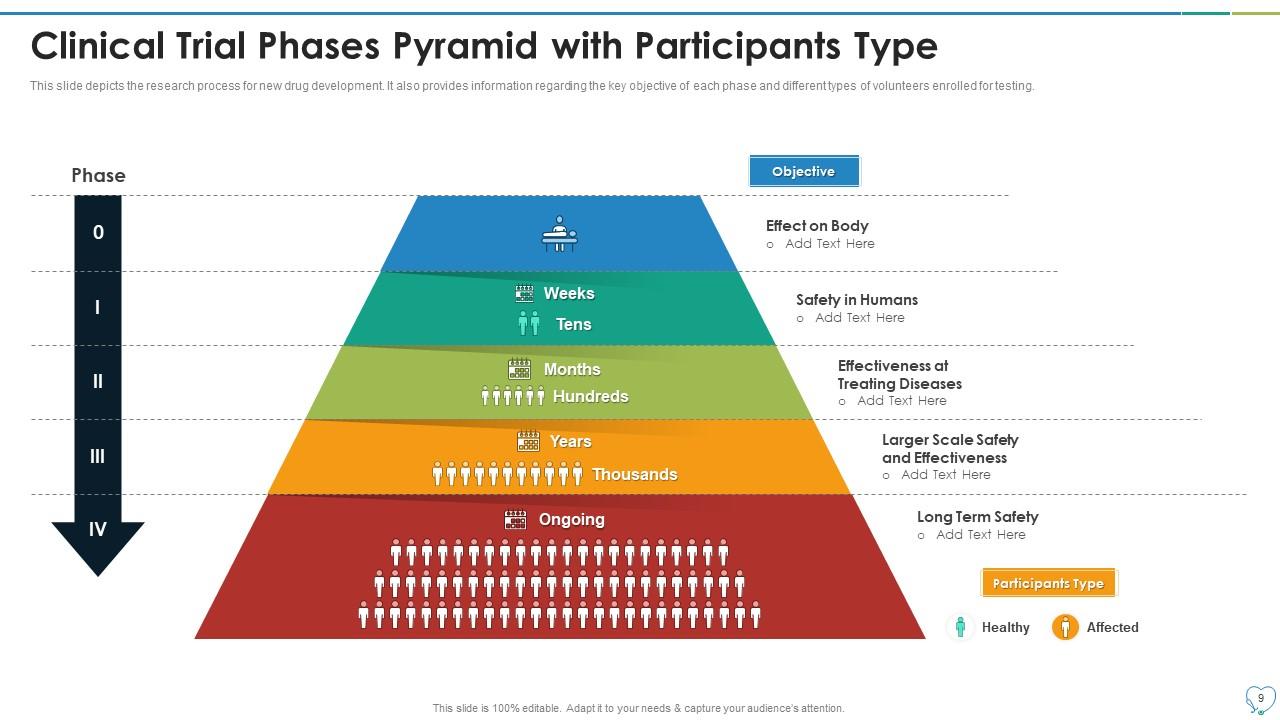
The slide is a graphical representation of the clinical trial phases, timeline, and objective, with the primary focus on participants. The main element of the slide is the pyramid at the center. It shows the number of participants required and the timeline of each stage. On the left-hand side, you will see an arrow graphic showing the phases. On the right-hand side, you can mention the desired outcome in relation to the participants. When added to PPTs, visual slides like this can give viewers a welcome break from content overload. It can also make complex topics easier to understand.
Template 8: Licensing
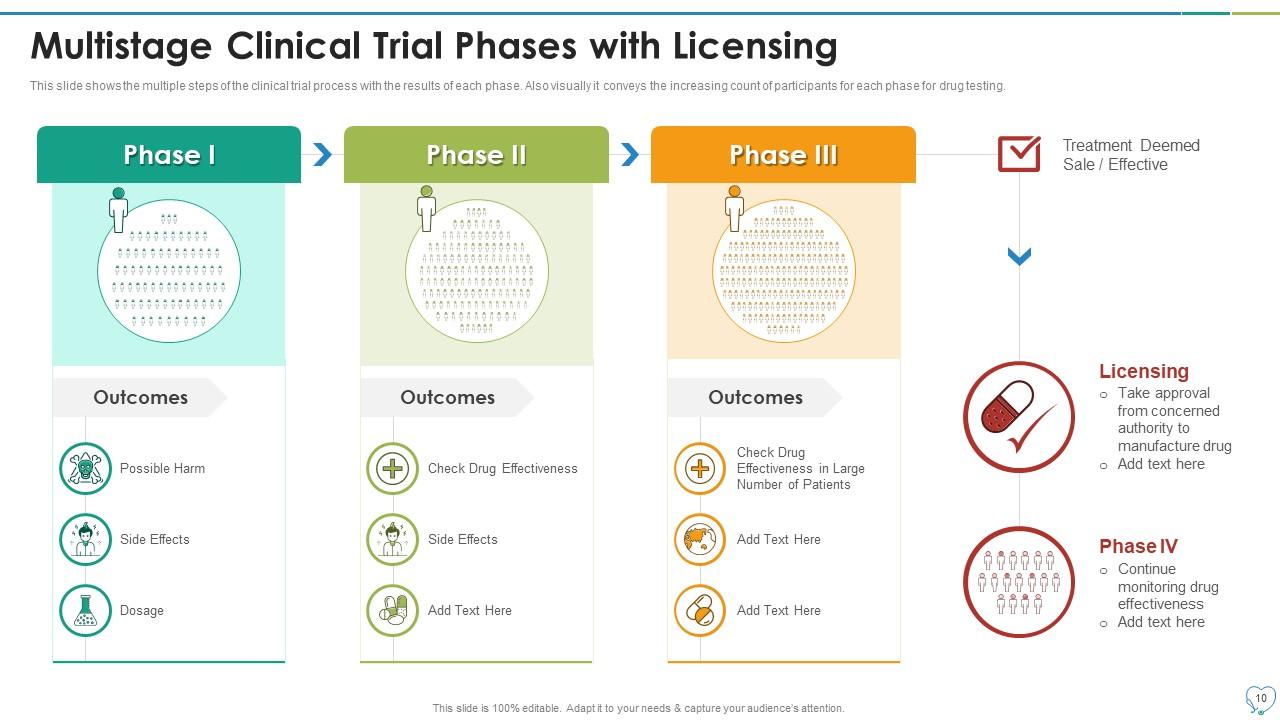
Depending on the regulatory bodies involved, every new treatment or drug must go through a licensing process. This is where the outcome of each phase is reviewed, and the authorities decide if the drug is safe for the population. The slide helps you list the drug's effectiveness, side effects, and dosage in each phase. You can explain the licensing process and when you can start manufacturing. A timeline flow with a mix of descriptive icons and lists is used for clear communication.
Template 9: Drug Compound
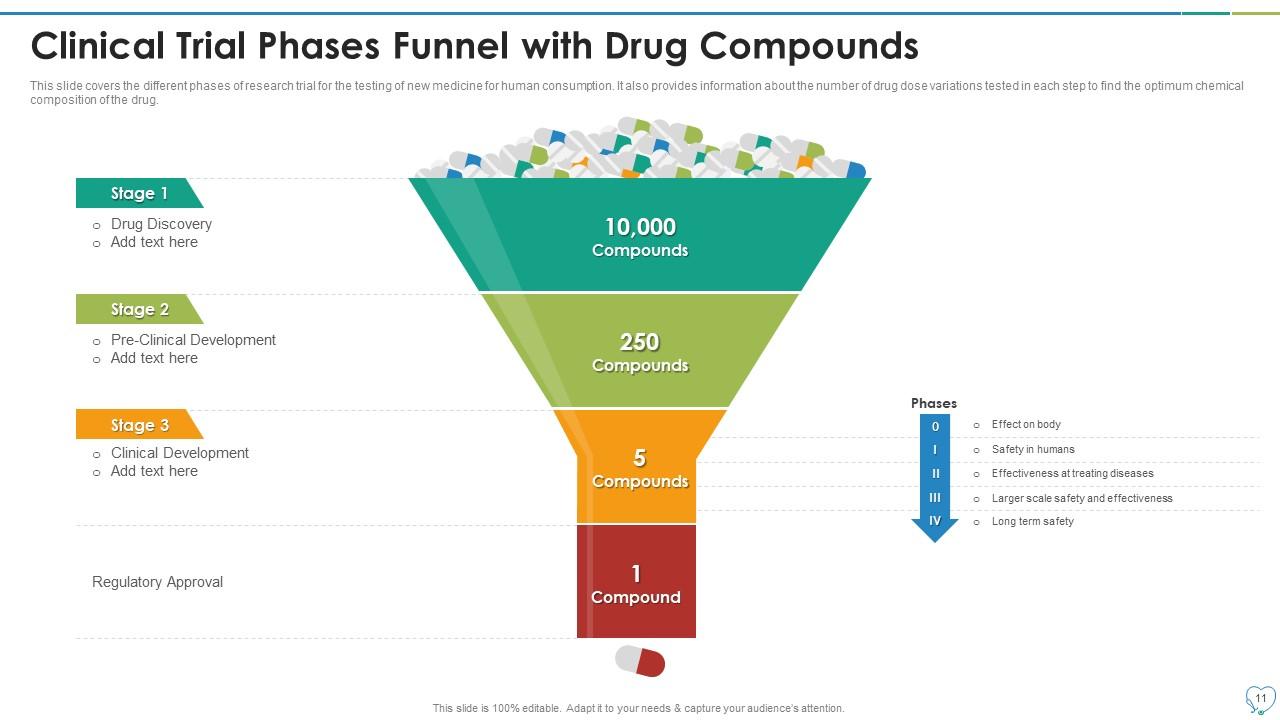
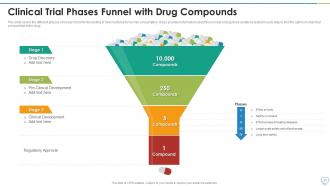
Drug compounds are tested for safety, dosage, and efficacy in a clinical trial. Looking at data from the FDA, during research, about 70% of compounds move from phase 1 to 2. But when it comes to phases 3 to 4, only 25 to 30% of drugs make the cut. You can present this data in the form of a funnel. The funnel is color-coordinated with the phases. You can mention the number of compounds that make it through each phase. You can add text to the left-hand side of the funnel, but the slide design moves towards a data visualization approach.
If you are looking for an alternative drug compound design, here is a template for your reference. You will also receive instructions on how to edit the slide to suit your clinical trial findings.
Template 10: Participants Required
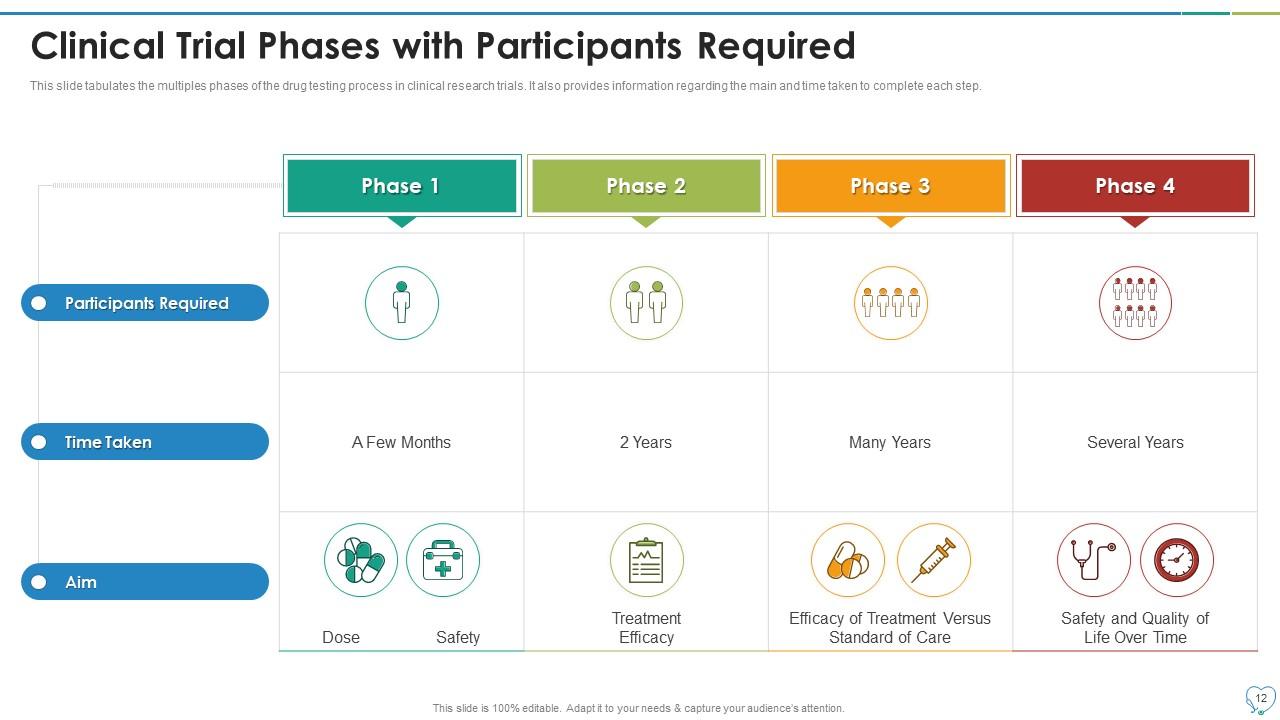
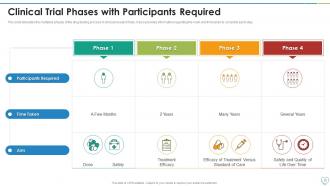
Use this PPT Template to elaborate on the participants required, the time taken, and the aim for each clinical trial phase. For example, the initial testing will be done on tens of participants for a few months. In contrast, the later phases will involve thousands of participants who will be studied over the years. You can present the data neatly using tables. Again, the text content is kept to a minimum while the focus is on graphical representation. The participants and aim details are represented with icons. As the slides are editable, you can change the graphics and include other icons as required.
A Complete Visual Aid for Clinical Trial Phases
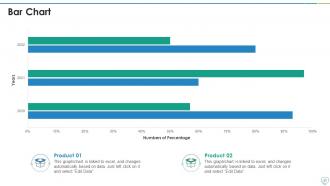
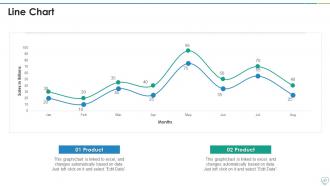
Our clinical trial phases PPT cover different aspects of the trial. These include objectives, timeline, cost, participants, processes, and reviews. You can use the PPT for sponsor and participant awareness, updates, or to present findings. The phases are color-coordinated throughout the PPT. We have used a mix of tables, funnels, charts, and timeline flows to present data. You can customize the slides according to your research findings. We provide additional slides complete with charts and Venn diagrams that can help you present supplementary topics.
Clinical Trial Phases Powerpoint Presentation Slides with all 59 slides:
Use our Clinical Trial Phases Powerpoint Presentation Slides to effectively help you save your valuable time. They are readymade to fit into any presentation structure.
-
Clinical Trial Phases
-
Multiple Phases of Clinical Trial with Milestones
-
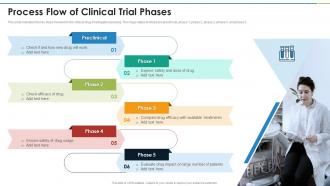
Process Flow of Clinical Trial Phases
-
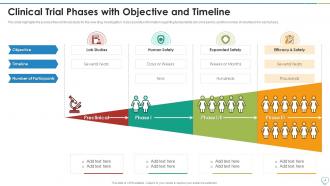
Clinical Trial Phases with Objective and Timeline
-
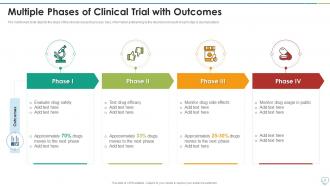
Multiple Phases of Clinical Trial with Outcomes
-
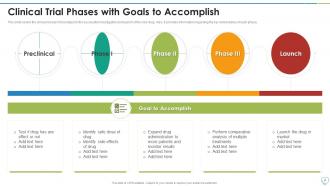
Clinical Trial Phases with Goals to Accomplish
-
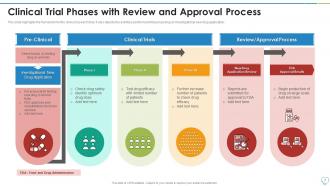
Clinical Trial Phases with Review and Approval Process
-
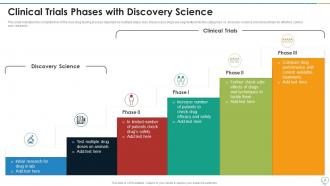
Clinical Trials Phases with Discovery Science
-
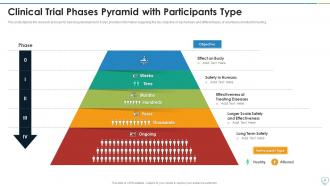
Clinical Trial Phases Pyramid with Participants Type
-
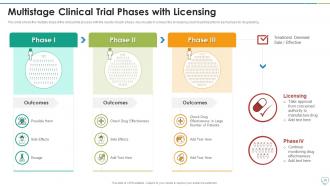
Multistage Clinical Trial Phases with Licensing
-
Clinical Trial Phases Funnel with Drug Compounds
-
Clinical Trial Phases with Participants Required
-
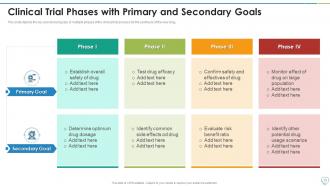
Clinical Trial Phases with Primary and Secondary Goals
-
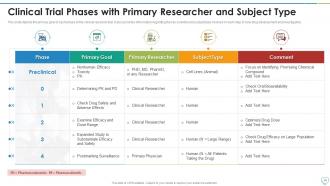
Clinical Trial Phases with Primary Researcher and Subject Type
-
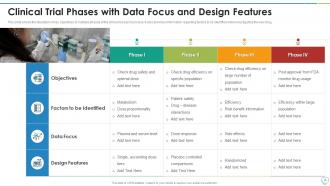
Clinical Trial Phases with Data Focus and Design Features
-
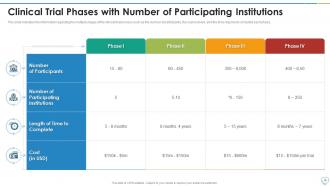
Clinical Trial Phases with Number of Participating Institutions
-
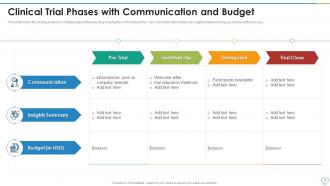
Clinical Trial Phases with Communication and Budget
-
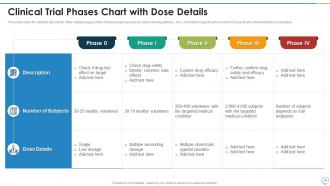
Clinical Trial Phases Chart with Dose Details
-
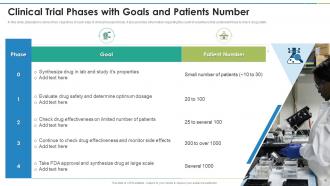
Clinical Trial Phases with Goals and Patients Number
-
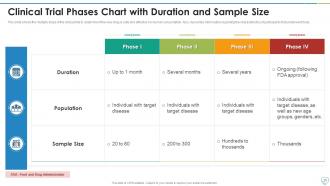
Clinical Trial Phases Chart with Duration and Sample Size
-
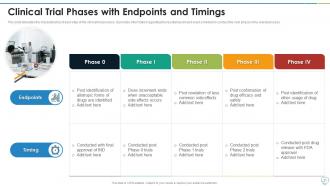
Clinical Trial Phases with Endpoints and Timings
-
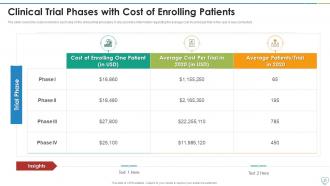
Clinical Trial Phases with Cost of Enrolling Patients
-
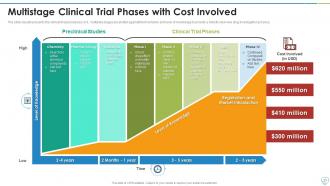
Multistage Clinical Trial Phases with Cost Involved
-
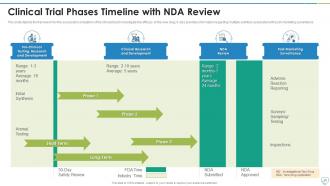
Clinical Trial Phases Timeline with NDA Review
-
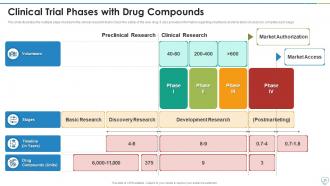
Clinical Trial Phases with Drug Compounds
-
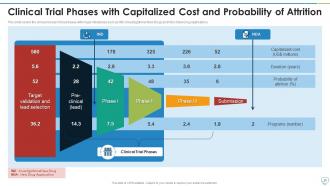
Clinical Trial Phases with Capitalized Cost and Probability of Attrition
-
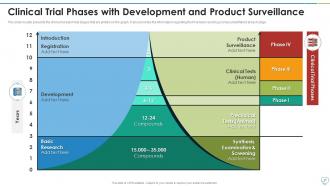
Clinical Trial Phases with Development and Product Surveillance
-
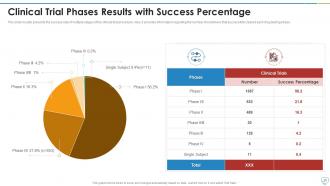
Clinical Trial Phases Results with Success Percentage
-
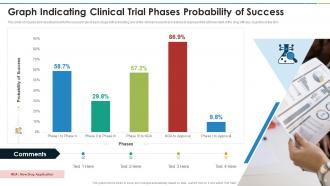
Graph Indicating Clinical Trial Phases Probability of Success
-
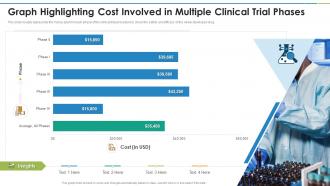
Graph Highlighting Cost Involved in Multiple Clinical Trial Phases
-
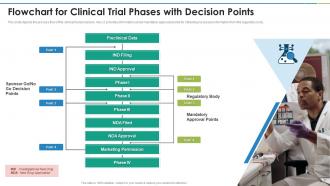
Flowchart for Clinical Trial Phases with Decision Points
-
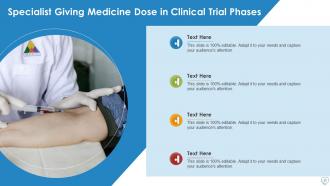
Specialist Giving Medicine Dose in Clinical Trial Phases
-
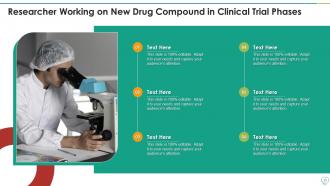
Researcher Working on New Drug Compound in Clinical Trial Phases
-
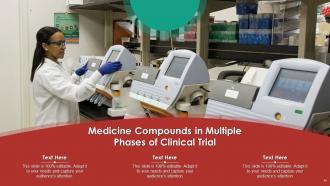
Medicine Compounds in Multiple Phases of Clinical Trial
-
Clinical Trial Phases Conducted by Technician in Laboratory
-
Drug Specialist Working with Microscope in Clinical Trial Phases
-
Clinical Trial Phases Performed by Pharmacist
-
Clinical Trial Phases Depicted Via DNA and Patients
-
Phase Endpoint Report of New Drug in Clinical Trial
-
Medical Reports with Injection for Clinical Trial Phases
-
Microscope with Medical Solution in Clinical Trial Phases
-
Clinical Trial Phases Poster with Medicines and Health Monitor
-
Icons Slide for Clinical Trial Phases
-
Additional Slides
-
About Us
-
Our Mission
-
Our Team
-
Timeline
-
30 60 90 Days Plan
-
Post it Notes
-
Venn
-
Bar Chart
-
Line Chart
-
Thanks for Watching
-

-

-

-

-

FAQs for Clinical Trial Phases
So there are four phases to clinical trials, each one getting bigger and more intense. Phase I is small (like 20-100 people) and they're basically figuring out if it'll kill you and what dose to use. Phase II brings in 100-300 people to see if the thing actually works while still watching for side effects. Then Phase III goes big - we're talking thousands of people comparing the new treatment to whatever's already out there. Honestly, this is where they prove it's better than current options. Phase IV happens after FDA approval to catch any weird long-term stuff. If you're thinking about joining one, definitely ask which phase because that tells you everything about what you're signing up for.
So there's actually a ton of safety stuff built into trials. IRBs have to approve everything upfront, and participants get detailed consent forms so they know what they're getting into. Trials also have strict rules about who can join, plus safety monitoring boards watching everything. Honestly, the paperwork alone is insane - any bad reaction gets documented and reviewed right away. Most studies have committees that can literally shut things down if something looks sketchy. Oh, and the participant's safety always comes first over the research goals, which is good obviously. Just make sure you understand the stopping rules before anyone enrolls.
So inclusion criteria - age range, disease stage, biomarkers, whatever fits your study goals. For exclusions, focus on safety stuff like pregnancy, bad comorbidities, meds that'll mess with your intervention. Also boot anyone who can't consent properly or follow protocol. Here's the thing though - be specific enough to get your target group but not so narrow you can't actually find people. I've seen studies die because criteria were too strict. Oh, and definitely loop in your biostatistician early to check if your numbers make sense for recruitment.
So basically you walk them through all the study details - risks, benefits, what else they could do instead. Give them time to think it over without being pushy about it. They sign forms that explain everything in normal language (nobody wants to decode medical speak). Keep the original, give them a copy. Oh and here's something that trips people up - if you change the protocol later, you've got to get their consent again. I always write down our conversations in my study notes too, just covers your bases. The paperwork part is honestly pretty simple once you get the hang of it.
So basically you need placebo groups to prove your treatment actually does something beyond just the mind game stuff. The placebo effect is crazy strong - like people genuinely feel better just thinking they're getting medicine. Your control group gets fake pills that look exactly like the real ones, then you compare results. Otherwise you're just guessing if your drug works or if it's all psychological. I mean, without that comparison you can't really separate cause from correlation, you know? Just make sure the fake treatment looks identical or people will catch on.
So power analysis is how they figure out sample sizes - you're basically juggling four things: effect size, statistical power (usually 80-90%), significance level (typically 0.05), and how much variability you expect. Honestly, it's pretty subjective when you're guessing effect sizes from sketchy prior data. Don't forget dropout rates because people bail on studies constantly. The real trick? Focus on what actually matters clinically, not just what'll show up statistically. Oh and definitely pad your numbers for dropouts - learned that one the hard way!
So there are three big ones: RCTs, cohort studies, and case-control studies. RCTs randomly split people into treatment vs control groups - they're considered the best for proving something actually causes an effect. Cohort studies track groups over time to see who gets sick. Case-control studies flip it around, starting with people who already have the disease and looking back at what might've caused it. Honestly, everyone obsesses over RCTs but cohort studies are underrated for tracking long-term stuff. My advice? Figure out if you need to prove causation first - that'll basically tell you which design to pick.
So once your trials are done, you send everything to the FDA - all your data, safety stuff, how you make the drug, everything. Usually takes 6-12 months for them to decide. Breakthrough treatments can move faster though, which is nice when people really need it. Honestly the waiting is brutal for companies. They might approve you, ask for more info, or just say no. Oh and definitely plan for delays - I swear these reviews never go as smoothly as you think they will. Always build in extra time.
Honestly? Finding people is brutal. Everyone's crazy busy and half of them bail halfway through because they're scared of side effects or just don't trust researchers anymore - can't really blame them. Location kills you too. If someone has to drive 3 hours each way, they're out. People drop out constantly. The treatment feels like too much work, they don't see results fast enough, or life happens. Building real relationships with participants helps though. Make everything as easy as possible - remote check-ins, flexible appointments, whatever it takes to keep them around.
So basically, clinical trials are great for showing if a drug works under perfect lab conditions, but real-world evidence shows what actually happens when regular doctors prescribe it to regular patients who forget doses and have other health issues. RWE catches long-term side effects and tells you how different age groups or ethnicities respond - stuff that controlled trials miss. Honestly, trials are still needed for FDA approval and all that, but RWE is where you see if treatments actually help people in practice. Both have their place, you know?
EDC systems basically killed off paper forms - way more accurate and efficient now. Wearables and health apps are everywhere, which is actually pretty cool because you get continuous data instead of just appointment snapshots. AI's getting good at catching data quality issues before they blow up. Cloud platforms handle everything from finding patients to regulatory stuff. Oh, and remote monitoring is worth looking into - saves money and the data quality is usually better. Honestly, the whole industry's moving so fast it's hard to keep up sometimes.
Oh man, so when bad stuff happens during trials, documentation is everything - literally drop what you're doing and write it all down. Serious events? You've got 24-48 hours to report to regulatory folks, which is honestly pretty stressful. The tricky part is figuring out if it's actually from your treatment or just random bad luck (sometimes you'll never know for sure). You'll assess how severe it is, maybe pull the participant if needed, and update all your safety reports. Trust me, set up your reporting systems way ahead of time because scrambling mid-crisis is the worst.
Your trial results literally shape everything that happens next in medicine. Good data fast-tracks FDA approval and gets insurance companies on board. But honestly? Failed trials might be even more valuable - they kill awful drugs before companies waste millions more. I've seen one solid study completely flip treatment guidelines overnight, which is pretty insane when you think about it. The data also feeds into future research designs and safety protocols. Just crazy how much weight these studies carry. So yeah, no pressure, but you're basically laying groundwork for patient care that could last decades.
Cultural stuff is huge for trial participation. Trust issues run deep in some communities - and honestly, they're not wrong to be skeptical given the history. Language barriers are obvious, but it goes way beyond just translation. Different communication styles matter. Some cultures need whole family buy-in for medical decisions, others have religious concerns about specific treatments. I'd definitely connect with community leaders super early in your planning. They know what'll actually work for outreach versus what just looks good on paper. Way more effective than trying to figure it out yourself later.
It's really about the money and motives. Pharma companies fund industry trials to get their drugs approved - they want that FDA stamp fast. Government trials? They're more interested in pure science, like comparing treatments or studying weird rare diseases nobody profits from. Industry ones usually have way bigger budgets and move quicker, which honestly makes sense. But government-funded studies are typically more open with their data. Both can be legit research - just depends what question they're trying to answer. Always peek at who's writing the checks though, because that totally shapes how they design the whole study.
-
Kudos to SlideTeam for achieving the high success rate in delivering the top-notch slides.
-
SlideTeam is the best in the business. Their templates are engaging and customizable. You can rely on them.