


Clothing Brand Business Plan Powerpoint Presentation Slides




Try Before you Buy Download Free Sample Product
 Impress Your
 Audience
 100%
100% Editable
 Save Hours
 of Time


A clothing store business is a place where clothing related to men, women, and children is sold. The store follows urban casual wear, western wear clothing, and traditional wear clothing. Check out our efficiently designed Clothing Brand Business Plan PowerPoint Presentation. The presentation covers details regarding the company executive summary, the quick pitch providing information about the business, the clothing market, and the opportunities available with the business. It displays the key to success factors, mission, vision, and the start-up summary, including all the necessary expenses. The business plan document exhibits the growth potential analysis, including SWOT analysis and Porters five force analysis model, customer analysis, and market sizing, including TAM, SAM, and SOM. The presentation also has an offline and online marketing strategy, and sales funnel for customer retention. The financial summary includes the basic assumptions which are used for estimating the future, scenario analysis showing nominal, optimistic, and pessimistic cases, profit and loss statement, cash flow statement, balance sheet, and providing a DCF valuation model for the business after five years with a graphical representation of all the three financial statements. Get access now.
People who downloaded this PowerPoint presentation also viewed the following :
Content of this Powerpoint Presentation
Slide 1: This slide displays the title Clothing Brand Business Plan.
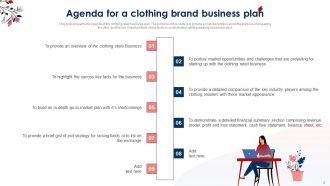
Slide 2: This slide displays the title Agenda for a clothing brand business plan.
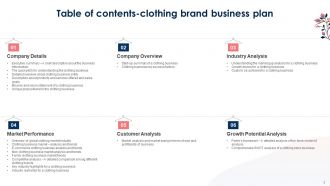
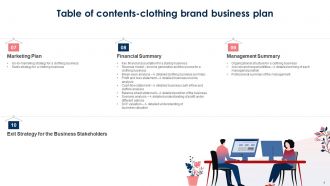
Slide 3: This slide exhibit table of content.
Slide 4: This slide exhibit table of content.
Slide 5: This slide exhibit table of content- Company Details.
Slide 6: This slide covers a brief glimpse of what the business will be offering to the customer with market information.
Slide 7: This slide covers a brief glimpse of what the quick pitch of the business to the customers with market information.
Slide 8: This slide provides a detailed information about the business’s incorporation, location, web-address, target market, and about the business.
Slide 9: This slide provides a list of products and services which the business will offer along with the revenue assumptions for the future growth of the business.
Slide 10: This slide provide a gist about the business mission and vision.
Slide 11: This slide provides a gist for the customers, why to buy products from the store.
Slide 12: This slide exhibit table of content- Company Overview.
Slide 13: This slide provides a gist of company start-up summary.
Slide 14: This slide provides a gist of company key to success.
Slide 15: This slide exhibit table of content- Industry Analysis.
Slide 16: This slide highlights the market gap which the industry is undergoing.
Slide 17: This slide also highlights the market gap which the industry is undergoing.
Slide 18: The business website plays an essential role in success.
Slide 19: This slide provides a detailed information about the business’s milestone, the business’s five year growth plan and it’s sales assumption to achieve.
Slide 20: This slide exhibit table of content- Market Performance.
Slide 21: This slide provides a glimpse of industry overview of the global clothing market.
Slide 22: This slide provides a glimpse of market overview concerning with the US clothing market, its growth, demand and future forecast.
Slide 23: This slide provides a glimpse of industry overview concerning with the US clothing e-commerce market, its growth, demand in future.
Slide 24: This slide provides a glimpse of industry overview concerning with the US clothing e-commerce market, its growth, demand in future.
Slide 25: This slide provides a glimpse of industry overview concerning with the women clothing market, its growth, demand in future.
Slide 26: This slide provides a glimpse of industry overview concerning with the family clothing market, its growth, demand in future.
Slide 27: This slide provides a competitive framework of clothing brand competitive analysis within the already existing market in the USA.
Slide 28: This slide provides a glimpse of industry highlights of the clothing market.
Slide 29: This slide provides a glimpse of industry highlights of the clothing market.
Slide 30: This slide provides a brief gist of industry restraints of the US clothing market.
Slide 31: This slide provides a brief gist of industry restraints of the US clothing market.
Slide 32: This slide exhibit table of content- Customer Analysis.
Slide 33: This slide provides a brief gist of customer analysis of the clothing store business.
Slide 34: This slide exhibit table of content- Growth Potential Analysis.
Slide 35: This slide provides detailed information on porter’s framework.
Slide 36: The slide highlights a swot analysis of the clothing business.
Slide 37: This slide exhibit table of content- Marketing Plan.
Slide 38: This slide provides a brief of go-to-marketing strategies which the company will follow to capture the market.
Slide 39: The user's enjoy worldwide purchasing experience is just as crucial as the previous point.
Slide 40: This slide provides a brief of sales strategies which the business will follow to retain and attract the customers.
Slide 41: This slide exhibit table of content- Financial Summary.
Slide 42: This slide represents financial assumptions of the clothing store business plan.
Slide 43: This slide presents revenue model of clothing retail business.
Slide 44: This slide represents breakeven graph.
Slide 45: This slide represents breakeven graph.
Slide 46: This slide represents profit and loss statement.
Slide 47: This slide represents graphs of gross profit of the business and earnings before interest tax & depreciation.
Slide 48: This slide represents graphs of total revenue from operations and earnings after tax.
Slide 49: This slide represents the business’s historical and forecasted cash flow results and the amount of cash the business will introduce to starts its operations.
Slide 50: This slide represents a graph on cash flow analysis and total assets.
Slide 51: This slide represents balance sheet statement.
Slide 52: This slide represents a graph on cash flow analysis and total assets.
Slide 53: This slide represents the different scenarios for deriving final annual profit after tax on the basis of best case, nominal case and worst case.
Slide 54: This slide presents a scenario analysis of annual revenue break-even, annual profit after tax and break-even analysis.
Slide 55: This slide represents the DCF valuation analysis of a business’s financials based on the free cash flow to firm.
Slide 56: This slide exhibit table of content- Management Summary.
Slide 57: This slide represents organizational structure of the business.
Slide 58: This slide represents organizational structure of the business.
Slide 59: The slide highlights the professional summary section of the café.
Slide 60: This slide exhibit table of content- Exit Strategy for the Business Stakeholders.
Slide 61: This slide represents exit strategy for stakeholders such as venture capitalists, private offerings and initial public offer.
Slide 62: This is the icons slide.
Slide 63: This slide presents title for additional slides.
Slide 64: This slide shows about your company, target audience and its client's values.
Slide 65: This slide shows details of team members like name, designation, etc.
Slide 66: This slide presents your company's vision, mission and goals.
Slide 67: This slide depicts posts for past experiences of clients.
Slide 68: This slide shows puzzle for displaying elements of company.
Slide 69: This slide exhibits column charts for different products.
Slide 70: This slide exhibits yearly profits stacked line charts for different products.
Slide 71: This slide showcase Our goal.
Slide 72: This is thank you slide & contains contact details of company like office address, phone no., etc.
Clothing Brand Business Plan Powerpoint Presentation Slides with all 77 slides:
Use our Clothing Brand Business Plan Powerpoint Presentation Slides to effectively help you save your valuable time. They are readymade to fit into any presentation structure.





FAQs for Clothing Brand Business Plan
Start with the basics - who's buying your stuff and how you'll beat competitors. Product details and pricing come next. Manufacturing is honestly the worst part because of those annoying minimums and wait times. Figure out if you're selling direct or through stores (maybe both?). Your financial projections need to cover 3 years - startup costs, inventory, cash flow, all that fun stuff. Don't make your numbers too rosy or you'll hate yourself later. I'd sketch out a simple one-page version first, then flesh it out once you know what actually works.
Okay so you really need to get specific about who's buying your stuff - like way more than just "women 25-35." What's their actual life like? Are they scrolling Instagram for outfit ideas or rushing between meetings? Income matters too. I know it sounds kind of weird, but literally make up fake customers with names and everything. Sarah the eco-conscious grad student vs. Michelle the busy mom, you know? Once you figure out 2-3 types, pricing becomes obvious. Same with where to advertise. Start by asking people you think would wear your clothes - even if it's just your sister's friends or whatever.
Start by stalking your competitors' prices and seeing who they're targeting on social. Then actually talk to people - Instagram polls work, or just ask friends what they hate about shopping for clothes. Fashion weeks are amazing for trend spotting but honestly pretty expensive if you're just starting out. I'd also check out those fashion forecasting reports (some are free online) and watch what influencers are genuinely wearing vs. what they're getting paid to post. The thing is, you need both the numbers AND real conversations. Data's great but it won't tell you why someone chose one dress over another, you know?
Dude, you NEED a unique value proposition - seriously. There's like thousands of clothing brands out there, and without one you're just another generic option fighting on price alone. That's honestly a nightmare scenario. Your UVP explains why someone should pick you instead of everyone else. Maybe it's sustainable fabrics, fits for curvy women, whatever makes you different. Once you nail that down, it becomes your whole marketing foundation. Plus you'll attract customers who actually give a damn about what you're doing, not just bargain hunters.
Honestly, figure out what makes you different first - the market's insane right now. Pick your colors, fonts, and photo style and stick with them everywhere. Your story has to actually connect with people, not just look Instagram-ready. I'd focus on maybe 2-3 core things your brand stands for and don't budge on those. Make a brand guide (boring but necessary) and use it. Consistency is literally how people start recognizing you. Oh, and make sure it feels emotional, not just pretty - that's what actually gets customers.
Honestly, you're looking at anywhere from $15K to $50K+ to get started, maybe more depending on how fancy you want to go. The big money drains are inventory, fabric, manufacturing, and getting your brand looking legit. But here's what caught me off guard when I looked into this - all those sneaky costs like legal stuff, photo shoots, and packaging design. They pile up quick. My advice? Start small with like 3-5 pieces, find a solid manufacturer, and split your budget roughly 40% production, 30% marketing, 30% emergency fund. Oh, and definitely try pre-orders first to test if people actually want your stuff before you're stuck with boxes of unsold shirts.
Definitely go with certified suppliers who focus on eco-friendly stuff - organic cotton, Tencel, recycled polyester, hemp, that kind of thing. Check out Sourcing at Magic or Texworld to connect with sustainable mills. Honestly, skip the super cheap options because "sustainable" gets thrown around pretty loosely these days. Look for legit certifications like GOTS or OEKO-TEX to make sure it's actually what they claim. Oh, and deadstock fabrics are great too - way cheaper and you're basically rescuing waste from other brands. Always order samples first though. I learned that one the hard way!
Honestly, I'd start with your own website and social media - way better margins and you control everything. Pop-ups are amazing for feedback (and kinda addictive once you start). Online stuff like Etsy works for volume but it's a total bloodbath competition-wise. Department stores? Hard pass for now - they'll destroy your profits and honestly you're just not there yet. Oh, and local boutiques are clutch too. My approach would be test small first, see what actually moves, then go bigger on whatever's working. Don't overthink it.
Start with a 3PL for warehousing - way easier than doing it yourself. Get inventory software that syncs with your sales channels for real-time stock tracking. Trust me, this stuff spirals out of control quick if you're not careful. Build relationships with 2-3 manufacturers so you're not stuck if one bails on you. Order smaller batches more often at first until you figure out what actually sells. Oh, and set up automatic reorder points for your bestsellers - running out of popular items is the worst. The hybrid approach works best because you keep control of the important stuff while outsourcing the headache parts.
Dude, you NEED to be on social media if you're doing clothing. Instagram and TikTok are perfect for showing off your stuff visually. Build your brand, talk to customers directly, work with influencers - honestly, I've seen so many brands explode just from one viral TikTok post. Don't spread yourself too thin though. Pick 2-3 platforms max and actually engage with people who comment instead of just posting and ghosting. Oh, and stay consistent with posting! The brands that make it are the ones creating authentic content that feels real, not like some corporate ad campaign.
Okay so first thing - figure out your brand story and who you're actually selling to. What makes your stuff different? Start teasing on social before you launch, and find some micro-influencers who actually match your aesthetic (not just random people with big followings). Limited quantities work great for first drops - creates that FOMO thing. The fashion space is insane right now but good storytelling still works. Get your product photos dialed in and honestly, start collecting emails like yesterday. That email list is gonna be gold for getting people to come back. Oh and map out your content calendar so you're not scrambling later.
Focus on the money stuff first - revenue per customer, margins, how fast inventory moves. Customer acquisition cost vs lifetime value is critical since fashion depends on people coming back. Social media followers and email rates actually do matter in this industry, I don't care what people say about vanity metrics. Website conversion rates too. Honestly, start simple with these basics. You can always add more tracking later, but jumping into everything at once? That's just setting yourself up to feel completely buried in data you won't even use.
Okay so first thing - start your trademark search ASAP because that process takes forever. Register your business as an LLC or corp and grab an EIN for taxes. Don't mess around with the trademark stuff, I've seen people get burned badly on that. You'll need to follow FTC rules for all your labels - fabric content, care instructions, where it's made, the whole deal. If you're going overseas for manufacturing (which honestly most people do), learn the import rules before you get hit with surprise fees. Oh and definitely get business insurance because clothing liability claims are no joke.
Honestly, partnering up is one of the smartest moves you can make. Find influencers, other brands, or local shops that have your same crowd. You're basically borrowing their audience and credibility - which sounds sketchy but it totally works. Try co-designed stuff, cross-promotions, maybe even pop-up events together. Just make sure your values actually match up or it'll feel super fake. Oh, and don't go chasing after huge influencers right away. Start with micro-influencers or small local boutiques first - way easier and usually more genuine anyway.
Honestly, it's all about making customers feel special rather than just another sale. Start with a loyalty program - points, early access, exclusive stuff. That actually works. Social media is where you'll see the biggest impact though, especially if you're responding to comments and reposting customer photos. Email marketing can be gold for fashion brands, but skip the constant sales pitches. Send styling tips and outfit inspo instead. I'd pick one thing and get really good at it first. The whole community vibe matters way more than people think - when customers feel like they belong to your brand, they stick around.
-
Easily Understandable slides.
-
“The presentation template I got from you was a very useful one.My presentation went very well and the comments were positive.Thank you for the support. Kudos to the team!”