

Cloud Operating Model Powerpoint PPT Template Bundles




Try Before you Buy Download Free Sample Product
 Impress Your
 Audience
 100%
100% Editable
 Save Hours
 of Time


Our Cloud Operating Model Powerpoint PPT Template Bundles are topically designed to provide an attractive backdrop to any subject. Use them to look like a presentation pro.
People who downloaded this PowerPoint presentation also viewed the following :
Cloud Operating Model Powerpoint PPT Template Bundles with all 18 slides:
Use our Cloud Operating Model Powerpoint PPT Template Bundles to effectively help you save your valuable time. They are readymade to fit into any presentation structure.










FAQs for Cloud Operating Model Powerpoint
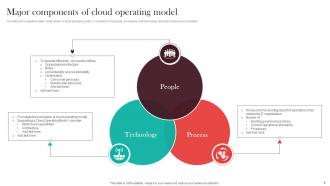
Key components of an effective cloud operating model include governance frameworks, security protocols, cost management systems, automation tools, and performance monitoring capabilities. These elements work together by streamlining resource allocation, enhancing operational efficiency, and ensuring compliance across cloud environments, with many organizations finding that this strategic combination delivers faster deployment times, reduced operational costs, and improved scalability.
A cloud operating model emphasizes flexibility, scalability, and service-oriented delivery, while traditional IT models rely on fixed infrastructure, hierarchical processes, and capital-intensive hardware investments. Cloud models enable organizations to scale resources dynamically, reduce operational overhead, and accelerate service delivery through automation and self-service capabilities, ultimately delivering greater agility and cost efficiency.
Cloud operating model benefits include enhanced scalability, reduced infrastructure costs, improved operational efficiency, faster deployment capabilities, and increased business agility. These advantages enable organizations to streamline resource allocation, minimize capital expenditures, and accelerate service delivery, with many enterprises finding that cloud adoption ultimately delivers competitive advantage and supports rapid business growth.
Organizations assess their current IT infrastructure for cloud operating model transition by evaluating application portfolios, data dependencies, security frameworks, compliance requirements, and operational workflows. Through comprehensive audits, many enterprises identify workloads suitable for migration, legacy systems requiring modernization, and skill gaps needing development, ultimately delivering strategic roadmaps that streamline transformation while minimizing business disruption.
Automation streamlines cloud operations by reducing manual tasks, accelerating deployment processes, and minimizing human errors across infrastructure management, security monitoring, and resource allocation. Through automated scaling, provisioning, and incident response, organizations achieve significantly lower operational costs, faster service delivery, and enhanced reliability, with many enterprises finding that comprehensive automation delivers up to 40% improvement in operational efficiency.
Security should be integrated through automated compliance monitoring, identity and access management protocols, continuous threat detection, and zero-trust architecture principles throughout the cloud infrastructure. Financial services and healthcare organizations increasingly embed security into their DevOps workflows, enabling faster deployments while maintaining regulatory compliance, ultimately delivering enhanced protection and operational efficiency.
Cloud operating model success metrics include cost optimization ratios, resource utilization rates, deployment velocity, system uptime percentages, and security compliance scores. These measurements enable organizations to track operational efficiency, scalability achievements, and service quality improvements, with many enterprises finding that comprehensive metric frameworks deliver enhanced visibility, faster decision-making, and sustained competitive advantage.
Organizations ensure compliance in cloud operating models through automated monitoring tools, comprehensive data governance frameworks, regular security audits, and robust access controls that track regulatory requirements continuously. These approaches enable companies to maintain transparency across multi-cloud environments, streamline compliance reporting, and reduce manual oversight costs, with many financial services and healthcare institutions finding that cloud-native compliance tools actually enhance their regulatory posture while accelerating operational efficiency.
Common challenges include legacy system integration, skill gaps in cloud technologies, security and compliance concerns, cost management complexities, and organizational resistance to change. These obstacles often require strategic workforce retraining, phased migration approaches, and robust governance frameworks, with many enterprises finding that comprehensive change management and cross-functional collaboration ultimately streamline the transition process.
A cloud operating model supports DevOps practices by providing scalable infrastructure, automated deployment pipelines, and integrated development environments that streamline collaboration between development and operations teams. Through cloud-native tools and services, organizations enhance continuous integration, accelerate release cycles, and improve system reliability, while reducing infrastructure management overhead, ultimately delivering faster time-to-market and enhanced operational efficiency.
Cloud cost management strategies include automated resource scaling, reserved instance purchasing, multi-cloud optimization, usage monitoring and alerts, and rightsizing infrastructure based on actual demand patterns. These approaches streamline expenses by eliminating waste, maximizing utilization efficiency, and leveraging competitive pricing, with many organizations finding that strategic cloud financial management delivers 20-30% cost reductions while maintaining performance.
A cloud operating model facilitates cross-departmental collaboration by providing centralized data access, standardized workflows, real-time communication tools, and shared digital workspaces that break down traditional silos. Through cloud-based platforms, teams across finance, marketing, operations, and IT can seamlessly share resources, coordinate projects, and maintain visibility into organizational processes, ultimately delivering faster decision-making and enhanced operational efficiency.
Essential tools for cloud operating model management include Infrastructure as Code platforms, cloud management dashboards, automated monitoring systems, cost optimization analyzers, and security compliance frameworks. These technologies streamline operations by enabling real-time visibility, automating resource provisioning, and optimizing spending, with many organizations finding that integrated toolsets deliver enhanced operational efficiency and strategic cost control.
Organizations leverage multi-cloud strategies by distributing workloads across multiple cloud providers, implementing unified management platforms, establishing consistent security protocols, and optimizing cost allocation based on provider strengths. This approach enables enhanced resilience through redundancy, prevents vendor lock-in, and delivers improved performance optimization, with many enterprises finding that strategic provider selection ultimately reduces costs while maintaining operational flexibility.
A cloud operating model significantly enhances disaster recovery and business continuity through automated backups, geographically distributed data centers, rapid failover capabilities, and scalable recovery resources. These cloud-native approaches streamline recovery processes by reducing downtime windows, minimizing data loss, and enabling faster restoration, with many organizations finding that cloud infrastructure delivers more resilient continuity planning than traditional on-premises solutions.
-
It's always a delight to see new templates from you! I am extremely pleased with the fact that they are easy to modify and fit any presentation layout in seconds!
-
I was never satisfied with my own presentation design but SlideTeam has solved that problem for me. Thank you SlideTeam!