


Commercial Excellence Framework For Implementation Of Mind Set And Behaviour Program




Try Before you Buy Download Free Sample Product
 Impress Your
 Audience
 100%
100% Editable
 Save Hours
 of Time


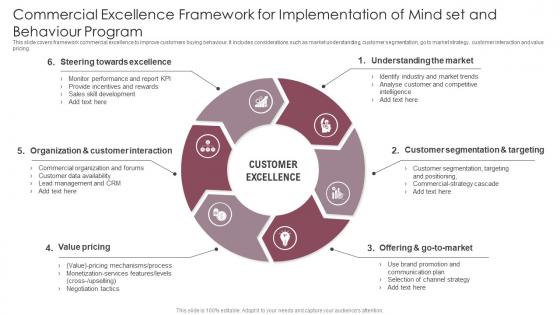
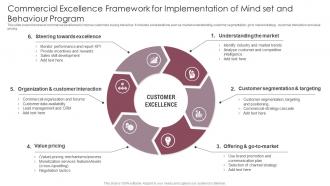
This slide covers framework commercial excellence to improve customers buying behaviour. It includes considerations such as market understanding, customer segmentation, go to market strategy, customer interaction and value pricing.
People who downloaded this PowerPoint presentation also viewed the following :
Commercial Excellence Framework For Implementation Of Mind Set And Behaviour Program with all 6 slides:
Use our Commercial Excellence Framework For Implementation Of Mind Set And Behaviour Program to effectively help you save your valuable time. They are readymade to fit into any presentation structure.





FAQs for Commercial Excellence Framework For Implementation Of Mind Set
Honestly, commercial excellence boils down to four things you can't mess up: know what your customers actually want (not what you assume), make decisions based on real data, get your teams aligned, and keep tweaking your go-to-market stuff. Here's the kicker though - most companies are delusional about how well they're doing this. You'll know you're on the right track when sales, marketing, and customer success stop fighting and start using the same scoreboard. I'd audit where you stand on each one first. That'll show you which fires to put out.
Track both leading and lagging stuff across your revenue cycle. Conversion rates and deal velocity for acquisition. Then retention, upselling, customer lifetime value. Sales productivity per rep is honestly my favorite metric - tells you everything about commercial health. Customer satisfaction scores matter too, plus win/loss analysis (though that one's kind of a pain to do consistently). Create a dashboard for real-time visibility into what's actually working. Stick to maybe 5-7 core metrics max and review weekly with your team. More than that gets overwhelming fast.
Think of customer insight as your secret weapon for sales. You get inside your customers' heads - figure out what bugs them, how they shop, what makes them say yes. Then boom, you can adjust your prices and pitch to actually connect. Without it? You're basically guessing and praying something works. I learned this the hard way when I first started out, honestly. The magic happens when you take all that juicy data and use it to tweak your whole approach. Your conversion rates will thank you later.
Honestly, the data stuff is kind of a game-changer once you get into it. Instead of just guessing what customers want, you can actually see their behavior patterns and figure out which deals are worth pursuing. The predictive analytics will blow your mind - like seriously, it's scary accurate sometimes. You can automate all that tedious paperwork that bogs everyone down too. Plus personalizing your pitch for different customer types becomes way easier. I'd say start with something simple though, maybe lead scoring? Prove it works there first, then expand from there. Don't try to do everything at once.
Honestly, the worst part is when departments just don't communicate - marketing creates leads that sales can't even follow up on properly. Your data's probably a mess across different systems too. Everyone's using their own process, which is... fun. Most companies obsess over meaningless numbers instead of tracking what actually drives revenue. Oh, and leadership wants results but won't invest in decent tools first. Classic. Start by mapping where prospects are falling off in your customer journey. That'll tell you exactly what's broken and needs fixing.
Look, you can't expect your commercial strategies to work if your team doesn't know how to execute them properly. Training directly impacts the stuff that actually makes money - sales processes, customer relationships, market insights. Confident employees perform better, and trust me, customers can tell the difference immediately. Your trained team will catch opportunities that others completely miss while making way fewer expensive mistakes. Honestly though, don't just throw random training at people. Figure out what specific skills are missing first, then build programs around those gaps. It's like... why fix what isn't broken, you know?
Dude, you gotta force sales and marketing to actually talk. I'm talking shared meetings, same KPIs, the whole thing. Most places totally bomb this because everyone's defending their little kingdom - but whatever. Focus on revenue targets instead of weird separate metrics like leads versus closes. When you align your messaging and how you hand off prospects, conversions go way up. Weekly calls between team leads are huge. Oh and get them on the same CRM dashboard so they're looking at identical data. It's wild how much better things get when both teams feel responsible for the same outcome.
Look, most companies are terrible at actually using the feedback they collect - they just let it sit there. Pick your top 3 feedback patterns this quarter and make real action plans. When customers mention unmet needs, that's literally handing you upsell opportunities. Fix the friction points that are killing your deals too. Also train your sales team on what actually resonates with people based on this feedback. I mean, you're already asking customers what they think, so why not use those insights to adjust your pricing or approach? It's honestly one of the easiest ways to spot gaps between what you're selling and what people actually want.
Honestly, benchmarks are like getting a wake-up call about how you're really doing against your competition. You'll spot where you're falling behind on pricing, sales efficiency, customer acquisition costs - all that stuff you can't see when you're just looking at your own numbers. Finding good, comparable data is honestly the hardest part though. Once you've got solid benchmarks, you can actually set targets that make sense and figure out what needs fixing first. I'd say pick 2-3 metrics where you're clearly behind and start there.
Your brand reputation is honestly like having a money-making machine. Customers will pay more when they trust you, and they stick around way longer too. Makes hitting those profit targets so much easier. Your sales team will actually thank you because their job becomes a breeze - people basically sell themselves on your stuff. Good brands also pull in better employees and partnerships, which just keeps building on itself. Oh, and here's the thing - you can't fake it with flashy campaigns. You've got to actually deliver on what you promise consistently. That's where the real magic happens commercially.
Honestly, just make questioning stuff feel totally normal instead of some big corporate thing. Get your teams asking "why do we even do this?" and actually listen when they pitch ideas. Monthly check-ins work great - way better than those ridiculous suggestion boxes that collect dust. When someone improves a process, celebrate it! Even if it's just saving 10 minutes daily. Here's the thing though - people won't speak up if they're scared of getting blamed when experiments fail. You need safe-to-fail testing. Oh, and block out quarterly time for teams to try new approaches.
Look, your leadership team makes or breaks this whole thing. They've got to actually set the vision and get everyone aligned around customer value - not just throw around buzzwords in meetings. The good ones break down those stupid silos between sales, marketing, and ops while setting real metrics people can follow. I've watched so many companies where executives talk a big game but don't model what they're preaching. It's painful to watch honestly. Strong commercial leaders communicate constantly, invest in capabilities that matter, and aren't afraid to make hard calls on where resources go. First step? Take a hard look at whether your current team actually practices what they preach.
Build that agility right into how you actually run things - like a feedback loop between what the market's telling you and what you're doing about it. Regular check-ins with customers and your frontline people will catch changes before they smack you in the face. Most companies I've watched get totally blindsided because they're only looking at what already happened. You want leading indicators, not just the stuff that's already done. Stay consistent with your core practices but flexible in how you use them. Oh, and figure out which market signals actually matter for your specific business first - then set up quick ways to spot and react to them.
Honestly, the top companies do three things really well. First thing - they're totally obsessed with customer data and actually use it (not just collect it). Everyone rows in the same direction toward revenue goals, not just the sales team. They also dump serious money into training their people. Look at Amazon - those guys basically live inside their customer metrics. Oh, and they break down all those stupid walls between marketing, sales, and support so teams actually talk to each other. They're always testing new stuff too, never think they've got it all figured out. My advice? Pick one place where your teams don't communicate and start there.
Honestly, cross-department collab is a game changer because it stops good ideas from dying in those stupid company silos. Sales and marketing actually talking? Revolutionary, I know. But seriously - when teams share data and coordinate instead of working in bubbles, you'll spot opportunities way faster. Plus customers won't get mixed messages from different departments, which is always awkward. I've watched companies where marketing launches campaigns while sales has zero clue what's happening. What a disaster. Get your teams in regular meetings focused on actual customer outcomes. Start there and you'll see the difference pretty quick.
-
“I really like the convenient operation and professionalism I saw on the SlideTeam website. I want to express my regards and appreciation to the team.”
-
Fantastic collection of visually appealing PowerPoint templates. They certainly uplift the look of the presentation.