


Commercial Real Estate Leasing Services Brochure Trifold




Try Before you Buy Download Free Sample Product
 Impress Your
 Audience
 100%
100% Editable
 Save Hours
 of Time


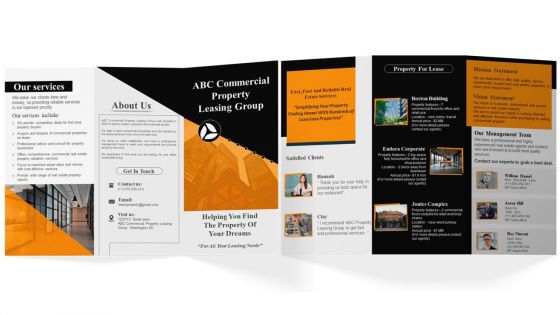
Advertise your commercial real estate leasing services business by using our visually appealing Commercial Real Estate Leasing services Trifold Brochure Template. Use this pamphlet presentation template to provide information about the company overview, including its vision, mission and services. With the assistance of the Commercial Real estate Leasing Services Brochure PowerPoint theme, you can talk about property available for lease along with their description such as lease term, apartment size, location, features and prices. Employ this professionally designed PPT brochure to showcase unique leasing points and special services provided by business to attract clients. Further, this brochure covers various services and contact details of management team to get better advice for leasing plans.
People who downloaded this PowerPoint presentation also viewed the following :
Commercial Real Estate Leasing Services Brochure Trifold with all 1 slides:
Use our Commercial Real Estate Leasing Services Brochure Trifold to effectively help you save your valuable time. They are readymade to fit into any presentation structure.
FAQs for Commercial Real Estate Leasing
Commercial leases typically involve longer terms, higher rental amounts, complex negotiations, and greater tenant responsibility for maintenance and utilities compared to residential leases. While residential leases offer standardized protections and landlord-maintained properties, commercial agreements enable businesses to customize spaces for operational needs, with many retailers, offices, and industrial tenants finding strategic advantages through flexible lease structures.
Lease terms vary significantly across commercial property types, with retail leases typically featuring percentage rent clauses and shorter 5-10 year terms, office spaces offering longer 10-20 year commitments with built-out allowances, and industrial properties providing extended terms up to 25 years with minimal landlord improvements. These variations reflect each sector's operational needs and investment patterns, with many businesses finding that understanding these distinctions enables better negotiation outcomes and strategic space planning.
Common commercial real estate lease clauses include rent escalation terms, maintenance responsibilities, assignment and subletting rights, use restrictions, and termination conditions. These clauses protect both landlords and tenants by clearly defining financial obligations, operational boundaries, and exit strategies, with many businesses finding that well-negotiated clauses significantly reduce disputes and enhance long-term operational stability.
Zoning regulations directly influence commercial real estate leasing by determining permitted business activities, building usage restrictions, and operational parameters for each property. These requirements affect tenant eligibility, lease negotiations, and rental rates, with retail spaces, office complexes, and industrial facilities each facing specific zoning compliance needs that ultimately shape leasing strategies and property values.
Commercial real estate brokers facilitate leasing transactions by conducting market research, identifying suitable properties, negotiating lease terms, and managing documentation throughout the process. They streamline complex negotiations between landlords and tenants, leveraging their market expertise and industry relationships to secure favorable terms, ultimately delivering faster deal closures and optimized lease agreements for both parties.
Tenants can negotiate favorable terms by demonstrating financial stability, proposing longer lease commitments, offering higher security deposits, and highlighting their business reputation. In competitive markets like downtown financial districts, successful tenants often negotiate flexible expansion clauses, tenant improvement allowances, and phased rent increases, ultimately securing strategic locations while managing occupancy costs effectively.
Landlords should consider market comparables, property location, tenant creditworthiness, lease duration, property condition, and local economic indicators when setting commercial lease rates. Through comprehensive market analysis, property owners can balance competitive pricing with profitability, while factoring in tenant improvements and concessions, ultimately delivering optimal returns and attracting quality tenants in increasingly dynamic markets.
Commercial lease agreements must address liability and insurance requirements, property maintenance responsibilities, zoning compliance, assignment and subletting rights, and dispute resolution mechanisms. These legal frameworks protect both landlords and tenants by establishing clear operational boundaries, financial obligations, and exit strategies, with many real estate professionals finding that comprehensive agreements minimize costly conflicts and ensure regulatory compliance.
Market demand significantly influences commercial real estate leasing strategy by determining rental rates, lease terms, tenant concessions, and property positioning within competitive markets. In high-demand areas, property owners can command premium rents and shorter lease terms, while softer markets require strategic concessions, flexible terms, and enhanced tenant services, with many landlords finding that adapting quickly to demand fluctuations ultimately delivers sustained occupancy and competitive advantage.
Triple net leases shift property expenses like taxes, insurance, and maintenance to tenants, giving landlords predictable income while reducing their operational responsibilities. While tenants gain greater control over property management and potential cost savings through efficient operations, they also assume financial risks from unexpected expenses, with many commercial tenants finding this arrangement beneficial in stable markets where predictable occupancy costs enable better budget planning.
Technology revolutionizes commercial leasing through virtual property tours, automated lease management systems, AI-powered tenant screening, digital signature platforms, and integrated CRM solutions. These innovations streamline property marketing, accelerate document processing, and enhance tenant-landlord communications, with many real estate firms finding that digital workflows reduce lease cycle times by 40-60%, ultimately delivering faster transactions and improved operational efficiency.
Tenants should evaluate risks including escalating operating expenses, restrictive use clauses, personal guarantees, inadequate lease terms for business growth, and potential landlord financial instability. These factors can significantly impact operational costs and business flexibility, with many retail and office tenants finding that thorough due diligence on lease terms and landlord creditworthiness prevents costly surprises.
Property condition significantly influences lease negotiations by affecting rental rates, tenant improvement allowances, maintenance responsibilities, and lease duration terms. Well-maintained properties command higher rents and attract quality tenants, while properties requiring updates often necessitate reduced rates or substantial landlord concessions, with many commercial tenants increasingly prioritizing move-in ready spaces that minimize their capital expenditure requirements.
Current trends shaping commercial real estate leasing include hybrid work models driving flexible space demands, ESG requirements influencing tenant decisions, technology integration for smart buildings, shorter lease terms, and flight-to-quality movements. These shifts enable landlords to diversify offerings through co-working partnerships, sustainable certifications, and adaptive spaces, ultimately delivering enhanced tenant experiences while maintaining competitive market positioning.
Businesses can assess their space needs by evaluating current headcount, projected growth, operational requirements, technology infrastructure needs, and desired workplace flexibility. Through comprehensive space planning that considers departmental workflows, collaboration areas, and storage requirements, organizations can accurately determine square footage needs, ultimately avoiding costly relocations while ensuring the lease supports long-term business objectives and scalability.
-
The templates are the best in class. Very clear and innovative graphics! I am excited to explore and download more presentations.
-
Their templates are super easy to edit and use even for the one like me who is not familiar with PowerPoint. Great customer support.