


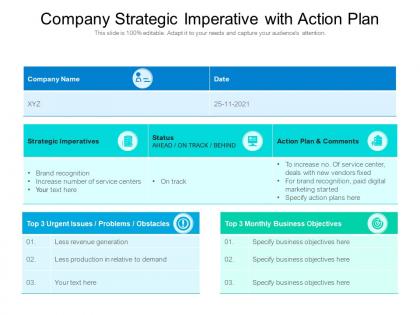
Company strategic imperative with action plan




Try Before you Buy Download Free Sample Product
 Impress Your
Audience
 100%
Editable
 Save Hours
of Time


Our Company Strategic Imperative With Action Plan are topically designed to provide an attractive backdrop to any subject. Use them to look like a presentation pro.
People who downloaded this PowerPoint presentation also viewed the following :
Company strategic imperative with action plan with all 2 slides:
Use our Company Strategic Imperative With Action Plan to effectively help you save your valuable time. They are readymade to fit into any presentation structure.


FAQs for Company strategic imperative
Key components of effective strategic planning include environmental analysis, vision and mission development, goal setting, strategy formulation, resource allocation, implementation planning, and performance monitoring systems. These elements work together by aligning organizational capabilities with market opportunities, establishing clear priorities, and creating accountability mechanisms, ultimately delivering competitive advantage and sustainable growth across industries.
Organizations align strategic goals with mission and vision by conducting regular assessment workshops, establishing clear performance metrics, and creating cross-functional alignment teams that translate high-level statements into actionable objectives. Through strategic mapping and stakeholder engagement, companies like healthcare systems and financial institutions ensure their operational priorities directly support their foundational purpose, ultimately delivering consistent organizational focus and measurable progress toward long-term aspirations.
SWOT analysis serves as a foundational assessment tool in strategic planning, systematically evaluating internal strengths and weaknesses alongside external opportunities and threats to inform decision-making. When effectively implemented through cross-functional team workshops, regular quarterly reviews, and integration with goal-setting processes, organizations can identify competitive advantages, anticipate market challenges, and develop strategic initiatives that leverage their capabilities while addressing vulnerabilities in an increasingly dynamic business environment.
External factors significantly influence strategic planning by shaping resource allocation, market positioning, and competitive strategies, with organizations continuously monitoring economic indicators, consumer behavior shifts, and industry disruptions. These influences enable companies to anticipate challenges, capitalize on emerging opportunities, and adjust operational priorities, ultimately delivering enhanced resilience and competitive advantage in an increasingly dynamic business environment.
Strategic planning fosters innovation by establishing clear innovation goals, allocating dedicated resources for research and development, creating structured processes for idea evaluation, and building cross-functional collaboration frameworks. These strategic approaches enable organizations to systematically identify market opportunities, reduce innovation risks through planned experimentation, and ultimately deliver breakthrough products and services that provide sustainable competitive advantage.
Organizations ensure strategic plan flexibility by implementing regular review cycles, scenario planning, agile methodologies, continuous market monitoring, and stakeholder feedback loops. These approaches enable companies to pivot quickly when market conditions shift, with many financial services and retail organizations finding that quarterly strategy assessments and cross-functional planning teams deliver faster adaptation and sustained competitive advantage.
Strategic planning success metrics include financial performance indicators, customer satisfaction scores, operational efficiency measures, market share growth, and employee engagement levels. These metrics enable organizations to track progress across revenue targets, cost reduction goals, and competitive positioning, with many companies finding that balanced scorecards combining quantitative and qualitative measures deliver comprehensive insights into strategic execution effectiveness.
Stakeholder input integrates into strategic planning through surveys, focus groups, advisory committees, town halls, and collaborative workshops that capture diverse perspectives and priorities. These engagement methods enable organizations to align strategic objectives with stakeholder expectations, identify potential implementation challenges early, and build broader buy-in, ultimately delivering more robust strategies and smoother execution across all organizational levels.
Common strategic planning pitfalls include lack of stakeholder engagement, unrealistic goal setting, insufficient market analysis, poor resource allocation, and inadequate progress monitoring. These challenges can derail organizational growth by creating misaligned priorities, wasted investments, and missed opportunities, with many companies finding that structured frameworks and regular review cycles ultimately deliver better strategic outcomes and competitive positioning.
Technology enhances strategic planning through data analytics, scenario modeling, collaborative platforms, automated reporting, and real-time performance tracking. These digital tools streamline decision-making by processing vast datasets, enabling predictive insights, and facilitating cross-departmental collaboration, with many organizations finding that technology-driven planning delivers faster strategy execution and improved competitive positioning.
Scenario planning enables organizations to anticipate multiple future possibilities, assess potential risks and opportunities, and develop flexible strategic responses before uncertainties materialize. By modeling different market conditions, competitive landscapes, and operational challenges, companies like financial institutions and manufacturers can make more resilient decisions, allocate resources strategically, and maintain competitive advantage in volatile environments.
Organizations effectively communicate their strategic plan through multi-channel approaches including town halls, digital dashboards, stakeholder-specific presentations, regular progress updates, and visual storytelling formats. These communication strategies streamline alignment by ensuring consistent messaging, enhancing transparency across all organizational levels, and building stakeholder buy-in, with many companies finding that tailored communication delivers stronger execution and sustained competitive advantage.
Strategic initiative prioritization techniques include impact-effort matrices, weighted scoring models, return on investment analysis, resource capacity planning, and stakeholder value assessments. These frameworks enable organizations to systematically evaluate competing priorities by balancing potential outcomes against available resources, with many companies finding that combining quantitative metrics with strategic alignment criteria delivers optimal resource allocation and sustainable competitive advantage.
Organizational culture significantly impacts strategic plan implementation by influencing employee behavior, decision-making processes, and change adoption throughout the organization. Companies with aligned cultures experience smoother transitions, faster execution, and higher success rates, while misaligned cultures create resistance, ultimately requiring cultural transformation initiatives alongside strategic changes for effective implementation.
Leadership drives strategic planning success by setting clear vision, securing organizational alignment, allocating necessary resources, and maintaining accountability throughout implementation. Effective leaders communicate strategic priorities across all levels, navigate resistance to change, and adapt plans based on market feedback, with many organizations finding that engaged leadership increases plan execution rates by over 60%.
-
Nice and innovative design.
-
Attractive design and informative presentation.
-
It saves your time and decrease your efforts in half.
-
Unique design & color.