


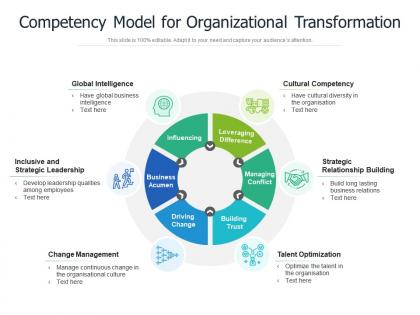
Competency model for organizational transformation




Try Before you Buy Download Free Sample Product
 Impress Your
 Audience
 100%
100% Editable
 Save Hours
 of Time


Our Competency Model For Organizational Transformation are topically designed to provide an attractive backdrop to any subject. Use them to look like a presentation pro.
People who downloaded this PowerPoint presentation also viewed the following :
Competency model for organizational transformation with all 2 slides:
Use our Competency Model For Organizational Transformation to effectively help you save your valuable time. They are readymade to fit into any presentation structure.
FAQs for Competency model
A comprehensive competency model should include technical skills, behavioral competencies, leadership capabilities, core values alignment, and performance indicators with measurable outcomes. These components work together by defining role-specific expertise, interpersonal effectiveness, and strategic thinking abilities, with many organizations finding that this structured approach streamlines talent development, enhances recruitment accuracy, and ultimately delivers improved performance management and succession planning across all organizational levels.
Competency models enhance employee performance by providing clear behavioral expectations, targeted skill development pathways, and objective performance measurement criteria. Through structured competency frameworks, organizations streamline talent management processes, identify specific development gaps, and create personalized growth plans, with many companies finding that employees demonstrate improved job performance, faster skill acquisition, and greater career clarity, ultimately delivering enhanced productivity and strategic workforce alignment.
Competency models streamline talent acquisition by defining specific skills, behaviors, and qualifications needed for success, enabling recruiters to create targeted job descriptions, develop structured interview questions, and establish consistent evaluation criteria. Through competency-based recruitment, organizations can better identify high-potential candidates, reduce hiring bias, and improve role-fit accuracy, ultimately delivering faster placements and enhanced workforce quality.
Organizations ensure competency model alignment with corporate strategy by conducting strategic gap analyses, involving senior leadership in model development, and mapping competencies directly to business objectives and future goals. Through regular reviews and updates, companies like tech firms and financial institutions streamline talent development, enhance succession planning, and accelerate strategic execution, ultimately delivering competitive advantage and organizational agility.
Developing competency models involves job analysis and task identification, behavioral interviews with high performers, focus groups with subject matter experts, performance data analysis, and competency gap assessments. These methodologies work together by identifying critical skills, validating performance indicators, and mapping behavioral patterns, with many organizations finding that combining multiple approaches delivers more comprehensive and accurate competency frameworks.
Competency models vary significantly across industries, with healthcare emphasizing clinical expertise, patient safety protocols, and regulatory compliance, while technology focuses on innovation, agility, and technical problem-solving capabilities. Financial services prioritize risk management, analytical thinking, and regulatory knowledge, with many organizations finding that industry-specific competencies ultimately drive performance standards and competitive advantage.
Competency models support succession planning by identifying critical skills for key roles, assessing current talent gaps, creating targeted development pathways, and establishing objective criteria for leadership readiness. Through systematic competency mapping, organizations streamline talent identification processes, accelerate leadership development programs, and ensure smoother transitions, with many finding that structured competency frameworks reduce succession risks while building stronger internal talent pipelines.
Employee feedback can be integrated through surveys, focus groups, performance reviews, and structured interviews that identify critical skills and behaviors for success. Organizations increasingly use 360-degree feedback tools and competency assessment platforms to gather input from multiple levels, enabling HR teams to create more accurate, role-specific models that reflect actual workplace requirements and drive targeted development programs.
Organizations face challenges including resistance to change, lack of leadership buy-in, insufficient resources for development, difficulty measuring competencies objectively, and maintaining model relevance over time. While these implementation hurdles can be significant, many companies find that phased rollouts, comprehensive training programs, and regular model updates help streamline adoption, ultimately delivering improved performance management and strategic workforce alignment.
Competency models foster continuous learning by identifying skill gaps, creating targeted development pathways, and establishing clear performance benchmarks across organizations. Through regular competency assessments, companies can personalize learning experiences, track progress systematically, and align individual growth with strategic objectives, with many organizations finding that this structured approach enhances employee engagement while building adaptable, future-ready workforces.
Competency model effectiveness can be measured through performance improvement rates, employee engagement scores, skill gap reduction percentages, promotion success rates, and training ROI metrics. These measurements enable organizations to track talent development progress, optimize resource allocation, and demonstrate strategic value, with many companies finding that comprehensive tracking ultimately delivers enhanced workforce capabilities and improved business outcomes.
Technology enables competency model creation through AI-powered skill assessment platforms, data analytics tools, learning management systems, and automated performance tracking software. These technologies streamline competency identification, real-time skill gap analysis, and personalized development pathways, with organizations in healthcare, finance, and manufacturing finding that integrated platforms deliver faster talent development, improved workforce planning, and enhanced competitive advantage through strategic skill alignment.
Leadership drives competency model adoption by championing the initiative, allocating necessary resources, and modeling expected behaviors throughout the organization. Effective leaders communicate the strategic value, ensure consistent implementation across departments, and integrate competency frameworks with performance management systems, ultimately creating cultural alignment and sustainable adoption that enhances organizational capability and competitive advantage.
Organizations should review competency models annually at minimum, with comprehensive updates every 2-3 years to reflect evolving industry demands, technological changes, and strategic shifts. However, rapidly changing sectors like technology and healthcare often require more frequent reviews, with many companies conducting quarterly assessments to ensure their models remain aligned with market dynamics and organizational growth objectives.
**INPUT**: What are some best practices for communicating a competency model to all employees? **OUTPUT**: Best practices include multi-channel communication strategies, interactive workshops, visual documentation, manager-led discussions, and regular reinforcement sessions. These approaches streamline understanding by connecting competencies to daily roles, providing clear examples, and demonstrating career pathways, with many organizations finding that consistent messaging and practical applications ultimately enhance employee engagement and performance alignment.
-
Content of slide is easy to understand and edit.