


Organizational effectiveness model powerpoint slide




Try Before you Buy Download Free Sample Product
 Impress Your
 Audience
 100%
100% Editable
 Save Hours
 of Time


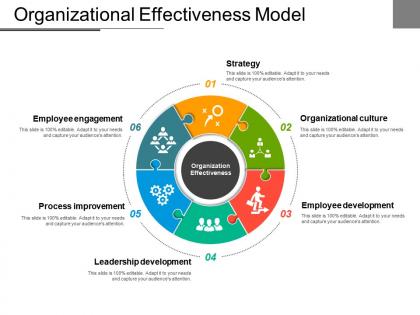
Choose the organizational effectiveness model PowerPoint slide PPT for creating a presentation to discuss the concept of how effective your organization is in achieving the outcomes of the organization which it intends to produce. The organizational performance PPT slide can be used in the groups and by the organizations as well which are directly concerned with several key areas such as; talent management, leadership development, organization design, structure, design of measurements, scorecards, implementation of change, transformation, deploying smart processes and smart technology to manage the organizational human capital and the formulation of the broader human resources agenda. The business growth and development PPT slide can be used for the groups also to perform the following roles such as; examines alignment between the areas and improves them, Improves trade-offs between reliability, speed and quality in the above areas, strategies for higher adoption rates in these areas and facilitates / initiates / catalyses the capability building which are; structure, process and people. Adopt a fresh approach with our Organizational Effectiveness Model Powerpoint Slide. Come up with contemporary concepts.
People who downloaded this PowerPoint presentation also viewed the following :
Organizational effectiveness model powerpoint slide with all 5 slides:
Feel chilled out anywhere with our Organizational Effectiveness Model Powerpoint Slide. They help you beat the heat.

FAQs for Organizational effectiveness
So honestly, I'd focus on the big ones first - financial performance, how engaged your employees actually are, and customer satisfaction. Operational efficiency matters too, but don't get overwhelmed trying to track everything. Talent retention is huge though. High turnover usually means something's broken underneath. Also keep an eye on how quickly you adapt to changes and whether you're hitting your main goals. My advice? Pick maybe 3-4 metrics that actually match what you're trying to accomplish this year. You can always add more later once you've got a rhythm going. Better to nail the basics than have a fancy dashboard nobody looks at.
Honestly, your leadership style pretty much dictates everything about how your team functions. Micromanage people and watch their motivation just tank - they'll stop thinking for themselves completely. Trust them though? Suddenly everyone's more engaged and actually solving problems creatively. Here's what's wild: it cascades down too. Managers under you will copy your approach, whether it's good or bad. Right now you need to figure out what your org actually needs - sometimes it's more structure when everything's falling apart, other times people need freedom to grow.
Look, engaged employees are basically your secret weapon. They're way more productive and actually stick around instead of job-hopping every year. When people genuinely care about their work, they collaborate better and come up with creative solutions - honestly, it's night and day compared to teams just phoning it in. Quality goes up because they're not cutting corners. Oh, and they'll actually have your back during crunch time. My advice? Start tracking engagement scores and figure out what's blocking your team from being all-in. It'll transform how your whole organization performs.
Okay so you definitely need both the hard data and the softer stuff. Numbers like productivity rates, project timelines, revenue per employee - that's your baseline. But honestly? The real magic happens when you talk to people directly through surveys and one-on-ones. Team morale tells you way more than spreadsheets sometimes. Don't go crazy measuring everything though - pick maybe 3-5 things that actually move the needle for each team. Oh, and here's what works: ask your people what success looks like first, then build around that. They'll tell you exactly what matters.
Okay so three main things to work on: clarity, how often you communicate, and mixing up your methods. Drop the corporate speak - nobody understands that stuff anyway. Talk to people more frequently, especially when things are changing. Radio silence drives everyone crazy! Don't just rely on email either. Try team meetings, quick one-on-ones, slack or whatever tools you use, even grabbing coffee with people. You want info flowing in all directions. Oh and start by figuring out where your current communication sucks the most, then fix those gaps first.
Think of your company culture like your phone's OS - it controls how everything runs. People collaborate and take risks when they actually buy into the mission. But man, I've watched solid teams completely tank because they rewarded solo wins instead of teamwork. That's brutal to see happen. If your culture doesn't match your goals, you're fighting an uphill battle every day. Short version? Check if your daily habits actually push you toward what you're trying to achieve. Otherwise you'll keep wondering why nothing sticks.
Honestly, I'd start with the Balanced Scorecard - hits all the bases with financial, customer, internal process, and learning stuff. OKRs are solid for keeping everyone aligned on goals. Don't sleep on employee engagement surveys though, because nothing kills results like a checked-out team. McKinsey's 7S model digs deeper into organizational health if you need that level of detail. It covers strategy, structure, systems, culture - the whole nine yards. Quick pulse checks? 360-degree feedback and performance dashboards work great. My advice: pick whatever matches where your company's at right now, then add more tools once you've got the hang of it.
Honestly, you've gotta think beyond just those yearly reviews - they're basically useless on their own. Set up pulse surveys, maybe some 360 feedback, real-time dashboards if you can swing it. But here's the thing that drives me crazy: so many companies ask for feedback then completely ignore it. That's actually worse than not asking at all because now people feel unheard. Whatever you do, have a solid plan for analyzing the data and actually acting on it. Oh, and communicate back what you found! Start small with one feedback method that works well, then build from there.
So basically you want everyone pulling in the same direction instead of fighting each other, right? When people's personal goals actually match what the company needs, they stop feeling like work is just... work. They get genuinely excited because growing their career helps the bigger mission too. Less babysitting for you, better results for everyone. People stick around longer when they see the point of what they're doing. Oh and honestly? Start with those one-on-one meetings where you literally connect their career dreams to what's happening now at work. Game changer.
Oh totally - market trends can completely mess up how well your company runs. When demand shifts or new tech pops up, you've got to change how things work internally or you'll get left behind. I watched this happen to a place I used to work at, honestly it was painful to see. The trick is staying flexible and actually paying attention to what's happening outside your bubble. You need people watching for changes and - this sounds obvious but most places suck at it - you need to be able to move fast when things shift.
Look, companies that don't innovate just get left behind - it's that simple. Your team needs to feel comfortable trying new stuff and occasionally screwing up. Innovation isn't always about groundbreaking products either (though those are cool). Sometimes it's tweaking how you answer phones or streamline boring processes. These changes add up fast. Organizations that encourage this kind of thinking adapt way quicker when markets shift. They solve problems faster too. Honestly, just start by asking your people what tiny things bug them about their daily work. You'd be amazed what insights come out of those conversations.
Honestly, tech can be a game-changer if you don't go overboard with it. Start by picking ONE thing that's driving everyone crazy - maybe it's project tracking or those endless status meetings. Find software that actually works with how your team operates now, not some fancy system that'll sit unused (we've all been there). Automation is clutch for the boring stuff like reports. Communication tools help too, but only if people will actually use them. I'd say test something small first, see if it makes a real difference, then add more later. Don't try to fix everything at once though.
Dude, poor communication kills teams every single time. I've seen it happen so much it's not even funny. Goals get fuzzy, people resist change, and departments basically pretend others don't exist. Oh, and weak leadership makes everything worse. Start with getting your objectives super clear - like, painfully obvious clear. Fix how people actually talk to each other first. Training helps but honestly? You need the bosses on board or you're screwed. Don't try tackling everything at once though, that's a recipe for burnout. Pick one thing and nail it.
Look, mixed teams just work better - you get way more creative solutions when people challenge ideas from different angles. Homogeneous groups? They fall into groupthink so fast it's not even funny. Having varied backgrounds means someone's always questioning assumptions others might miss. Your customers are diverse too, so teams that reflect that will connect better with them. Oh, and it obviously helps your profits when you actually understand your market. The trick is making sure you're not just checking boxes - you need people who'll actually speak up and contribute their unique perspective.
Look, training your people is honestly one of the smartest moves you can make. It keeps everyone sharp and ready for whatever curveballs come up. People actually stick around longer when they feel like they're growing - nobody wants to feel stuck, you know? Instead of panicking and hiring externally every time something new pops up, you'll have folks who can already handle it. The key is matching your training to real gaps you're seeing now, plus where the business is headed. Random workshops are just a waste of everyone's time. Focus on stuff that actually matters.
-
The content is very helpful from business point of view.
-
Very well designed and informative templates.