


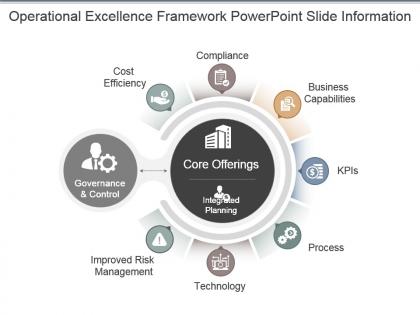
Operational excellence framework powerpoint slide information





Try Before you Buy Download Free Sample Product
 Impress Your
 Audience
 100%
100% Editable
 Save Hours
 of Time


Be a compelling force for change with our Operational Excellence Framework Powerpoint Slide Information. Bring about a distinct improvement.
People who downloaded this PowerPoint presentation also viewed the following :
Operational excellence framework powerpoint slide information with all 5 slides:
Our Operational Excellence Framework Powerpoint Slide Information ensure amicable behaviour. Your thoughts encourage genial interaction.



FAQs for Operational excellence framework
You need four main things: standardized processes, a culture where people actually want to improve stuff, metrics that matter, and bosses who don't just talk the talk. Start by mapping out your current processes - find the biggest headaches first since that's where you'll see real results. Clear SOPs help, but only if people follow them (good luck with that part). Regular improvement sessions work great. Your front-line workers are gold since they see problems before anyone else does. Oh, and skip the vanity metrics - track what actually moves the needle. Leadership commitment isn't optional here.
Track both types of metrics - leading ones like employee engagement scores, training completion rates, and process improvement ideas submitted. Then your lagging indicators: cost savings, defect rates, customer satisfaction, cycle time reductions. Executives honestly only care about the lagging stuff (the results), but leading indicators help you catch problems early. Build a simple dashboard with maybe 3-5 key metrics you check monthly. Oh, and start measuring everything now before you change anything - you'll need that baseline later or you won't know if your improvements actually worked.
Honestly, culture is huge for this stuff - probably the biggest factor. When your team actually wants to improve things and solve problems, they'll jump on the tools and processes. But toxic blame cultures? Forget it. Nobody's going to speak up about issues if they get thrown under the bus. You need psychological safety first, which means leadership has to walk the walk and celebrate wins (even tiny ones). I've seen too many companies treat this like some management initiative instead of everyone's responsibility. Do yourself a favor and figure out what your culture actually looks like before you roll anything out.
Honestly, leadership makes or breaks this stuff. They set the whole vibe - if they're not actually walking the walk on continuous improvement, forget about it. Your teams need to see leaders putting money behind initiatives and creating space where people can mess up without getting burned. Otherwise you just get another fancy framework gathering dust. The good ones celebrate quick wins and clear roadblocks. They make operational excellence feel like "this is just how we roll here" instead of some temporary project. I'd start by figuring out who in your company already gets this - those are your real champions.
Automation's a game changer for cutting operational costs. It wipes out those annoying human errors and handles all the boring repetitive stuff your team hates doing anyway. Real-time data collection helps you make smarter decisions, and honestly, the dashboards are pretty cool - you'll spot problems you never even knew existed. Your people can focus on actual meaningful work instead of mindless tasks. Standardizing processes becomes way easier too. Just don't go crazy at first - pick one process that's already working well and automate that. Scale up later.
Honestly, most companies try to do everything at once and just end up spinning their wheels. Leadership says they're all in but bails when it gets messy - happens way more than you'd think. Teams also get way too caught up in fancy dashboards and forget they're supposed to be fixing actual problems. Oh, and don't underestimate how much people hate change if they don't get why you're doing it. My advice? Pick one thing, make sure your boss actually cares, and explain what's in it for everyone. Small wins first.
So continuous improvement is like the engine behind operational excellence - can't really have one without the other. Your processes might be working fine now, but there's always room to make them better through small tweaks. Everyone on the team should be looking for those annoying bottlenecks or waste, not just the bosses. Honestly, I've seen companies transform just by empowering frontline people to suggest fixes. You're constantly testing little changes and seeing what sticks. My advice? Pick that one process that drives you nuts every day and see if you can make it even 10% smoother.
So Lean and Six Sigma are the big ones everyone talks about with OpEx. Lean cuts out waste, Six Sigma fixes quality problems with data. Agile works great if you're in tech - we tried it at my last job and it actually stuck. Kaizen's good for getting people into that continuous improvement mindset. Most companies I've seen don't go all-in on just one though. They grab bits from each framework depending on what's broken. Start with whatever addresses your worst headache first, then add more methodologies once you've got that down. Way easier than trying to boil the ocean from day one.
Start with getting teams to actually see what each other do - those gemba walks are seriously eye-opening. Shared metrics help too since everyone's working toward the same goals instead of just their own department's numbers. I'd set up mixed improvement teams where people from different functions tackle problems together. Rotating who leads these teams works surprisingly well from what I've seen. Oh, and don't try to fix everything at once - pick one pilot project between two departments first. The trick is making this collaboration stuff part of regular work, not something you only do during crisis mode. Build from there once you get some wins.
Track both speed AND quality - that's the key thing. Efficiency stuff like cycle time, throughput, costs per unit. Quality metrics too: customer satisfaction, defect rates, whether you're actually hitting targets. Don't make my mistake though - I once got so obsessed with faster turnaround that our error rate went through the roof. Pick maybe 3-4 metrics that your team can actually control. Build dashboards that update regularly so people see real numbers, not last month's data. The whole thing falls apart if your team can't influence what you're measuring. You'll just end up with fancy reports nobody acts on.
Make your team actual partners, not just order-followers. Let them own the problems in their areas and design fixes themselves. Regular feedback sessions are crucial - they'll tell you what's broken since they live it daily. Cross-functional teams work great too. Honestly, your most frustrated employees usually have the best solutions, which sounds backwards but it's true. Recognize wins publicly and connect engagement scores to your operational metrics. Start simple: ask what one process drives everyone crazy, then let them fix it. You'll be surprised how much they already know.
Honestly, it's all about what industry you're in. Healthcare can't mess around with patient safety stuff - that's non-negotiable. Manufacturing deals with supply chain nightmares and machines breaking down constantly. Financial services? Don't even get me started on compliance - they need approval for literally everything. Tech companies have it weird though. They innovate so fast that by the time you implement a process, it's already outdated. My advice? Work with your industry's constraints instead of trying to bulldoze through them. Fighting regulations is just gonna give you a headache.
Look, compliance doesn't have to fight against your OpEx stuff - it can actually guide it. Build those requirements right into your process improvements from day one. Think of them as guardrails that keep you from doing something stupid later. Honestly, I've seen too many teams try to bolt compliance on afterward and it's a mess. Map out where your regulatory requirements touch your current projects. You'll probably find they line up more than you'd expect. Short version: treat compliance like a quality standard that cuts down on all the random variability screwing up your operations.
Honestly, start small with just one area first - don't try to boil the ocean. Train your people regularly and rotate them around so knowledge doesn't get trapped in silos. The leadership thing is critical though - I've watched so many of these programs crash and burn when the C-suite loses interest. Build feedback loops that people actually use (not just suggestion boxes that get ignored). Pick metrics everyone gets, celebrate the small stuff to keep momentum going. Oh and here's the key - weave this into daily work instead of making it some separate "project." Continuous improvement should feel natural, not like extra homework. Make one thing stick before you expand.
Honestly, just start with whatever feedback you're already getting - surveys, support tickets, whatever. The trick isn't collecting more data (trust me, we all have enough of that). It's actually doing something with it. Pick one channel and commit to reviewing it weekly with your team. Look for patterns that point to real bottlenecks in your process. Then fix those first. I've seen too many companies collect feedback just to let it sit there gathering digital dust. Make changes based on what customers tell you, then circle back to see if it worked. Start small - maybe just one feedback source you can realistically act on.
-
Great experience, I would definitely use your services further.
-
Easy to edit slides with easy to understand instructions.