


Concept Of Emotional Intelligence Training Ppt




Try Before you Buy Download Free Sample Product
 Impress Your
 Audience
 100%
100% Editable
 Save Hours
 of Time


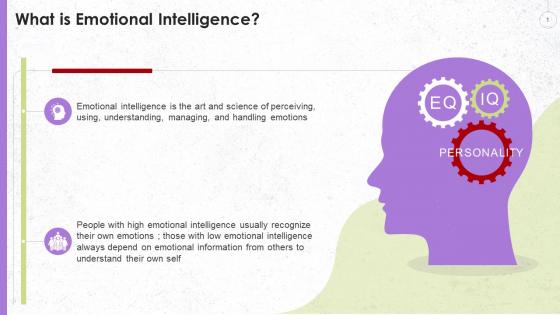
This slide illustrates the brief introduction to emotional intelligence. It explains that emotional intelligence is defined as perceiving, using, understanding, managing, and handling emotions.
People who downloaded this PowerPoint presentation also viewed the following :
Concept Of Emotional Intelligence Training Ppt with all 16 slides:
Use our Concept Of Emotional Intelligence Training Ppt to effectively help you save your valuable time. They are readymade to fit into any presentation structure.








FAQs for Concept Of Emotional
Emotional intelligence training should address self-awareness, self-regulation, motivation, empathy, and social skills as core components. These elements work together by helping employees recognize their emotions, manage responses effectively, and navigate workplace relationships, with organizations in healthcare, finance, and customer service finding that comprehensive EI training ultimately delivers improved team collaboration and enhanced client interactions.
Emotional intelligence training enhances team dynamics by developing self-awareness, empathy, active listening skills, and conflict resolution abilities among team members. Through structured workshops and coaching sessions, organizations see improved communication, reduced workplace tensions, and stronger collaborative relationships, with many companies in sectors like healthcare and financial services finding that emotionally intelligent teams deliver faster project completion and higher employee satisfaction.
Self-awareness serves as the foundation of emotional intelligence training programs, enabling participants to recognize their emotional patterns, triggers, responses, and behavioral tendencies in various situations. Through structured self-assessment tools, reflective exercises, and feedback mechanisms, organizations help employees develop deeper emotional insight, ultimately enhancing their interpersonal effectiveness, decision-making capabilities, and leadership potential across diverse workplace scenarios.
Emotional intelligence training significantly enhances managerial decision-making by improving self-awareness, empathy, and stress management capabilities, while enabling leaders to better read team dynamics and stakeholder concerns. Through enhanced emotional regulation and social awareness, managers in sectors like healthcare and financial services make more balanced strategic choices, ultimately reducing impulsive decisions and fostering collaborative problem-solving approaches.
Effective measurement techniques include pre-and-post training assessments, 360-degree feedback surveys, behavioral observation metrics, performance review integration, and employee engagement scores. These methods enable organizations to track improvements in communication, leadership effectiveness, and team collaboration, with many companies finding that systematic measurement approaches ultimately deliver enhanced workplace relationships, reduced conflicts, and measurable productivity gains across departments.
Organizations can tailor emotional intelligence training through role-specific modules, multi-generational learning approaches, cultural sensitivity adaptations, personalized assessment tools, and flexible delivery formats including virtual and in-person options. By customizing content for different departments like sales, leadership, and customer service teams, companies enhance workplace collaboration, reduce conflicts, and improve employee engagement, ultimately delivering stronger team performance and organizational resilience.
Participants typically face challenges including resistance to self-reflection, difficulty recognizing emotional triggers, struggle with vulnerability in group settings, and applying new skills consistently in high-pressure situations. These obstacles can be addressed through gradual skill-building exercises, creating psychologically safe learning environments, providing ongoing coaching support, and incorporating real-world practice scenarios, with many organizations finding that peer mentorship and regular feedback sessions significantly enhance training effectiveness and long-term behavioral change.
Technology enhances emotional intelligence training through immersive VR simulations, AI-powered feedback systems, real-time behavioral analytics, and adaptive learning platforms that personalize development paths. These tools enable organizations to scale training across teams while delivering measurable improvements in communication, leadership effectiveness, and workplace collaboration, with many companies finding significant ROI through enhanced employee engagement.
Best practices for integrating emotional intelligence training include conducting baseline EQ assessments, embedding experiential learning modules, implementing peer coaching systems, utilizing real-world case studies, and establishing ongoing feedback mechanisms. These approaches work seamlessly within existing frameworks by enhancing current leadership simulations, mentoring programs, and performance reviews, with many organizations finding that strategic integration delivers improved team dynamics, enhanced decision-making capabilities, and ultimately stronger organizational culture.
Emotional intelligence training enhances employee engagement and productivity by improving communication skills, fostering better workplace relationships, and developing stronger conflict resolution abilities. Through structured programs focusing on self-awareness and empathy, organizations experience increased collaboration, reduced turnover rates, and higher performance levels, with many companies finding that emotionally intelligent teams deliver superior customer service and innovative solutions.
Common misconceptions include believing emotional intelligence means being overly emotional, that it's just about being nice, that it can't be developed, and that it's less important than technical skills. Effective training clarifies that emotional intelligence involves managing emotions strategically, making tough decisions with empathy, and developing skills through practice, with many organizations finding that it significantly enhances leadership effectiveness and team performance.
Emotional intelligence training enhances conflict resolution by teaching active listening, empathy, and emotional regulation techniques that help team members understand different perspectives and manage reactions constructively. Through improved self-awareness and communication skills, teams can address disagreements more collaboratively, transforming workplace conflicts into productive discussions that ultimately strengthen relationships and improve overall team dynamics.
Research demonstrates that emotional intelligence training delivers sustained improvements in leadership effectiveness, employee retention, team collaboration, and customer satisfaction scores over 12-24 month periods. Studies from organizations like Johnson & Johnson and American Express show participants maintain enhanced communication skills, reduced workplace conflict, and stronger decision-making capabilities, with many companies reporting measurable ROI through decreased turnover costs and increased productivity metrics.
Emotional intelligence training enhances diversity and inclusion by developing cultural awareness, empathy, and bias recognition among employees across all organizational levels. Through improved communication skills and emotional regulation, teams become more collaborative and inclusive, with many organizations finding that EI training reduces workplace conflicts, increases cross-cultural understanding, and ultimately delivers stronger team cohesion and employee retention.
Feedback plays a crucial role in reinforcing emotional intelligence skills by providing real-time awareness of behavioral patterns, identifying improvement areas, and validating progress in self-regulation and empathy development. Through structured feedback mechanisms, organizations enable employees to recognize emotional triggers, refine interpersonal communication, and apply learned techniques more effectively, ultimately delivering enhanced team collaboration and stronger workplace relationships.
-
The Designed Graphic are very professional and classic.
-
“Excellent information with easy access.”