

Thomas Kilmann Conflict Management Styles Training Ppt





Try Before you Buy Download Free Sample Product
 Impress Your
Audience
 100%
Editable
 Save Hours
of Time


These slides in-depth cover the multiple styles of the Thomas Kilmann Conflict Mode Instrument TKI, which are Accommodating, Avoiding, Compromising, Competing, and Collaboration. They also contain details about these techniques applications, pros, and cons.
People who downloaded this PowerPoint presentation also viewed the following :
Content of this Powerpoint Presentation
Slide 1
This slide showcases accommodating as a conflict management styles. It explains when to use the accommodating style of conflict management.
Instructor’s Notes:
Examples of this to resolve any conflict and bring closure are as follows:
- Discussion on choosing the color for a New Spring Campaign
- The first party selects color A and second party picks color B
- The first part that instead of arguing about the choice of color, it will let the second party decide on the matter
Slide 2
This slide showcases the multiple pros and cons of the accommodating style of conflict management
Slide 3
This slide showcases avoiding as a conflict management style. It also illustrates its use through examples and the limited ways in which it helps the organization.
Instructor’s Notes:
Illustration on avoidance conflict management style in action:
- Jack and Amy are working on a new UX design; there are differences on design changes needed
- The management gives them some other project for a day or two, which just about meets a new, extended deadline
- The expectation is that the space they get in between and the extra time to complete the project can cool them down. Then, both can come back
Slide 4
This slide showcases the multiple pros and cons of avoidance as a conflict management style. Its overuse is something that can create havoc at workplace.
Slide 5
This slide showcases compromising as a conflict management styles. It explains when to use compromising style to resolve a conflict and bring order.
Instructor’s Notes:
Example where compromising style of conflict management works:
- Rosa and Charles are head of advertising budget for the next quarter
- Rosa wants a full-time social media person, but Charles wants to increase targeted digital ads
- As a compromise they hire a part-time social media person with the rest of the budget being spent on digital advertising
Slide 6
This slide showcases the multiple pros and cons of compromising as a conflict management style.
Slide 7
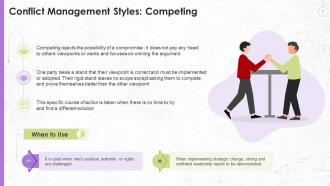
This slide showcases competing as a conflict management styles. It explains when to use competing style during conflict.
Instructor’s Notes:
An example where competing style of conflict management works:
- As the head of her department, Sophia has to resolve a conflict between Paul and Kevin as they could not agree on a venue to hold their annual team-building activity
- Sophia stepped in before the conflict could escalate any further; she announced that the department would look for a venue and both Paul and Kevin should let the matter rest, department would look for a place to hold the annual team-building activity
Slide 8
This slide showcases the multiple pros and cons of competing as a conflict management style.
Slide 9
This slide showcases collaboration as a conflict management style. It explains when to use this to resolve conflicts.
Instructor’s Notes:
A collaborative mind manifests itself as:
- Terry and Janet are heads of the new prototype design and are facing the challenge of incorporating features that do not sit together as a whole
- They both sat down and discussed the issue to discover that it is even better to make a combination of the individual features they wanted As an added bonus of this collaboration, they discovered some new features that both had not thought of
Slide 10
This slide showcases multiple pros and cons of collaboration in conflict management The key point to remember is that it satisfies all stakeholders, but can take time.
Thomas Kilmann Conflict Management Styles Training Ppt with all 26 slides:
Use our Thomas Kilmann Conflict Management Styles Training Ppt to effectively help you save your valuable time. They are readymade to fit into any presentation structure.















FAQs for Thomas Kilmann Conflict Management
Okay so there are five ways people handle conflict. Competing is when you just push for what you want. Accommodating means you give in to avoid drama. Then there's avoiding - which honestly, who doesn't do this sometimes? It's just easier to pretend problems don't exist. Compromising is where you both sacrifice something. Collaborating is the fancy one where everyone wins. Most people avoid conflict because it's uncomfortable as hell. But you gotta match your style to what's happening. Fight hard when it's urgent and you know you're right. Work together when the relationship matters. Compromise when you're rushed but need people on board. Figure out which one you usually do - it helps you switch it up when needed.
Honestly, how you handle conflict totally shapes your team's vibe. Avoiding stuff? Problems just pile up and nothing gets done. Being too aggressive ruins relationships - like, who wants to work with someone who bulldozes everyone? Accommodating feels nice but people end up resenting you. Compromise is decent for quick wins, though it usually leaves everyone kinda meh about the outcome. Collaboration takes forever but actually builds trust and gets better results. Figure out what you naturally do first, then pick what actually fits the situation. Sometimes you need to switch it up completely.
Yeah, industries totally have their go-to conflict styles. Healthcare and tech both love collaborating - makes sense since patient safety matters more than egos, and developers need to brainstorm together. Military/emergency services? Pure competing mode because someone's gotta make fast calls when lives are on the line. Retail and hospitality usually accommodate since the whole "customer's always right" thing. Law firms are weird though - they'll fight tooth and nail against opposing counsel but work together internally on cases. Just watch what style gets rewarded at your company and don't fight against the current.
Honestly, emotional intelligence is everything when you're dealing with conflict. You've gotta read the room AND the people - like, are they pissed off and need space, or ready to hash things out? When you can spot emotions (theirs and yours), you know whether to collaborate, find middle ground, or just back away slowly. I swear, half the time I catch myself getting triggered and realize my go-to reaction won't work here. The key is checking the vibe first. Then you pick your battle strategy based on what's actually happening, not just what you usually do.
Honestly, just think about your last few fights - did you duck out, go for the win, or try to split the difference? That usually tells you everything. You could do one of those formal assessments like the Thomas-Kilmann thing, but honestly those feel super sterile to me. Better move? Ask people you trust how you handle disagreements. They see stuff you totally miss. But here's the real trick - notice your gut reaction the second conflict pops up. That's your default before you can overthink it.
Oh man, this stuff is so real! Different cultures handle conflict completely differently. Some go straight for direct confrontation, others will do anything to avoid making someone lose face. I've noticed collectivist cultures usually want group solutions that work for everyone. Individualist ones? They're fine with more competitive approaches. High-context cultures read between the lines and pick up on body language, while low-context ones just spell everything out. Honestly, you should just ask your team upfront how they prefer handling disagreements - way better than guessing wrong.
So accommodating is solid when the relationship matters more than whatever you're fighting about, or honestly when you just don't care that much about the outcome. You're basically prioritizing their needs over yours, which can score you points as being cooperative. But here's the thing - do it too often and people might walk all over you. Plus you'll probably get bitter eventually if your stuff never matters. Works best when you pick your battles strategically, but definitely don't make it your go-to move for everything.
Look, competitive approaches are basically you vs. them - someone wins, someone loses. Collaboration is different though. You're actually trying to figure out what both people need and get creative about solutions together. Sure, sometimes being competitive works when you need quick decisions. But honestly? It usually screws up relationships in the long run. Collaboration takes way more time upfront - which can be annoying - but you end up with better ideas and people actually trust you afterward. Next time you're butting heads with someone, try asking what success would look like for both of you. Works surprisingly well.
Honestly, I'd jump straight into hands-on workshops with real scenarios your people might actually deal with. Role-playing is clutch here - lets everyone screw up without consequences first. Bringing in outside trainers isn't a bad move either since they'll catch blind spots your internal folks miss. Oh, and definitely cover those five conflict styles (competing, accommodating, all that) so people recognize their go-to reactions. Managers should go first, then spread it out. One thing though - you'll need regular refreshers because this stuff fades quick if you don't use it.
Honestly, compromise works great when you're pressed for time and both sides have decent points. Perfect for those budget meetings where everyone's gotta give something up, you know? I'd go with it when keeping the peace matters more than getting exactly what you want. Sure, nobody walks away with their dream outcome, but at least everyone gets something reasonable. Works especially well when you've got equal power in the room - nobody can just steamroll the other side. Sometimes "good enough" beats dragging things out forever, especially if deadlines are breathing down your neck.
Figuring out your conflict style is seriously so helpful for personal growth. You start catching yourself in these patterns - like I'm always the person who just shuts down instead of saying what I actually think, or maybe you're that friend who jumps straight into debate mode. Once you notice it, you can switch things up depending on what's happening. It really does make conversations smoother and relationships less weird. Plus you get better at solving problems instead of just... arguing in circles? Next time you're in a disagreement, try watching how you react. You might surprise yourself.
Ok so first thing - get them to actually explain their reasoning to you separately. Like, sit down with each person and figure out WHY they do things that way. Then bring them together once you get it. Don't skip that prep step though, I've watched this go sideways so many times when people jump straight into group discussions. Talk about what you're all trying to achieve instead of whose method is "better." Maybe one person handles X and the other does Y, or you can mix both approaches somehow. The whole thing works way better when it's not a competition, you know? Just focus on using what each person's actually good at.
Honestly, numbers and feedback both matter here. Track stuff like how long conflicts take to resolve, whether the same people keep having issues, and turnover in teams with lots of drama. The data helps, but surveys about workplace relationships give you the real tea - people will actually tell you if they feel supported or not. Oh and exit interviews? Those are brutal but so useful since people leaving have zero filter about what sucked. I'd probably start with just 2-3 metrics that make sense for your situation and check them every few months.
Okay so active listening is seriously a game-changer when you're dealing with conflict. Like, when you actually paraphrase what someone said and ask follow-up questions, they feel heard instead of dismissed. That's usually half the battle right there. I swear most fights get worse just because people think you're not listening. Try this next time - summarize their point before jumping into yours. It sounds weird but it works. You'll actually figure out what's really bothering them (not just the surface stuff), and honestly? It completely changes how the conversation goes. Way less defensive, more collaborative.
Oh totally, context changes everything! Remote stuff is tricky because you can't see body language and things blow up so fast over text. I've learned the hard way that being aggressive on video calls makes you look like a complete ass compared to in-person. When you're face-to-face though, you can actually read the room and pivot if needed. Direct confrontation works better too. My take? Be way more collaborative when you're remote - like almost annoyingly over-communicate. Save the tough love approach for when you're actually in the same room and can see how people are reacting.
-
Professionally designed slides with color coordinated themes and icons. Perfect for enhancing the style of the presentations.
-
“Ample and amazing variety of templates available, really helpful for making professional PPT for day to day workings.”