


Construction Site Control Measures For Working At Heights Safety Program For Construction Site




Try Before you Buy Download Free Sample Product
 Impress Your
 Audience
 100%
100% Editable
 Save Hours
 of Time


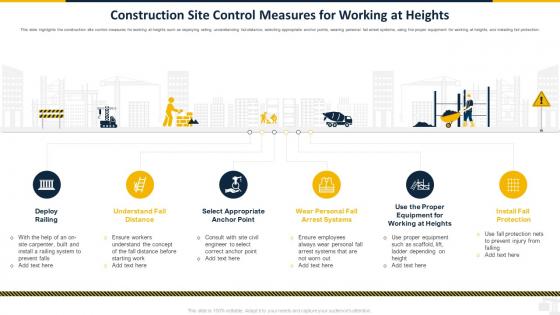
This slide highlights the construction site control measures for working at heights such as deploying railing, understanding fall distance, selecting appropriate anchor points, wearing personal fall arrest systems, using the proper equipment for working at heights, and installing fall protection.
People who downloaded this PowerPoint presentation also viewed the following :
Construction Site Control Measures For Working At Heights Safety Program For Construction Site with all 6 slides:
Use our Construction Site Control Measures For Working At Heights Safety Program For Construction Site to effectively help you save your valuable time. They are readymade to fit into any presentation structure.





FAQs for Construction Site Control Measures For Working At Heights Safety Program
Effective Working At Heights Safety Programs include comprehensive risk assessments, proper equipment selection and maintenance, mandatory training and certification, emergency response procedures, and regular safety inspections. These components work together by establishing clear protocols, ensuring worker competency, and maintaining equipment reliability, with many construction and industrial organizations finding that systematic implementation significantly reduces workplace incidents while enhancing operational compliance.
Companies assess their current working at heights safety practices through comprehensive safety audits, equipment inspections, incident analysis, employee competency evaluations, and regulatory compliance reviews. These assessments typically involve examining fall protection systems, training records, and procedural adherence, with many organizations finding that regular evaluations identify gaps early, streamline safety protocols, and ultimately deliver enhanced worker protection while minimizing liability risks.
Working at heights safety is governed by OSHA standards in the US, HSE regulations in the UK, provincial occupational health acts in Canada, and Safe Work Australia guidelines. These regulations establish requirements for fall protection systems, training protocols, equipment standards, and risk assessments, with many organizations finding that comprehensive compliance programs ultimately deliver reduced workplace incidents, lower insurance costs, and enhanced operational safety across construction, maintenance, and industrial sectors.
Risk assessments for height-related tasks involve systematically evaluating fall hazards, equipment conditions, weather factors, worker competency levels, and emergency response capabilities. Through comprehensive site inspections, hazard identification matrices, and regular safety audits, organizations streamline risk management, enhance worker protection, and ensure regulatory compliance, ultimately delivering safer work environments and reduced liability across construction, maintenance, and industrial sectors.
Essential training for elevated work includes fall protection systems, proper use of harnesses and safety equipment, hazard identification, emergency procedures, and equipment inspection protocols. Through comprehensive safety programs, construction companies, maintenance crews, and industrial facilities significantly reduce workplace accidents, enhance regulatory compliance, and improve operational confidence, with many organizations finding that systematic training ultimately delivers lower insurance costs and stronger safety cultures.
Employers ensure proper fall protection equipment use through comprehensive training programs, regular inspection schedules, and clear maintenance protocols that include pre-use checks and documented servicing intervals. Manufacturing facilities and construction companies increasingly implement digital tracking systems for equipment lifecycle management, while establishing replacement timelines and user certification requirements, ultimately reducing workplace incidents and ensuring regulatory compliance across all elevated work environments.
Safety harnesses and personal protective equipment serve as critical last lines of defense, including full-body harnesses, shock-absorbing lanyards, hard hats, non-slip footwear, and safety glasses. These systems work together by preventing falls, minimizing injury severity, and ensuring regulatory compliance, with construction companies and maintenance teams finding that proper PPE integration reduces workplace incidents by up to 60% while enhancing operational confidence.
Safety audits and inspections for height-related work should be conducted monthly for equipment checks, quarterly for comprehensive site assessments, and annually for full program evaluations. Many construction companies and maintenance organizations find that this layered approach enables early hazard identification, ensures regulatory compliance, and significantly reduces workplace incidents, ultimately delivering enhanced worker safety and operational efficiency.
Promoting a safety culture requires comprehensive communication training, regular safety meetings, employee recognition programs, peer-to-peer mentoring, and leadership accountability measures. These strategies enhance workplace safety by encouraging open reporting, rewarding safe behaviors, and empowering workers to intervene when risks arise, with many construction and maintenance organizations finding that engaged employees significantly reduce incident rates and improve overall operational efficiency.
Technology enhances working at heights safety through wearable sensors that monitor worker vitals and movement, drone inspections for hazard identification, IoT-enabled harnesses with real-time fall detection, and AR systems providing safety guidance. These technologies streamline risk assessment, automate emergency responses, and deliver predictive analytics, with construction and maintenance companies finding significantly reduced accident rates and enhanced operational efficiency.
Common hazards associated with working at heights include falls from ladders, scaffolds, roofs, and elevated platforms, unstable surfaces, equipment failure, weather conditions, and inadequate fall protection systems. These hazards significantly impact workplace safety across construction, maintenance, and industrial sectors, with many organizations finding that comprehensive training programs, proper equipment inspection, and safety protocols ultimately reduce accidents by up to 80% while enhancing operational efficiency.
Companies develop emergency response plans for height incidents by establishing clear rescue protocols, training designated response teams, and installing emergency equipment like descent devices and communication systems. These comprehensive plans enable immediate medical response, safe evacuation procedures, and coordination with emergency services, with many construction and maintenance organizations finding that structured emergency preparedness significantly reduces injury severity and ensures regulatory compliance.
Effective communication practices include visual safety signage, mandatory pre-shift briefings, hands-on training demonstrations, digital safety reminders, and multilingual protocol materials. These approaches enhance safety compliance by reinforcing critical procedures, addressing language barriers, and ensuring consistent message delivery, with many construction and maintenance organizations finding that combining visual and verbal communication significantly reduces workplace incidents and improves overall safety performance.
Management can effectively engage workers by conducting regular safety meetings, implementing feedback systems, forming worker safety committees, and involving experienced personnel in policy reviews. Through collaborative workshops and hands-on consultations, organizations streamline policy development while enhancing worker buy-in, ultimately delivering stronger safety compliance and reduced workplace incidents across construction, maintenance, and industrial sectors.
Employers can access OSHA guidelines, industry association resources, safety training organizations, manufacturer updates, and specialized safety consultants to stay current on height safety innovations. These resources deliver comprehensive regulatory updates, emerging technology insights, and best practice sharing, with many construction companies, maintenance contractors, and industrial facilities finding that regular engagement with multiple information sources significantly enhances their safety programs and regulatory compliance.
-
SlideTeam has helped me take my presentation to the next level. Everyone at the office is impressed! I’ll be using their designs for a long-long time.
-
I was confident and well prepared for my presentation for the first time ever. With SlideTeam’s templates, I could deliver one of my best presentations. Will be coming back for more!