

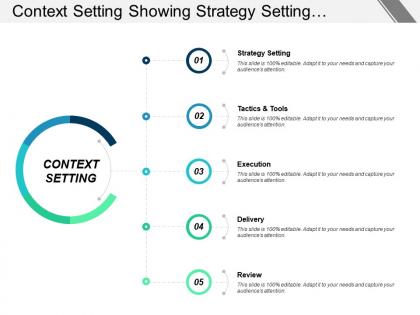
Context setting showing strategy setting execution delivery and review




Try Before you Buy Download Free Sample Product
 Impress Your
 Audience
 100%
100% Editable
 Save Hours
 of Time


Extend your global footprint with our Context Setting Showing Strategy Setting Execution Delivery And Review. gain access to greater connectivity.
People who downloaded this PowerPoint presentation also viewed the following :
Context setting showing strategy setting execution delivery and review with all 5 slides:
Create a global connect with our Context Setting Showing Strategy Setting Execution Delivery And Review. Your thoughts will carry to the ends of the earth.



FAQs for Context setting showing strategy setting execution
Okay so you'll want four main pieces: scanning your environment, creating the strategy, actually doing it, and checking how it's going. Most people totally skip the first part (huge mistake) - you gotta honestly look at what you're good/bad at internally, plus what's happening outside your company. Build your plan from there, making sure it fits your mission. Here's the thing though - implementation is where everything usually falls apart. You need clear communication and someone needs to own each piece. Don't treat this like a one-and-done thing either. Keep tweaking based on what's actually working.
SWOT's basically just organizing what you're good/bad at versus what's happening around you. Map out strengths, weaknesses, opportunities, threats - then figure out your next moves from there. Like, use your strong points to grab opportunities, or fix weak spots before they bite you. Honestly the hardest part is not lying to yourself about where you actually suck. I've seen teams get way too optimistic about "opportunities" that'll never happen. But once you've got realistic info, it's pretty obvious which projects you should tackle first to actually make a difference.
Your board basically acts as guardrails for big strategic calls. They'll approve major stuff like acquisitions or pivoting into new markets, plus hold leadership accountable when things go sideways. Good governance honestly saves you from expensive screw-ups - I've seen companies blow millions on dumb moves their board should've caught. The trick is getting board members who actually get your industry, not just generic business types. Bring them into strategic planning early so they're not just rubber-stamping decisions. They also shape priorities through how they structure exec compensation, which is pretty powerful when you think about it.
Dude, external stuff will mess with your plans no matter what. Economic changes, new rules, competitors doing weird things - it's all gonna hit you. I swear it's like trying to plan a road trip while they're constantly moving the roads around. You've got to build in wiggle room from day one. Check what's happening in your industry regularly so you catch changes early. Don't treat your strategy like it's carved in marble or whatever. Review it every few months and tweak based on what's actually going down in your space.
Start with your actual goals and figure out what capabilities you need to hit them. Innovation? Go flatter, get cross-functional teams talking. Efficiency matters more? Centralize decision-making. Make sure your reporting lines and who gets to decide what actually supports your strategy - not just some pretty org chart that looks impressive in PowerPoint. Culture beats structure every time though, so both need to work together. Oh, and review this stuff quarterly because strategies change way faster than most executives want to admit. Don't get stuck with last year's structure.
So you'll want both types of metrics - the early warning signs (like how much customers are actually engaging) and the final results stuff like revenue. Most companies totally screw this up by only checking the end numbers, which is way too late. Check in monthly or quarterly, whatever works for your timeline. Build a simple dashboard so you can actually see what's happening - I swear, half the battle is just making the data visible. And honestly? Pick metrics that matter for YOUR specific goals, not just whatever everyone else tracks. You can pivot faster when you spot problems early.
Honestly, the worst thing is when nobody really knows what the goal is. Communication breaks down fast after that. I've seen teams stick to plans that obviously aren't working anymore - like, just adapt already! Setting impossible deadlines is another classic mistake. Oh, and skipping the people who actually have to do the work? Recipe for disaster. What's worked for me: make your strategy super clear upfront. Check in regularly so you can change course. Get real data, not just gut feelings. The execution team needs to be on board from day one or you're screwed. Maybe start by looking at what's already going wrong in your current process?
Dude, strategic planning is totally different now. Real-time data changes everything - you can literally watch customer behavior shift and pivot your whole strategy overnight. Market trends, competitor moves, it's all right there. Honestly, if you're still doing those old-school annual planning sessions, you're toast. Speed is everything now, so you need way more agile cycles. The trick? Build flexibility into your framework from the start. That way when some new tech comes out of nowhere and disrupts your entire market - which happens like every other month these days - you can actually adapt instead of scrambling.
Dude, stakeholder analysis basically stops you from building strategies that'll crash and burn. Map out everyone who can influence or mess with your decisions - customers, employees, investors, regulators. I learned this the hard way after some pretty brutal presentation feedback lol. Figure out what each group wants and how much power they actually have. Some stakeholders seem important but can't really touch you, while others fly under the radar but could torpedo everything. Once you know their interests and potential reactions, you can build coalitions and anticipate pushback. Way better than creating beautiful strategies that nobody will actually support.
So basically you're preparing for multiple futures instead of just crossing your fingers and hoping for the best. Pick 3-4 realistic scenarios - worst case, best case, maybe some middle ground stuff. Then see how your strategy holds up against each one. Honestly, the whole process forces you to question things you probably take for granted. You'll start noticing warning signs way earlier. It's not magic, but it beats flying blind. Start with whatever uncertainties keep you up at night in your industry, then build your scenarios around those big variables. Way better than just winging it.
Dude, most people totally screw this up by turning it into just another dashboard. Here's the thing - map out those four areas (financial, customer, internal stuff, learning/growth) but actually connect them with cause-and-effect thinking. Mix leading indicators like training hours with lagging ones like revenue. Quarterly reviews are where the magic happens - that's when you dig into what these numbers actually mean for your strategy. Oh, and start with maybe 12-15 metrics max. I've seen teams go crazy with 50+ metrics and it becomes useless noise.
Honestly, culture is probably the biggest thing that'll tank your strategy if you ignore it. People resist changes that don't fit their "this is how we've always done it" mentality - and I mean they'll unconsciously sabotage stuff without even realizing it. When your culture actually aligns with the new direction though? Everything moves so much faster. You've basically got two options: either tweak your strategy to work with the existing culture, or spend time shifting the culture first. Figure out which cultural habits are helping vs. hurting your goals. It's kind of like swimming upstream otherwise.
Honestly, globalization makes strategic planning way messier but also more interesting. Now you're competing with companies worldwide, not just the shop down the street. COVID really showed us how fragile those international supply chains can be - everything's connected in ways we didn't expect. Different countries mean different rules, cultures, and economic situations to juggle. But here's the upside: you get access to talent everywhere and markets you never could've reached before. My advice? Don't lock yourself into rigid plans. Stay flexible and always have backup strategies ready.
Look, you can't just tack innovation onto the side and hope it works. Actually budget for it - set aside real money and people for experimenting. Most companies try copying Google's 20% time thing but totally mess it up. Your leadership needs to cheer for smart failures, not just the wins. Build small teams that can move without drowning in red tape. Here's what really matters though - track innovation metrics just like you track sales numbers. Don't just talk about it. Fund the experiments, measure what's happening, and reward people when they take the right risks.
Look, competitive analysis shows you where you actually stand versus where you think you stand - and that can be brutal honestly. You'll find gaps you didn't know existed and spot opportunities your competitors are sleeping on. Plus it keeps you from making dumb decisions in isolation. The thing is, you need to do this regularly, not just once when you remember to. I learned this the hard way at my last job. Short bursts work better than these massive quarterly deep-dives anyway. It's really about figuring out if your advantages are legit or just in your head.
-
Informative presentations that are easily editable.
-
Out of the box and creative design.