

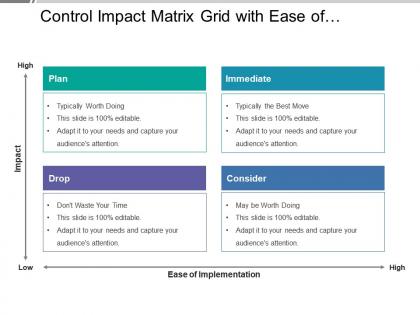
Control impact matrix grid with ease of implementation




Try Before you Buy Download Free Sample Product
 Impress Your
 Audience
 100%
100% Editable
 Save Hours
 of Time


Our Control Impact Matrix Grid With Ease Of Implementation are a pure delight. Your audience will soon have that enchanted look.
People who downloaded this PowerPoint presentation also viewed the following :
Control impact matrix grid with ease of implementation with all 5 slides:
Get a firmer grip with our Control Impact Matrix Grid With Ease Of Implementation. You will exercise better control.



FAQs for Control impact matrix grid with
The key components of a Control Impact Matrix include risk identification, control mechanisms, impact assessment, probability evaluation, and mitigation strategies. This strategic framework enables organizations to systematically analyze potential threats while mapping corresponding controls, with many financial institutions and healthcare organizations finding that this structured approach ultimately delivers enhanced operational resilience and regulatory compliance.
A Control Impact Matrix enhances project management effectiveness by categorizing risks and issues based on controllability and potential impact, enabling teams to prioritize resources strategically, focus efforts on high-impact controllable factors, and develop targeted mitigation strategies. This systematic approach streamlines decision-making processes, reduces project uncertainties, and ultimately delivers improved resource allocation and faster project outcomes.
Control Impact Matrices are most commonly utilized in healthcare, manufacturing, finance, oil and gas, and aviation industries where regulatory compliance and risk management are critical. These sectors leverage the matrix to systematically assess operational risks, streamline compliance processes, and enhance safety protocols, ultimately delivering improved regulatory adherence and operational efficiency across complex organizational structures.
A Control Impact Matrix aids risk assessment by systematically evaluating existing controls against potential risk impacts, identifying gaps where vulnerabilities exceed protective measures, and prioritizing mitigation efforts based on severity and likelihood. Financial institutions and healthcare organizations use these matrices to strengthen cybersecurity frameworks, optimize resource allocation, and demonstrate regulatory compliance, ultimately delivering more robust risk management and operational resilience.
Stakeholder analysis within a Control Impact Matrix identifies key individuals and groups who influence or are affected by potential risks, enabling organizations to prioritize engagement strategies and resource allocation effectively. This strategic approach helps businesses understand stakeholder power dynamics, anticipate resistance or support patterns, and develop targeted communication plans, ultimately delivering stronger project outcomes and stakeholder buy-in across complex organizational initiatives.
Impact criteria in a Control Impact Matrix are determined by evaluating factors like financial consequences, operational disruption, regulatory compliance, reputation damage, and customer satisfaction effects. Organizations typically customize these criteria based on their industry context, with banks focusing on regulatory penalties, manufacturers emphasizing production downtime, and retailers prioritizing customer experience impacts, ultimately enabling more strategic risk management decisions.
**INPUT**: What tools or software can facilitate the creation of a Control Impact Matrix? **OUTPUT**: Control Impact Matrix creation can be facilitated through Excel, Google Sheets, specialized risk management platforms like GRC software, project management tools such as Microsoft Project, and business intelligence dashboards. These technologies streamline risk assessment by enabling automated data visualization, collaborative input, and real-time updates, with many organizations finding that integrated platforms deliver enhanced analytical capabilities and strategic oversight.
Control measures in a matrix include preventive controls like access restrictions and authorization protocols, detective controls such as monitoring systems and audit trails, corrective controls including incident response procedures, and compensating controls like backup verification processes. These controls work across financial services, healthcare, and manufacturing sectors by reducing operational risks, ensuring compliance, and maintaining security standards, ultimately delivering enhanced governance and competitive advantage through systematic risk management.
The Control Impact Matrix enhances decision-making by systematically categorizing issues based on controllability and organizational impact, enabling leaders to prioritize resources strategically and focus efforts where they can drive meaningful change. Through this visual framework, organizations streamline problem-solving processes, minimize time spent on uncontrollable factors, and ultimately deliver more effective outcomes by directing attention toward high-impact, manageable initiatives.
Common challenges include accurately assessing control effectiveness, gathering reliable data across departments, achieving stakeholder consensus on risk ratings, and maintaining matrix relevance amid changing regulations. These obstacles can be overcome through cross-functional collaboration, standardized evaluation criteria, and regular review cycles, with many organizations finding that structured workshops and clear documentation processes ultimately deliver more accurate risk assessments and stronger compliance frameworks.
A Control Impact Matrix integrates into agile practices by helping teams prioritize user stories, assess risk during sprint planning, and make informed decisions about feature development and resource allocation. During retrospectives and daily standups, teams can reference the matrix to evaluate project blockers, adapt priorities based on changing stakeholder influence, and ensure high-impact deliverables receive appropriate attention, ultimately streamlining agile workflows.
**INPUT**: What metrics or KPIs should be tied to the controls listed in the matrix? **OUTPUT**: Control matrix metrics should include process efficiency rates, compliance percentages, risk reduction indicators, cost per incident, and response time measurements. These KPIs enable organizations to track control effectiveness across departments like finance, operations, and quality assurance, while ultimately delivering measurable risk mitigation and operational improvements that enhance competitive positioning.
A Control Impact Matrix should be reviewed quarterly and updated whenever significant operational changes, new risks, or strategic shifts occur within the organization. Regular reviews enable businesses to maintain accurate risk assessments, adapt control measures to evolving threats, and ensure resource allocation remains aligned with current priorities, ultimately delivering sustained operational resilience and competitive advantage.
Collaboration ensures comprehensive risk identification, accurate impact assessments, and realistic control evaluations by leveraging diverse perspectives across departments, functions, and expertise levels. Through cross-functional input, organizations enhance matrix accuracy, build stakeholder buy-in, and create more effective risk mitigation strategies, with many finding that collaborative approaches deliver stronger organizational resilience and faster implementation of critical controls.
A Control Impact Matrix supports compliance by systematically mapping regulatory requirements to specific controls, identifying risk exposure levels, and prioritizing remediation efforts based on potential impact. This structured approach enables organizations, particularly in heavily regulated sectors like financial services and healthcare, to demonstrate control effectiveness to auditors, streamline compliance reporting, and proactively address regulatory gaps before they become violations.
-
Commendable slides with attractive designs. Extremely pleased with the fact that they are easy to modify. Great work!
-
Excellent Designs.