


Corporate Regulatory Compliance Strategic Plan Strategy CD V




Try Before you Buy Download Free Sample Product
 Impress Your
 Audience
 100%
100% Editable
 Save Hours
 of Time


A compliance strategy is a plan of action that organizations use to ensure they abide by all applicable laws, rules, and industry standards. Grab our Corporate Regulatory Compliance Strategic Plan template. It includes a strategic plan to reduce the risks of non-compliance and to uphold the organizations good name and credibility. Our Compliance Program deck suggests strategies for managing organizational compliance requirements by identifying current issues faced by the enterprise. It further develops a compliance plan including steps, setting compliance goals, aligning business compliance with corporate culture, defining functional scope, etc. Additionally, our Risk Mitigation PPT provides information about various compliance management strategies addressing areas, complying with regulatory compliance, establishing organizational values, risk assessment, and management. These areas further include strategies such as regulatory compliance, data protection, workplace health and safety, environment safety, HR compliance, corporate governance, ethical behavior, risk management process, process risks, and quality standards. At last, our Regulatory Compliance module includes the implementation, budget, impact analysis, and dashboard tracking to measure the performance of essential compliance metrics. Get instant access.
People who downloaded this PowerPoint presentation also viewed the following :
Content of this Powerpoint Presentation
Slide 1: This slide introduces Corporate Regulatory Compliance Strategic Plan. Commence by stating Your Company Name.
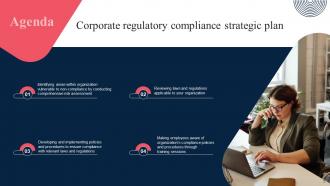
Slide 2: This slide depicts the Agenda of the presentation.
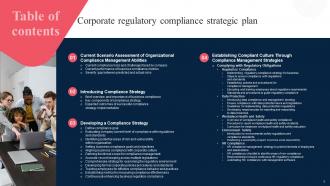
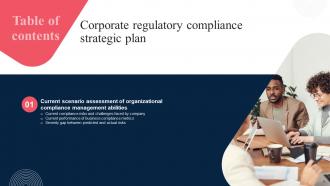
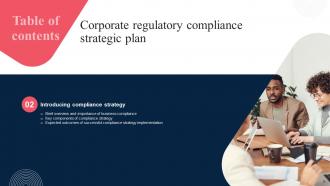
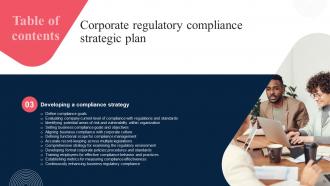
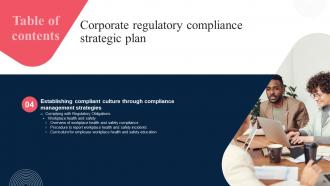
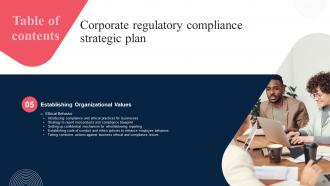
Slide 3: This slide includes the Table of contents.
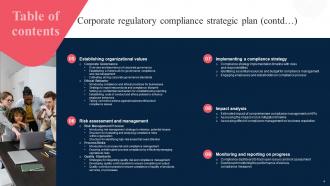
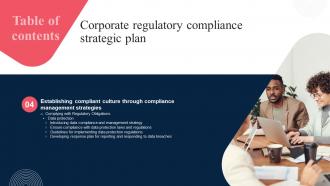
Slide 4: This slide further includes the Table of contents.
Slide 5: This slide highlights the Title for the Topics to be covered further.
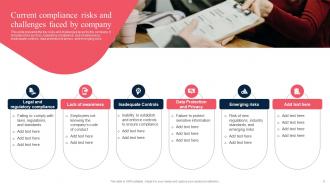
Slide 6: This slide presents the key risks and challenges faced by the company.
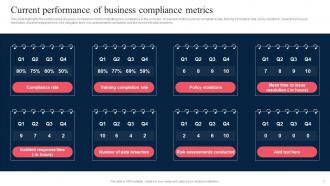
Slide 7: This slide highlights the performance of various compliance metrics indicating non-compliance in the company.
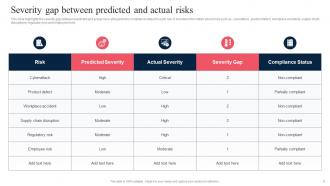
Slide 8: This slide shows the severity gap between predicted and actual risks alongside the compliance status for each risk.
Slide 9: This slide includes the Heading for the Contents to be discussed next.
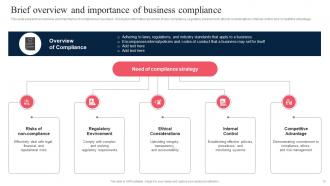
Slide 10: This slide presents an overview and importance of compliance in business.
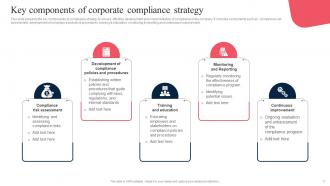
Slide 11: This slide portrays the key components of compliance strategy to ensure effective development and implementation of compliance in the company.
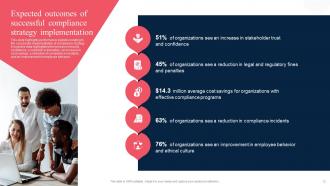
Slide 12: This slide highlights performance statistics relating to the successful implementation of compliance strategy.
Slide 13: This slide indicates the Title for the Ideas to be covered further.
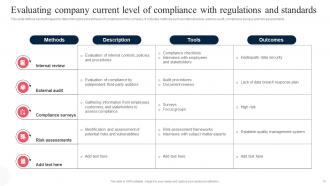
Slide 14: This slide defines key techniques for determining the present level of compliance in the company.
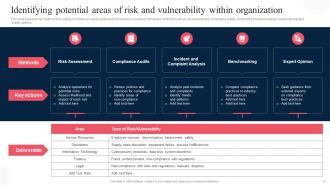
Slide 15: This slide presents key methods for locating compliance's weak spots and risky places in business.
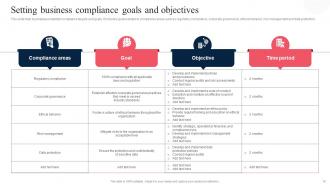
Slide 16: This slide helps businesses establish compliance targets and goals.
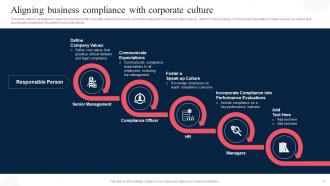
Slide 17: This slide outlines strategies for aligning compliance with corporate culture to ensure its successful integration.
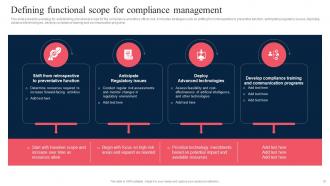
Slide 18: This slide shows a strategy for establishing a functional scope for the compliance and ethics officer role.
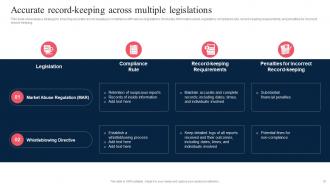
Slide 19: This slide includes a strategy for ensuring accurate record-keeping in compliance with various legislations.
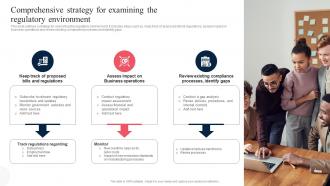
Slide 20: This slide outlines a strategy for examining the regulatory environment.
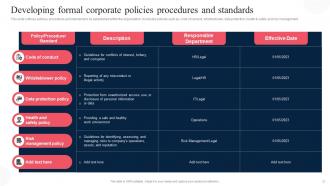
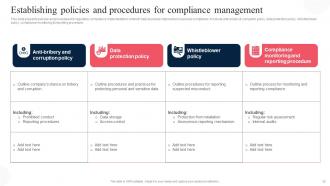
Slide 21: This slide portrays policies, procedures and standards to be established within the organization.
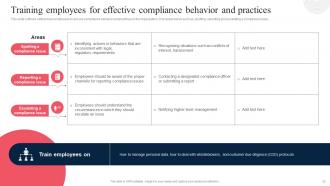
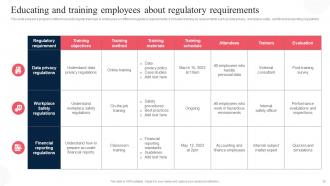
Slide 22: This slide outlines skills to train employees to ensure compliance behavior and practices in the organization.
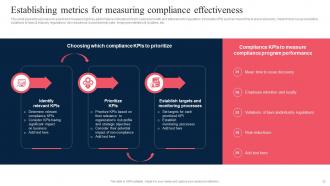
Slide 23: This slide presents a process to select and measure right key performance indicators to track business health and adherence to regulation.
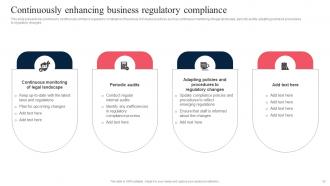
Slide 24: This slide contains key practices to continuously enhance regulatory compliance of business.
Slide 25: This slide shows the Heading for the Ideas to be discussed next.
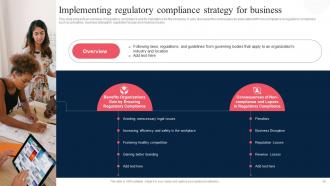
Slide 26: This slide presents an overview of regulatory compliance and its importance for the company.
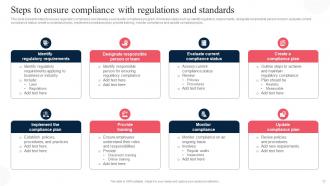
Slide 27: This slide illustrates steps to ensure regulatory compliance and develop a successful compliance program.
Slide 28: This slide presents policies and procedures for regulatory compliance implementation of which help business improve their business compliance.
Slide 29: This slide shows a program outline to provide regular trainings to employees on different regulatory requirements.
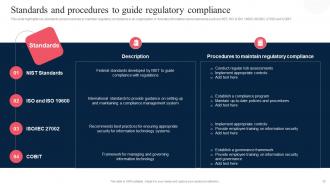
Slide 30: This slide highlights key standards and procedures to maintain regulatory compliance in an organization.
Slide 31: This slide indicates the Title for the Contents to be covered further.
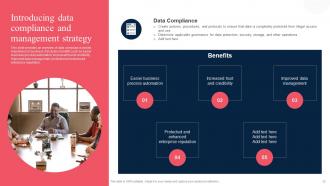
Slide 32: This slide provides an overview of data compliance and its importance in business.
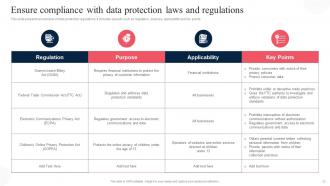
Slide 33: This slide presents an overview of data protection regulations.
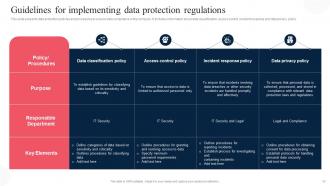
Slide 34: This slide reveals data protection policies and procedures to ensure data compliance in the company.
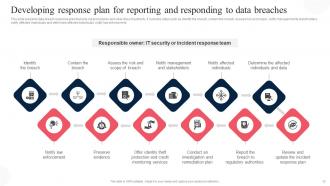
Slide 35: This slide depicts data breach response plan that sets out procedures and clear lines of authority.
Slide 36: This slide indicates the Heading for the Topics to be discussed next.
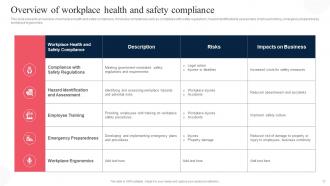
Slide 37: This slide presents an overview of workplace health and safety compliance.
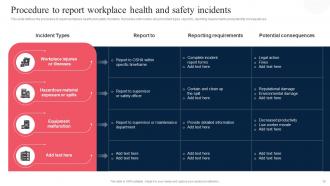
Slide 38: This slide defines the procedure to report workplace health and safety incidents.
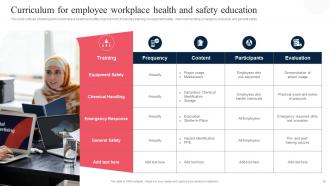
Slide 39: This slide outlines a training plan on workplace health and safety improvement.
Slide 40: This slide represents the Title for the Topics to be covered in the following template.
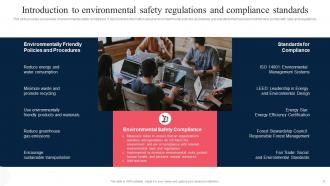
Slide 41: This slide provides an overview of environmental safety compliance.
Slide 42: This slide shows the sustainability program to promote environmentally responsible practices throughout the organization.
Slide 43: This slide indicates the Heading for the Contents to be discussed further.
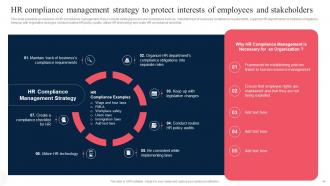
Slide 44: This slide presents an overview of HR compliance management.
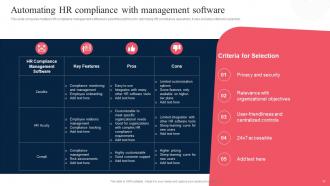
Slide 45: This slide compares multiple HR compliance management software to select the right tool for optimizing HR compliance operations.
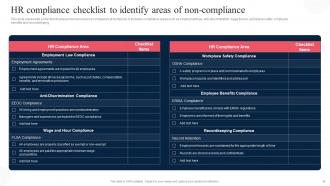
Slide 46: This slide represents a checklist to ensure human resource compliance at workplace.
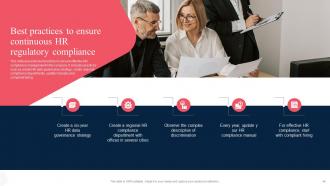
Slide 47: This slide exhibits best practices to ensure effective HR compliance management in the company.
Slide 48: This slide includes the Title for the Ideas to be covered next.
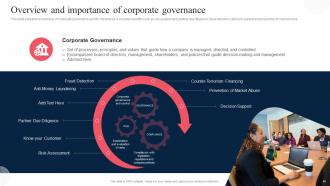
Slide 49: This slide presents an overview of corporate governance and its importance.
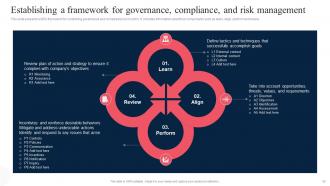
Slide 50: This slide shows a GRC framework for controlling governance and compliance risk in a firm.
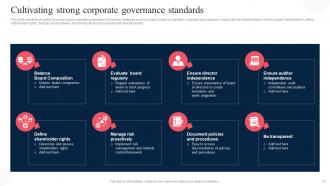
Slide 51: This slide portrays key tactics to ensure good corporate governance.
Slide 52: This slide highlights the Heading for the Ideas to be discussed further.
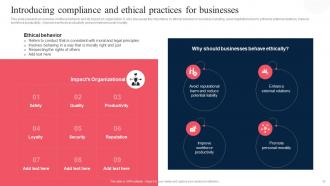
Slide 53: This slide presents an overview of ethical behavior and its impact on organization.
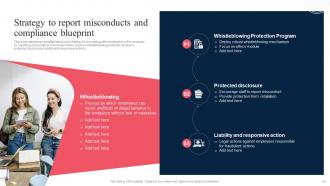
Slide 54: This slide introduces whistleblowing and strategy for promoting ethical behavior in the company by reporting misconducts.
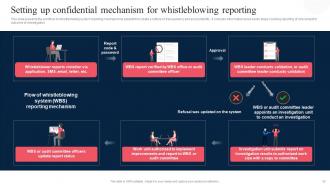
Slide 55: This slide shows the workflow of whistleblowing system reporting mechanism to establish to create a culture of transparency and accountability.
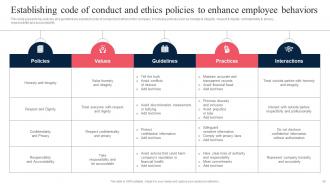
Slide 56: This slide presents key policies and guidelines to establish code of conduct and ethics in the company.
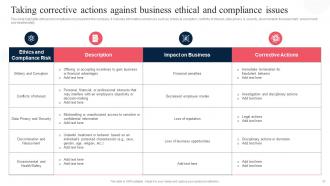
Slide 57: This slide highlights ethical and compliance risk present in the company.
Slide 58: This slide contains the Title for the Contents to be discussed next.
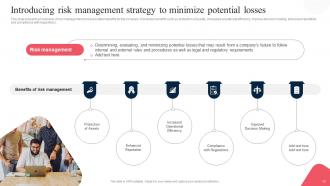
Slide 59: This slide presents an overview of risk management and associated benefits for the company.
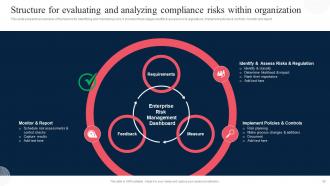
Slide 60: This slide depicts the Overview of framework for identifying and monitoring risks.
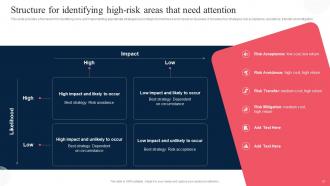
Slide 61: This slide provides a framework for identifying risks and implementing appropriate strategies according to its likelihood and impact on business.
Slide 62: This slide shows the Heading for the Topics to be covered further.
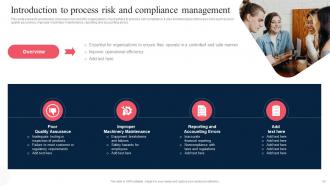
Slide 63: This slide presents an overview of process risk and why organizations must adhere to process risk compliance.
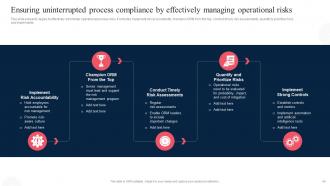
Slide 64: This slide presents strategies to effectively administer operational process risks.
Slide 65: This slide indicates the Title for the Topics to be discussed next.
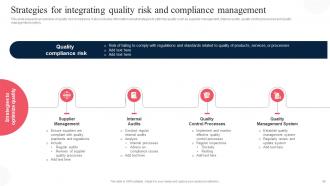
Slide 66: This slide presents an overview of quality risk compliance.
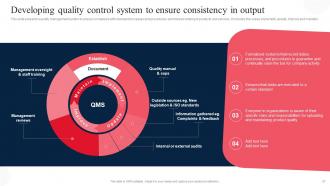
Slide 67: This slide portrays Quality management system to ensure compliance with standard processes and procedures.
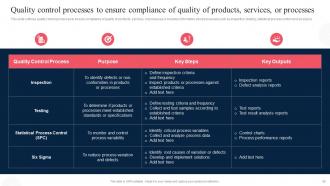
Slide 68: This slide outlines quality control processes to ensure compliance of quality of products, services, or processes.
Slide 69: This slide exhibits the Heading for the Contents to be covered in the next template.
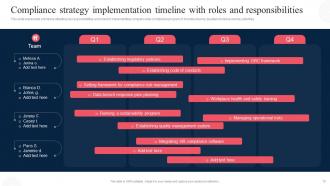
Slide 70: This slide represents a timeline detailing key responsibilities and roles for implementing company wide compliance program.
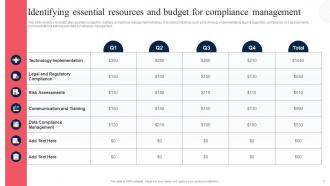
Slide 71: This slide analyzes and allocates quarterly budget for multiple compliance management initiatives.
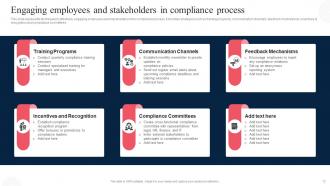
Slide 72: This slide represents techniques to effectively engaging employees and stakeholders in the compliance process.
Slide 73: This slide shows the Title for the Ideas to be covered further.
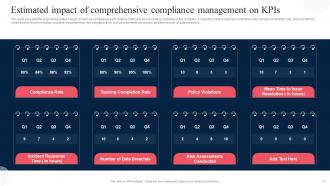
Slide 74: This slide presents the projected positive impact on various compliance performance metrics to ensure total compliance in the company.
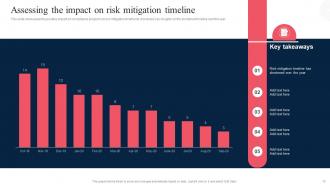
Slide 75: This slide showcases the positive impact on compliance program on risk mitigation timeframe.
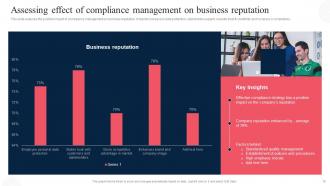
Slide 76: This slide analyzes the positive impact of compliance management on business reputation.
Slide 77: This slide depicts the Heading for the Ideas to be further discussed.
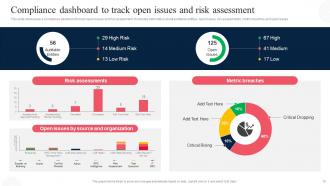
Slide 78: This slide showcases a compliance dashboard to track open issues and risk assessment.
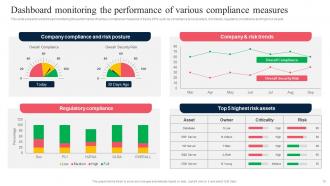
Slide 79: This slide reveals the dashboard for monitoring the performance of various compliance measures.
Slide 80: This is the Icons slide containing all the Icons used in the plan.
Slide 81: This slide is used for showcasing some Additional information.
Slide 82: This slide incorporates the company's mission, vision, and goals.
Slide 83: This is the About us slide. State your organization-related information here.
Slide 84: This is Meet our team slide.
Slide 85: This slide shows the goals of the firm.
Slide 86: This slide contains the Post it notes for reminders and deadlines.
Slide 87: This is the Venn diagram slide.
Slide 88: This is the Puzzle slide with related imagery.
Slide 89: This slide displays the SWOT analysis.
Slide 90: This slide shows the Column chart.
Slide 91: This slide displays the Line chart.
Slide 92: This slide reveals the timeline.
Slide 93: This is the roadmap slide.
Slide 94: This is the Thank You slide for acknowledgement.
Corporate Regulatory Compliance Strategic Plan Strategy CD V with all 94 slides:
Use our Corporate Regulatory Compliance Strategic Plan Strategy CD V to effectively help you save your valuable time. They are readymade to fit into any presentation structure.














FAQs for Corporate Regulatory Compliance Strategic Plan
So it really comes down to what kind of business you're running. Most places have to deal with SOX if they're public, plus data privacy stuff like GDPR or CCPA. Employment laws are everywhere too, obviously. Healthcare and finance get hit with way more - HIPAA, SEC requirements, all that banking nonsense. It's honestly pretty overwhelming when you start digging into it. I'd figure out what data you're collecting first, then look at where you operate geographically. Your industry matters a ton too. Legal should help map this out, but those three things will give you a starting point at least.
Honestly, leadership has to actually walk the walk first - if they're cutting corners, forget it. Make training that doesn't suck by connecting it to people's real work instead of those awful generic modules. I'd set up regular check-ins where managers discuss compliance stuff in team meetings, maybe monthly? Create safe ways for people to ask questions without getting thrown under the bus. Oh, and explain WHY it matters beyond just "legal says so" - like how it protects their actual jobs. The key thing is making everyone feel responsible for it, not just dumping it on legal.
Look, technology really does change everything for compliance stuff. You can automate all that tedious monitoring work and get alerts when regulations shift. Plus it catches potential violations early - way better than dealing with expensive problems later. Set up systems that automatically pull reports from different databases. AI tools scan emails and messages for risky content too. Digital audit trails make regulators happy, which honestly saves everyone headaches. Your team won't be stuck doing boring manual tasks anymore. They'll actually get to work on the important strategic decisions. I'd start by figuring out what compliance work takes forever, then find tech solutions for those specific pain points first.
Most companies do annual training plus regular workshops throughout the year. Pizza at lunch-and-learns definitely boosts turnout - learned that the hard way! Start with a training calendar mapping out what each role actually needs. Mix foundational stuff with whatever new regulations are hitting your industry. Bringing in outside experts works well too. The big thing is making it continuous, not just checking boxes once. Track who's completing what and actually test if people retained anything. Oh, and create formal learning paths so there's some structure to it all.
Honestly, most companies I've seen mess up because their policies are ancient - like nobody's looked at them since 2018. Training is usually garbage too. Regulatory changes happen way more often than people realize, and documentation? Don't even get me started on how messy that gets. Privacy laws are the worst though, especially with every state doing their own thing now. You really need regular audits and proper training for your team. Oh, and definitely set up some kind of compliance calendar to track deadlines - trust me on that one. It's boring but it'll save your butt.
Track your training completion rates and how many issues you catch internally vs externally finding them first. Time to resolution is honestly my go-to metric - shows if your team actually responds fast or just talks about it. Employee reporting through hotlines matters too. Higher rates usually mean people trust the system won't screw them over. Set benchmarks and check monthly, not just when audits happen. Oh, and focus on your biggest risks first rather than measuring everything at once. Leading and lagging indicators together give you the real picture of what's working.
Honestly, start by mapping out what you're doing now - you'll spot the biggest time wasters pretty quick. Automate your data collection and get standard templates going across all departments. Workflow tools are a lifesaver for tracking deadlines and who's doing what (way better than those messy spreadsheets we all hate). RegTech solutions can plug into your existing systems and cut down on manual entry errors. Oh, and cross-train people on different reports so you're not screwed when Sarah goes on vacation. Focus on fixing the worst bottlenecks first - don't try to overhaul everything at once.
Oh yeah, this happens way more than people realize. Even if you're purely domestic, international rules can still bite you. GDPR hits anyone handling EU customer data - doesn't matter where you're based. Anti-corruption laws, export controls, financial stuff... lots of regulations have this weird reach across borders now. Your suppliers or customers abroad? That's another potential headache right there. Honestly, I'd take a quick look at anywhere you touch international stuff (even just having overseas clients counts) and see what compliance issues might be lurking. Better to catch it early than deal with fines later.
So governance is basically your company's playbook for making decisions and running things day-to-day. Compliance? That's just making sure you're following all the laws and regulations that hit your industry. Here's the thing though - they work together like crazy. When you've got solid governance with clear processes and accountability, compliance becomes so much easier. You're not scrambling to figure out who does what when regulators come knocking. Honestly, I've seen too many companies try to fix compliance problems without looking at their governance first. That's backwards. Fix your decision-making framework and the regulatory stuff usually falls into place.
Start digging into their compliance stuff way early - regulatory history, any investigations brewing, gaps they're trying to hide. Figure out which regulatory bodies you'll need to deal with (this gets annoying with all the overlapping jurisdictions). Your legal team should flag anything sketchy that could tank the whole deal. Document everything, obviously. Here's what I learned the hard way - build compliance into your M&A timeline from the beginning instead of scrambling later. Oh, and set up those regular check-ins between both compliance teams so nobody's blindsided.
First thing - map out your audit plan against whatever regs you're dealing with and grab all the docs upfront. Interview people from different departments, though honestly getting them to actually call you back is like pulling teeth. Document everything as you go instead of scrambling later to remember what happened. Look for compliance gaps but also check if current controls actually work (spoiler: they often don't). Before you wrap up, run your findings by the business folks to make sure you didn't miss context. The magic happens when you turn everything into a real action plan with names and dates attached.
Honestly, just make everything way more visible to whoever's watching. Regular reports help, but skip the corporate speak - actually explain what you're doing instead of those useless checkbox updates everyone ignores. Put your policies somewhere people can find them without a treasure hunt. Proactively talk to regulators instead of waiting for them to come knocking. Oh, and here's the thing most companies screw up - admit when stuff goes wrong. I've seen way too many places try to act like they're flawless. That just makes people suspicious.
Dude, seriously - when you mess up compliance, your reputation gets absolutely wrecked. Trust me, I've seen it happen. Customers bail, investors panic, and the media just tears you apart. Bad news spreads so damn fast now with social media and everything. Your brand value? Gone overnight. Then you're stuck trying to rebuild for years while good employees jump ship and potential partners won't even return your calls. Even your stock price and team morale take a hit. Way easier to just stay compliant from the start than deal with that nightmare later.
Ugh, regulatory changes are such a pain - they make you totally rethink how you operate. Your processes need tweaking, teams might get reshuffled, sometimes you're looking at a complete business model overhaul just to stay legal. And don't get me started on compliance costs, they add up fast. But honestly? Your competitors are dealing with the same headache, so there's opportunity there. The smart move is treating these shifts like a chance to innovate and get ahead. Oh, and definitely set up some kind of monitoring system now - trust me, you don't want to be caught off guard when the next wave hits.
Start with an audit of what you've got now - that'll show you where the real gaps are. Your industry association probably has solid training programs, though some are better than others. Check out what your regulators publish too (SEC, FDA, whoever). Yeah, it's boring stuff but surprisingly helpful. External consultants can do gap analysis if you need it. Honestly, don't underestimate just talking to other compliance officers at conferences - they'll tell you what actually works versus what looks good on paper. Focus on your biggest problems first instead of trying to fix everything at once.
-
I am really satisfied with their XYZ products. Used their slides for my business presentations and now I am taking their help for my son's high-school assignments. Super satisfied!!
-
“There is so much choice. At first, it seems like there isn't but you have to just keep looking, there are endless amounts to explore.”