


Corporate Restructuring Project Roles Responsibilities After Organizational Restructuring




Try Before you Buy Download Free Sample Product
 Impress Your
 Audience
 100%
100% Editable
 Save Hours
 of Time


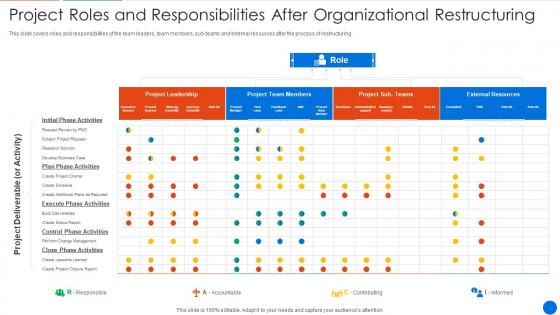
This slide covers roles and responsibilities of the team leaders, team members, sub teams and external resources after the process of restructuring
People who downloaded this PowerPoint presentation also viewed the following :
Corporate Restructuring Project Roles Responsibilities After Organizational Restructuring with all 6 slides:
Use our Corporate Restructuring Project Roles Responsibilities After Organizational Restructuring to effectively help you save your valuable time. They are readymade to fit into any presentation structure.





FAQs for Corporate Restructuring Project Roles Responsibilities
Corporate restructuring aims to enhance operational efficiency, reduce costs, improve financial performance, streamline organizational structure, and strengthen competitive positioning. Through strategic reorganization, companies eliminate redundancies, optimize resource allocation, and accelerate decision-making processes, with many organizations finding that restructuring ultimately delivers improved profitability and sustainable growth in increasingly dynamic markets.
Effective communication strategies facilitate corporate restructuring by establishing transparent channels, addressing employee concerns proactively, and maintaining stakeholder confidence throughout the transition process. These approaches enable organizations to minimize resistance, preserve talent retention, and ensure operational continuity, with many companies finding that clear, consistent messaging ultimately delivers faster implementation timelines and stronger post-restructuring performance.
Financial analysts play crucial roles in corporate restructuring by conducting financial modeling, valuation analysis, due diligence assessments, and scenario planning to evaluate restructuring options. They analyze debt structures, cash flow projections, and asset valuations while collaborating with investment bankers and legal teams, ultimately delivering data-driven insights that guide strategic decisions and optimize financial outcomes for stakeholders.
Corporate restructuring risks include operational disruption, employee morale decline, cultural integration challenges, financial strain, and regulatory compliance issues. While these challenges can temporarily impact productivity and stakeholder confidence, organizations that plan strategically often find that proactive communication, phased implementation, and clear change management ultimately deliver enhanced operational efficiency and stronger market positioning.
Mergers and acquisitions involve combining separate companies or acquiring ownership stakes, while other restructuring forms like divestitures, spin-offs, and reorganizations focus on internal operational changes within existing entities. M&A transactions typically require extensive due diligence, regulatory approvals, and integration planning, with companies in sectors like technology and healthcare finding that strategic acquisitions accelerate growth faster than internal restructuring alone.
Stakeholder analysis is crucial for restructuring success because it identifies all parties affected by organizational changes, assesses their influence levels, and determines their potential support or resistance. This comprehensive mapping enables leadership teams to develop targeted communication strategies, anticipate challenges from key stakeholders like employees, investors, and creditors, and secure buy-in for transformation initiatives, ultimately delivering smoother transitions and higher implementation success rates.
Project management principles streamline corporate restructuring by establishing clear timelines, defining stakeholder responsibilities, and creating structured communication frameworks throughout organizational transitions. These methodologies enable companies to manage complex changes systematically, with many financial services and manufacturing firms finding that applying project management reduces restructuring timeframes by 30-40% while minimizing operational disruptions.
Legal considerations during corporate restructuring include compliance with securities regulations, employment law requirements, contractual obligations, tax implications, and creditor rights protection. These requirements vary significantly across jurisdictions, with companies needing specialized legal counsel to navigate merger approvals, debt restructuring terms, and regulatory filings, ultimately ensuring the restructuring delivers operational efficiency while minimizing legal risks and maintaining stakeholder confidence.
Cultural factors significantly influence restructuring success by affecting employee acceptance, change adaptation, and communication effectiveness throughout the organization. Companies with collaborative cultures often experience smoother transitions, while hierarchical environments may face resistance, with many organizations finding that addressing cultural alignment early through transparent communication, leadership modeling, and inclusive change management ultimately delivers higher restructuring success rates and sustained organizational transformation.
Strategic planning for restructuring typically employs SWOT analysis, scenario planning, financial modeling, stakeholder mapping, and balanced scorecards. These frameworks enable organizations to assess current positions, model potential outcomes, and track progress systematically, with many companies finding that combining multiple tools delivers more comprehensive insights and ultimately supports more successful transformation initiatives across diverse industries.
Leadership drives restructuring success by establishing clear vision, communicating transparently with stakeholders, making strategic decisions about resource allocation, and maintaining employee morale during transitions. Through decisive action and consistent messaging, executives navigate organizational changes while preserving operational continuity, with many companies finding that strong leadership ultimately delivers faster adaptation, reduced resistance, and sustainable competitive advantage.
Employee engagement during corporate restructuring can be maintained through transparent communication, involving employees in change processes, providing career development opportunities, and recognizing contributions throughout transitions. Organizations like GE and IBM have successfully preserved morale by offering retraining programs, maintaining open dialogue channels, and clearly articulating future vision, ultimately delivering retained talent and smoother organizational transformation.
Organizations should evaluate restructuring effectiveness using financial metrics like cost reduction percentages, revenue growth, and ROI, alongside operational indicators such as employee productivity, customer satisfaction scores, and process efficiency improvements. These comprehensive measurements enable companies across sectors like manufacturing and financial services to track both immediate cost savings and long-term strategic gains, ultimately delivering measurable competitive advantage.
Technology streamlines corporate restructuring through automated data analytics, real-time financial modeling, digital communication platforms, and integrated project management systems. These tools enable organizations to accelerate due diligence processes, enhance stakeholder collaboration, and minimize operational disruptions, with many companies finding that technology-driven restructuring delivers faster decision-making and significantly reduced restructuring costs.
Corporate restructuring significantly impacts company culture and morale through organizational uncertainty, communication changes, role redefinitions, and shifting workplace dynamics. While restructuring can create initial anxiety and resistance among employees, strategic implementation with transparent communication, clear vision articulation, and employee engagement initiatives ultimately enhances organizational alignment, operational efficiency, and competitive positioning, with many companies finding stronger, more focused cultures emerge post-restructuring.
-
Keep doing the good work guys. Surpass the needs and expectations always!!
-
I downloaded some of the presentations for work. They were simple to modify and saved me a lot of time and effort.