


Organization chart after restructuring organizational chart and business model restructuring




Try Before you Buy Download Free Sample Product
 Impress Your
 Audience
 100%
100% Editable
 Save Hours
 of Time


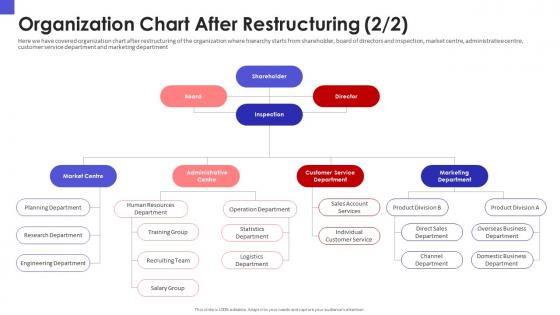
Here we have covered organization chart after restructuring of the organization where hierarchy starts from shareholder, board of directors and inspection, market centre, administrative centre, customer service department and marketing department.
People who downloaded this PowerPoint presentation also viewed the following :
Organization chart after restructuring organizational chart and business model restructuring with all 6 slides:
Use our Organization Chart After Restructuring Organizational Chart And Business Model Restructuring to effectively help you save your valuable time. They are readymade to fit into any presentation structure.





FAQs for Organization chart after restructuring organizational chart and
Organizations typically consider restructuring to improve operational efficiency, reduce costs, adapt to market changes, enhance competitive positioning, and streamline decision-making processes. These strategic transformations enable companies to realign resources, eliminate redundancies, and respond more effectively to evolving customer demands, with many finding that restructuring ultimately delivers improved profitability and organizational agility.
Effective communication strategies mitigate resistance during organizational restructuring by establishing transparency through regular updates, addressing employee concerns directly, and clearly articulating the benefits and timeline of changes. Through consistent messaging across all levels, organizations can build trust, reduce uncertainty, and foster buy-in, with many companies finding that proactive communication ultimately accelerates implementation while maintaining employee morale and productivity.
Employee feedback serves as a critical foundation for successful restructuring by identifying operational inefficiencies, revealing employee concerns, and uncovering hidden organizational challenges that leadership might overlook. Through surveys, focus groups, and one-on-one interviews, companies can strategically align restructuring decisions with ground-level realities, ultimately enhancing employee buy-in and minimizing resistance while delivering smoother transitions.
Organizations can assess restructuring success through employee engagement surveys, financial performance metrics, operational efficiency indicators, customer satisfaction scores, and talent retention rates. These measurement approaches enable companies to evaluate whether changes have streamlined processes, reduced costs, and improved market responsiveness, with many finding that comprehensive assessment frameworks ultimately deliver clearer insights into competitive positioning.
Organizational restructuring risks include employee resistance, talent loss, decreased productivity, communication breakdowns, and cultural disruption. While these challenges can temporarily impact operations, organizations that implement clear communication strategies, phased transitions, and comprehensive change management find that proactive planning minimizes disruption and ultimately delivers stronger competitive positioning.
Organizational culture significantly influences restructuring by shaping employee resistance levels, communication patterns, and change adoption rates throughout the transformation. Companies with collaborative cultures often experience smoother transitions, while rigid hierarchical environments may face greater pushback, with many organizations finding that aligning restructuring strategies with existing cultural values ultimately delivers faster implementation and higher employee buy-in.
Leaders can maintain employee morale during restructuring through transparent communication about changes, involving employees in decision-making processes, providing professional development opportunities, and recognizing contributions consistently. These strategies work by reducing uncertainty, fostering engagement, and demonstrating investment in staff, with many organizations finding that proactive support ultimately delivers higher retention rates and smoother transitions.
Technology supports organizational restructuring through automation tools, data analytics platforms, communication systems, project management software, and digital workflow solutions. These technologies streamline restructuring by enabling real-time collaboration, providing data-driven insights for decision-making, and automating routine processes, with many organizations finding that strategic technology integration reduces restructuring timelines while enhancing operational efficiency.
Restructuring can temporarily disrupt customer relationships through changes in account management, service processes, and communication channels, potentially creating confusion or delays. However, well-executed restructuring often enhances service delivery by streamlining operations, improving response times, and better aligning resources with customer needs, with many organizations finding that strategic restructuring ultimately strengthens customer satisfaction and competitive positioning.
Horizontal restructuring involves flattening organizational hierarchies by removing management layers and expanding roles laterally, while vertical restructuring focuses on streamlining reporting chains and consolidating departments upward or downward. Organizations typically choose horizontal approaches when seeking enhanced collaboration and faster decision-making, with many technology companies finding significant improvements in innovation speed, while vertical restructuring suits cost reduction initiatives and clearer accountability structures.
Mergers and acquisitions typically drive comprehensive organizational restructuring through consolidating duplicate departments, integrating different corporate cultures, and realigning reporting structures to achieve operational synergies. These strategic combinations enable companies to streamline operations, eliminate redundancies, and optimize resource allocation, with many organizations finding that successful integration ultimately delivers enhanced market position and improved operational efficiency.
Key metrics include employee productivity levels, decision-making speed, communication flow efficiency, cost per operational unit, and employee satisfaction scores. These indicators help organizations assess whether structural changes enhance collaboration, reduce bureaucratic delays, and improve resource allocation, with many companies finding that effective restructuring delivers measurable improvements in both operational efficiency and competitive responsiveness.
Leadership roles should adapt by embracing collaborative decision-making, enhancing communication transparency, developing cross-functional expertise, and fostering change resilience throughout their teams. These adaptations enable leaders to navigate flatter hierarchies, facilitate smoother transitions, and maintain employee engagement, with many organizations finding that adaptive leadership ultimately delivers improved operational efficiency and stronger competitive positioning.
Organizations should establish clear communication channels, engage employees early in the process, provide comprehensive training programs, maintain transparent timelines, and designate change champions across departments. Through strategic planning and consistent feedback mechanisms, companies like IBM and General Electric have successfully navigated major restructurings, ultimately delivering improved operational efficiency and stronger competitive positioning while minimizing disruption.
Organizations can prepare for legal implications by conducting thorough compliance audits, consulting employment law specialists, reviewing union agreements, and ensuring transparent communication with stakeholders. Through strategic legal planning, companies streamline regulatory adherence, minimize litigation risks, and protect employee rights while maintaining operational continuity, ultimately delivering smoother transitions and reduced restructuring costs.
-
Informative design.
-
Qualitative and comprehensive slides.
-
Unique and attractive product design.
-
Colors used are bright and distinctive.
-
Nice and innovative design.