


Cost Benefit Analysis For Software Project Management




Try Before you Buy Download Free Sample Product
 Impress Your
 Audience
 100%
100% Editable
 Save Hours
 of Time


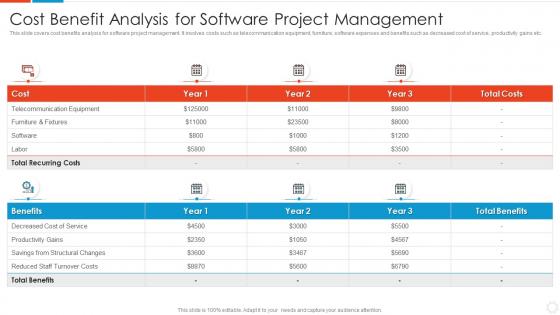
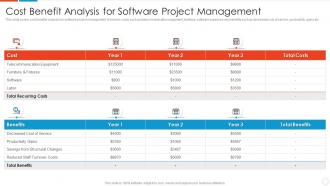
This slide covers cost benefits analysis for software project management. It involves costs such as telecommunication equipment, furniture, software expenses and benefits such as decreased cost of service, productivity gains etc.
People who downloaded this PowerPoint presentation also viewed the following :
Cost Benefit Analysis For Software Project Management with all 6 slides:
Use our Cost Benefit Analysis For Software Project Management to effectively help you save your valuable time. They are readymade to fit into any presentation structure.





FAQs for Cost Benefit Analysis For
Honestly, just start by making two lists - what it'll cost you vs what you'll get back. Include the obvious stuff plus any sneaky costs that might pop up later. Then try putting actual dollar amounts on everything. Yeah, it's annoying when you're dealing with fuzzy benefits like "better team morale" or whatever. I usually just ballpark those - better than ignoring them completely. Once you have rough numbers, calculate your ROI or payback period. Don't stress about getting everything perfect right away. Even messy estimates beat making decisions based on hunches alone.
Honestly, you'll want to find ways to put dollar signs on those fuzzy benefits. Surveys work well - just ask people what they'd actually pay for whatever you're measuring. Time savings are the easy ones since you can multiply saved hours by wages. For safety stuff, there are statistical life values you can use (sounds morbid but it's standard practice). Environmental benefits? Check out hedonic pricing from housing markets - people pay more for clean air areas. You could also look at replacement costs or dig into actual market behaviors to see what people really value. Just be upfront about your assumptions when presenting everything.
So you've got a few ways to tackle cost estimation. Bottom-up is probably your best bet - estimate each piece then add it all up. Takes longer but way more accurate. Top-down uses old project data for quick ballparks, though it can be pretty rough. There's also parametric stuff like cost per square foot, which works great for construction but maybe not your thing? Three-point estimation covers best case, worst case, and realistic scenarios. Honestly, I'd mix bottom-up with some historical data to double-check your numbers. That combo usually works pretty well.
So discounting makes future money worth less than today's money in your calculations. Higher rates? Those long-term benefits barely matter. A project with huge upfront costs but massive payoffs later could look awful with high discounting, then suddenly brilliant with lower rates. There's no perfect rate to use, which honestly drives me crazy sometimes. Your choice can totally flip whether something seems worthwhile. I always test different rates to see how much my conclusions change - you'd be surprised how dramatic the swings can be.
Sensitivity analysis is your reality check for CBA. It tests how your results change when you mess with key assumptions or variables. Run different scenarios - tweak discount rates, cost estimates, benefit projections. See if your conclusions survive. Think of it as stress-testing because our initial estimates? Usually way off. Small assumption changes that flip your recommendation from "yes" to "hell no" mean the project's shaky. I learned this the hard way once. Always test your three most uncertain variables. You'll thank me later when you don't look like an idiot.
Honestly, government agencies are probably the biggest users since they're spending taxpayer money and have to justify everything. Healthcare orgs do it tons too. Infrastructure projects - roads, bridges, that kind of thing - rely on it heavily because those decisions are huge and permanent. Oh and finance/consulting firms are obsessed with this stuff, but that's kind of their whole thing anyway. Makes sense though - when you're making massive capital decisions that'll affect things for decades, you need solid numbers to back it up. If you end up in any of these areas, you'll definitely want to get good at CBA since people will expect you to show your work.
Honestly, putting real numbers on environmental stuff is the only way you'll get budget approval. Start by listing who actually benefits - employees, customers, regulators, whatever. Then calculate the obvious wins like lower energy bills and avoiding those nasty regulatory fines. Brand reputation boost is harder to quantify but still matters. Yeah, some benefits are annoying to monetize (carbon reduction, ecosystem services), but there are frameworks out there. Don't forget long-term impacts - they're usually where the big money is. Just be upfront about your assumptions when you present it.
Honestly, most people mess up by being way too optimistic about costs and timelines. Implementation always costs more than you think. Maintenance fees add up fast too - nobody ever budgets enough for that stuff. Don't forget the soft benefits like happier employees, even though they're harder to measure. Double-counting is another trap I see all the time. Mix up your time periods and suddenly your whole analysis is garbage. Document everything though, because someone's definitely gonna question your math later. Being pessimistic upfront actually helps you look smarter when things go better than expected.
Get them involved from day one - seriously, don't wait. Figure out who's actually impacted (including the less obvious people). Ask what they think matters most for costs and benefits because you'll definitely miss things otherwise. Run some workshops or just sit down and talk with them. Then check back later to see if your assumptions were right. Oh and be upfront about the tradeoffs - nobody likes surprises. I've seen too many projects fail because people treated stakeholders like an afterthought instead of actual partners. Circle back to validate everything before you finalize anything.
NPV, ROI, and Benefit-Cost Ratio are your best bets here. ROI is what gets executives excited - they love seeing those percentages. NPV gives you the real dollar impact though, which is honestly more useful when you're actually making decisions. BCR shows how much bang you get for each buck spent (anything over 1.0 means you're winning). Throw in payback period too so people know when they'll see their money back. But seriously, don't go crazy with like 8 different metrics - pick maybe 2 or 3 tops. Nobody wants to wade through a spreadsheet nightmare.
Honestly, tech makes CBA so much better - you can automate all that tedious data collection instead of doing it by hand. AI processes huge datasets and spots patterns you'd totally miss otherwise. Real-time scenario modeling is a game changer too. Cloud tools let your whole team work on the same analysis without that annoying back-and-forth email thing we all hate. Machine learning cuts down on human bias in your calculations, which is pretty cool. I'd start with Monte Carlo simulation software if you're feeling ambitious. Or just upgrade your spreadsheet platform - even that helps with better modeling capabilities.
So basically, quantitative analysis is all the hard numbers - dollars, percentages, stuff you can actually measure and throw into a spreadsheet. Qualitative is the fuzzy stuff that's harder to pin down, like how happy your employees are or what customers really think about your brand. Here's the thing though - you kinda need both in most situations. I mean, not everything that matters has a clear dollar sign attached to it, you know? Start with whatever numbers you can get your hands on, then factor in those harder-to-measure things. That's usually how you get the whole story before deciding anything important.
So inflation basically eats away at what your money can actually buy down the road. You've got two options - either bump up all your future costs using inflation projections, or convert everything back to today's dollars with real discount rates. People screw this up constantly by mixing the two approaches, which honestly makes sense because it's confusing. Just pick one method and stick with it the whole way through. I'd probably go with real values if I were you. Way easier to explain to people who don't live and breathe this stuff, and you won't have to deal with as many moving parts in your calculations.
Honestly, cost-benefit analysis can be pretty useless in certain situations. Like when ethics or safety are involved - you can't really put a dollar amount on human life, right? It also sucks when you're working with crappy data or need to make quick decisions. And don't even get me started on trying to quantify stuff like team morale or how customers feel about your brand. That's nearly impossible. If you're dealing with any of this mess, just go with a simple pros and cons list instead. Sometimes trusting your gut and asking people what they think works way better than spreadsheets.
So first, figure out what could actually mess up your projections - like supply chain issues or market changes. Give each scenario a probability (best case, worst case, realistic). I always do a quick risk matrix because otherwise it's just chaos, honestly. From there you've got two options: either multiply outcomes by their probabilities for expected values, or run sensitivity tests to see how tweaking variables affects everything. Oh and don't forget the sensitivity analysis part - it's super useful for showing stakeholders different scenarios. Being upfront about potential problems beats crossing your fingers any day.
-
This design is not only aesthetically pleasing but it has many uses making the cost worthwhile. The graphics look stunning, and you can edit them as per your needs.
-
SlideTeam is the way to go when you are in a time crunch. Their templates have saved me many times in the past three months.