Enterprises Cost Benefit Analysis Report

Rating:
80%
Enterprises Cost Benefit Analysis Report
Slide 1 of 7

or

Favourites Favourites

Try Before you Buy Download Free Sample Product

Audience Impress Your
Audience
Editable 100%
Editable
Time Save Hours
of Time
The Biggest Sale is ending soon in
0
0
:
0
0
:
0
0
Rating:
80%
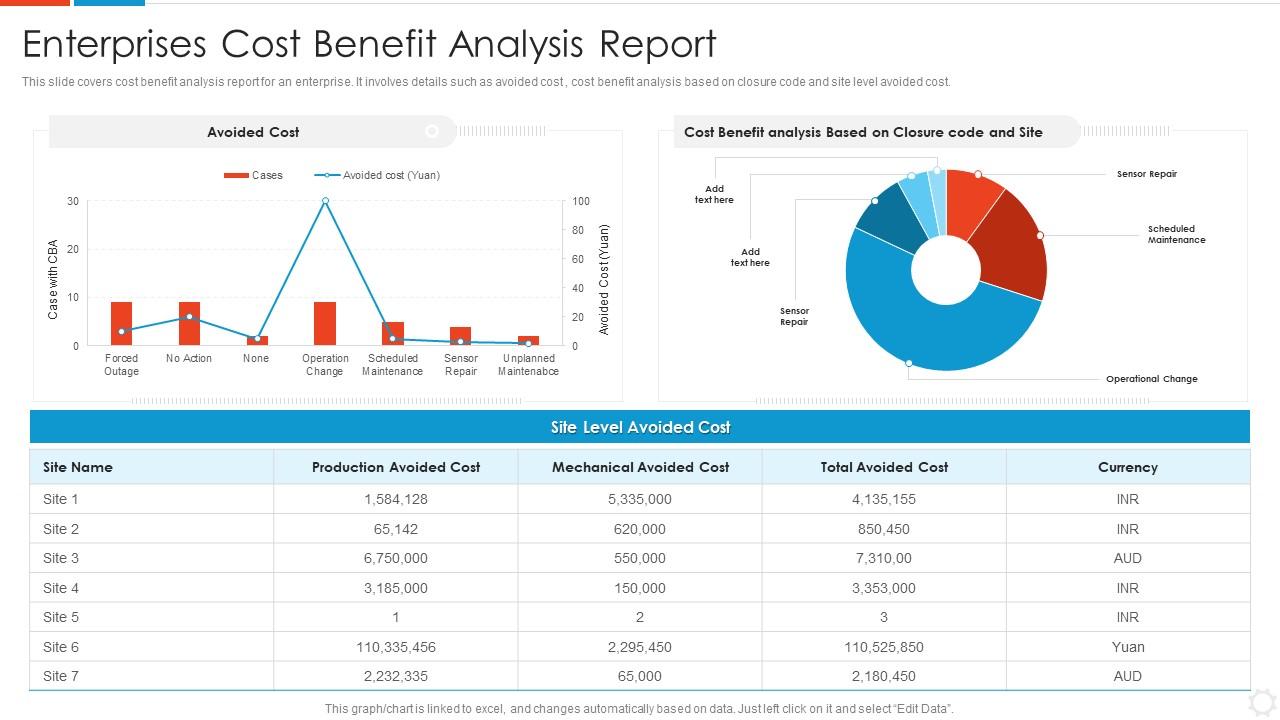
This slide covers cost benefit analysis report for an enterprise. It involves details such as avoided cost , cost benefit analysis based on closure code and site level avoided cost. Presenting our well-structured Enterprises Cost Benefit Analysis Report. The topics discussed in this slide are Enterprises Cost Benefit Analysis Report. This is an instantly available PowerPoint presentation that can be edited conveniently. Download it right away and captivate your audience.

FAQs for Enterprises Cost

Key components of a cost-benefit analysis include identifying all relevant costs, quantifying direct and indirect benefits, establishing timeframes, calculating net present value, and assessing risk factors. These elements work together by providing comprehensive financial visibility, enabling data-driven decision making, and supporting resource allocation strategies, with many organizations finding that systematic analysis ultimately delivers improved project outcomes and competitive advantage.

Organizations effectively quantify intangible benefits through methods like customer satisfaction surveys, employee retention metrics, brand value assessments, and risk reduction calculations. These approaches enable businesses to assign monetary values to improvements in reputation, workplace culture, and operational resilience, with many financial services and healthcare institutions finding that structured frameworks ultimately deliver measurable competitive advantages and strategic insights.

Risk assessment serves as a critical foundation for cost-benefit analysis by identifying potential uncertainties, quantifying probability-based scenarios, evaluating mitigation costs, and adjusting projected returns accordingly. Through comprehensive risk evaluation, organizations in sectors like healthcare, finance, and manufacturing can make more informed investment decisions, allocate resources strategically, and ultimately deliver more accurate project valuations while minimizing unexpected costs.

Varying discount rates significantly alter long-term project valuations by changing the present value of future cash flows, with higher rates reducing future benefits' current worth and lower rates increasing them. Financial institutions and infrastructure developers find that even small rate changes can shift project feasibility, making discount rate selection critical for accurate investment decisions and strategic resource allocation.

Cost-benefit analysis proves insufficient when decisions involve significant intangible factors like brand reputation, employee morale, or ethical considerations that resist quantification. Complex strategic initiatives, regulatory compliance requirements, and situations with high uncertainty or long-term cultural implications often require broader evaluation frameworks, with many organizations finding that qualitative assessments complement financial analysis for comprehensive decision-making.

**INPUT**: What tools and software can enhance the accuracy of cost-benefit analyses? **OUTPUT**: Cost-benefit analysis tools include Excel with advanced modeling capabilities, specialized software like @RISK for risk assessment, Crystal Ball for Monte Carlo simulations, and enterprise platforms such as IBM Planning Analytics. These technologies enhance accuracy by automating complex calculations, incorporating sensitivity analysis, and providing scenario modeling capabilities, with many financial institutions and consulting firms finding that integrated platforms ultimately deliver more reliable forecasting and strategic decision-making insights. **Word count: 60 words**

Sensitivity analysis strengthens cost-benefit analysis by testing how changes in key assumptions, variables, and scenarios affect overall outcomes, identifying critical factors that significantly impact results. Through systematic variation of inputs like costs, benefits, discount rates, and timeframes, organizations can assess project viability under different conditions, ultimately delivering more reliable decision-making frameworks and reducing investment risks.

Common pitfalls include underestimating hidden costs, overestimating benefits, ignoring intangible factors, using unrealistic timeframes, and failing to account for risk scenarios. These oversights can mislead decision-making in sectors like healthcare and manufacturing, where organizations increasingly find that comprehensive analysis, stakeholder input, and sensitivity testing ultimately deliver more accurate projections and strategic outcomes.

Cost-benefit analysis for nonprofits emphasizes social impact measurement, mission alignment assessment, and stakeholder value creation rather than pure financial returns. Organizations adapt traditional frameworks by incorporating qualitative metrics, community outcomes, and donor satisfaction indicators, while balancing program effectiveness with operational sustainability, ultimately enabling strategic resource allocation that maximizes both social impact and organizational growth.

Industries with high capital expenditures and regulatory requirements benefit most from rigorous cost-benefit analysis, including healthcare, manufacturing, financial services, energy, and telecommunications. These sectors leverage systematic analysis to evaluate major investments, comply with regulatory frameworks, and optimize resource allocation, with many organizations finding that structured evaluation processes deliver enhanced operational efficiency and competitive advantage.

Stakeholders can be engaged through collaborative workshops, structured interviews, survey feedback collection, and regular consultation meetings throughout the analysis process. These engagement methods enable organizations to gather diverse perspectives, validate assumptions, and build consensus around investment decisions, with many companies finding that inclusive stakeholder participation enhances analysis accuracy and implementation success.

Ethical considerations in cost-benefit analysis include equitable impact distribution, stakeholder representation, environmental sustainability, transparency in assumptions, and long-term societal effects. While quantifying benefits and costs, organizations must ensure fair treatment across demographics, consider intangible values like human dignity, and maintain accountability, ultimately delivering decisions that balance profitability with social responsibility and sustainable growth.

Historical data enhances predictive accuracy by identifying cost patterns, risk factors, implementation timelines, and actual versus projected outcomes from previous projects. Through comprehensive data analysis, organizations can calibrate assumptions, adjust for seasonal variations, and benchmark against industry standards, ultimately delivering more realistic projections and strategic decision-making capabilities for future investments.

Defining the time frame for cost-benefit analysis establishes when costs will be incurred and benefits realized, ensuring accurate financial projections and realistic expectations. This temporal framework enables organizations to account for implementation phases, seasonal variations, and long-term returns, with many businesses finding that well-defined timelines improve stakeholder buy-in and strategic planning accuracy.

Cost-benefit analysis supports strategic planning by providing quantitative frameworks for evaluating potential initiatives, comparing resource allocation options, and assessing long-term financial impacts across different scenarios. Through systematic evaluation of costs versus expected returns, organizations can prioritize high-impact projects, minimize financial risks, and make data-driven decisions that align with growth objectives, ultimately delivering improved operational efficiency and competitive advantage.

Ratings and Reviews

80% of 100
Review Form
Write a review
Most Relevant Reviews
  1. 80%

    by Damon Castro

    Crisp and neat slides. Makes it fun and easier to curate presentations. 
  2. 80%

    by Cliff Jimenez

    Unique research projects to present in meeting.

2 Item(s)

per page: