


Cost leadership strategy ppt slides




Try Before you Buy Download Free Sample Product
 Impress Your
 Audience
 100%
100% Editable
 Save Hours
 of Time


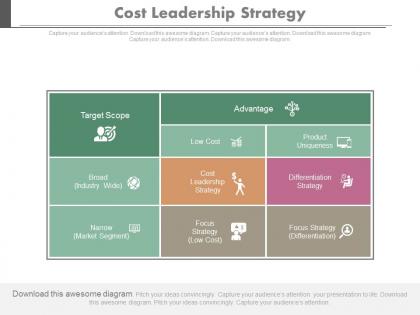
If as a business professional you want to achieve competitive advantage through your business strategies you need to communicate your plans to your teams. For this you will need our cost leadership strategy PPT slides. The cost leaders work out the strategies to ensure maximum output with minimum economical input in the area of production. Through our cost leadership organizational structure PowerPoint presentation, we tend to provide you a framework where you can talk about the cost leadership strategy, differentiation strategy and focus strategy in respect to market segmentation. The cost specific business slide template is brightly colored and graphed to ensure maximum disbursement of knowledge with great ease. All efforts have been made by our experts to make the understanding of cost leadership PPT presentation an easy one. We guarantee that if as a presenter you are well equipped with experience and knowledge, our platform in form of the provided cost strategy structure presentation model will work wonders for you by bringing the right match between your income and expense chart.Our Cost Leadership Strategy Ppt Slides help you build up your data bank. They keep generating fresh discoveries.
People who downloaded this PowerPoint presentation also viewed the following :
Cost leadership strategy ppt slides with all 6 slides:
Our Cost Leadership Strategy Ppt Slides ensure a cozy feeling. They will fit your thoughts like a glove.
FAQs for Cost leadership
So cost leadership is all about being the cheapest option while your quality doesn't totally suck. Walmart's the classic example - not glamorous but it works. You'll want to streamline everything, use tech to speed things up, and get better deals with suppliers. Honestly, Southwest Airlines nails this too. The whole point is cutting per-unit costs through efficiency and scale. Start by figuring out where you're bleeding money right now. Once you spot those drain points, you can actually do something about them.
Honestly, start with cutting the obvious waste - most companies are bleeding money in ways they don't even notice. Get better deals with suppliers by buying more volume, and spread those fixed costs across way more units. Technology's your friend here too, automate the boring repetitive stuff so you're not paying people to do robot work. Oh and audit your biggest expenses first, that's where the real money is hiding. The trick is finding savings without screwing up the quality customers actually give a damn about. It's like trimming fat but keeping the good meat, you know?
So basically, economies of scale are huge for keeping costs low. When you make more stuff, you spread those fixed costs across way more units - suddenly each thing costs less to produce. Think about it like Costco vs your corner store for toilet paper, except for actual manufacturing. Bigger companies already have this advantage locked down, so honestly? You can't really compete on price without it. The trick is ramping up your volume first. Once you've got that going, then you can work on making your operations smoother. But volume comes first - that's where the real savings happen.
Dude, cost leadership is honestly such a power move. You can slash prices below competitors and still make money, or keep prices the same and rake in way more profit. Price wars become an option (messy but sometimes necessary). Your low costs are like having a shield - competitors can't touch you even when markets get brutal. Quick responses to threats? Easy. The whole thing works because you've built this cost advantage that's super hard for others to copy. Just... make sure you're actually THE lowest cost player before you start getting aggressive with pricing. Otherwise you'll get burned.
Dude, price wars are brutal - you'll get stuck racing to the bottom with everyone else. Margins get crushed fast. Then there's the whole brand thing where customers start thinking you're just cheap instead of good value, which sucks. Also exhausting constantly cutting costs while trying not to screw up quality. What really worries me though? If some competitor figures out how to operate way cheaper, you're toast. Oh and honestly, competing only on price is just... risky as hell. You need other stuff going for you - better service, unique features, whatever. Don't put all your eggs in the cheap basket.
Honestly, tech is your best bet for cutting costs when you scale up. Automate the boring repetitive stuff first - that's where you'll see immediate savings. Better supply chain software helps too, plus data analytics will show you waste you never noticed before. Robotics and AI quality control are game-changers for manufacturing, though yeah, they're expensive upfront. I'd also look at redesigning products to use cheaper materials or simpler processes. Oh, and don't fall for shiny tech that doesn't actually reduce your cost per unit - seen too many companies waste money on that.
Look at Walmart - their whole thing is crushing prices through crazy scale and supply chains. Southwest ditched assigned seating and meals to keep flights cheap. Makes sense, honestly. McDonald's standardized everything to feed millions without breaking the bank. Then there's IKEA making you build your own furniture but giving you decent Scandinavian design for way less. The trick is figuring out what customers actually care about versus what's just nice-to-have fluff. These companies all cut the extras but didn't mess with quality where it counts.
Look, operational efficiency is basically your secret weapon for beating competitors on price. You cut waste, automate the boring stuff, fix your supply chain - suddenly you're producing things way cheaper than everyone else. Manufacturing companies figured this out ages ago with lean processes. Here's the thing though - those savings actually build on each other over time, which is pretty cool. While your competitors are stuck with messy, expensive operations, you've got room to drop prices and still make money. I'd start by mapping out where you're bleeding the most cash and tackle the obvious problems first.
So when you're going the cheap route, customer service gets stripped down - that's just how it works. Longer wait times, fewer ways to contact you, lots of "figure it out yourself" stuff. Can't do the fancy hand-holding that expensive brands offer because the math doesn't add up. Your customers know this though! They picked you for the price, not the treatment. Just be upfront about what they can expect. I'd focus on fixing the stuff everyone complains about super fast rather than trying to be everything to everyone. Keep it simple but don't let it suck completely.
Yeah totally doable, just gotta be smart about it. Cut costs where customers can't see it - back office stuff, supply chain, automation. Then pick maybe 2-3 things that actually matter to your customers and invest there. Southwest nailed this. Super cheap operations but they're known for being friendly and on-time. That's it - they don't try to be everything to everyone, which honestly more companies should figure out. I'd start by asking your customers what they actually care about vs what you think they want. You might be surprised how much "premium" stuff they couldn't care less about.
Look, mapping out your whole supply chain first is gonna show you where money's bleeding out. Build solid relationships with suppliers - bulk buying gets you way better deals. Just-in-time inventory saves a ton on storage costs too. Route optimization is honestly underrated, but the shipping savings add up fast. Better demand forecasting means you're not stuck with excess stock. Oh, and if you can sync up systems with your suppliers, coordination becomes so much smoother. The waste reduction alone makes it worth it. Start with the biggest cost drains and work from there.
Dude, you absolutely have to know what your competitors are doing price-wise. Map out their cost structures and supply chains first - figure out where you can beat them or where you're falling short. Honestly, skipping this is like trying to win a poker game blindfolded. Look at how they operate and steal their best ideas (then make them better). The whole point is finding ways to undercut their prices without your quality going to shit. Oh, and don't just do this once - keep tracking them because things change fast.
Cost per unit is honestly the main thing you should obsess over - it tells you everything about whether this is actually working. Track your gross margins against competitors too, plus operating efficiency and market share. Customer acquisition costs are tricky though, because cheaper prices should bring more customers but sometimes the math gets weird. I'd also watch inventory turnover and how efficient your production is running. The real test? You need to consistently beat competitors on price while your quality doesn't tank. If that's not happening, time to switch strategies.
Dude, culture totally makes or breaks cost leadership. Your team needs to actually *want* to find cheaper, faster ways to do things - not everyone's wired that way, which is fine but not great for this strategy. People have to get excited about operational stuff or you're screwed. Oh and if you're global? Good luck getting different cultures to follow your standardized processes. That's always messy. Bottom line: hire folks who genuinely love efficiency, not ones who'll just put up with it.
So basically, cost leadership means you're going after everyone - like how Walmart tries to beat all competitors on price across the board. Cost focus is totally different though. You pick one specific group and tailor everything just for them. Southwest Airlines is perfect for this - they don't bother with business travelers who want fancy meals. They just focus on people who want cheap flights, period. Honestly, I think cost focus is smarter if you don't have massive resources. Why spread yourself thin when you could absolutely crush it in one area?
-
Really like the color and design of the presentation.
-
Designs have enough space to add content.