


Coworking space pitch deck ppt template




Try Before you Buy Download Free Sample Product
 Impress Your
 Audience
 100%
100% Editable
 Save Hours
 of Time


Our Coworking Space Pitch Deck Ppt Template are topically designed to provide an attractive backdrop to any subject. Use them to look like a presentation pro.
People who downloaded this PowerPoint presentation also viewed the following :
Content of this Powerpoint Presentation
Slide 1: This is the introductory slide of the PPT presentation Co-working Space– Pitch Deck.
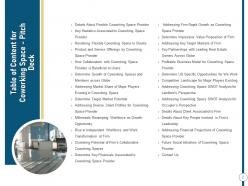
Slide 2: Specify the Table of Content for your presentation in this slide. Share the details, key benefits, market potential, etc..
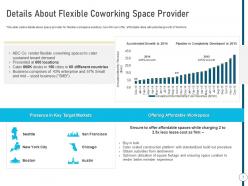
Slide 3: This slide caters to details about space providers for flexible workspace solutions and how firms can offer affordable rates with potential growth in a co-working space.
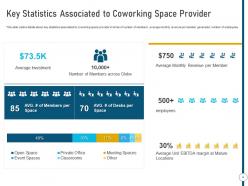
Slide 4: This slide caters to the details about the crucial statistics associated with co-working space providers regarding the number of members, average monthly revenue per member-generated, and the number of employees.
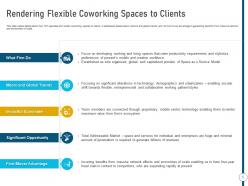
Slide 5: This slide caters to details about how firms operate and render co-working spaces to clients. It addresses macros and global trends and its first-mover advantage in generating benefits from massive networks and economies of scale.
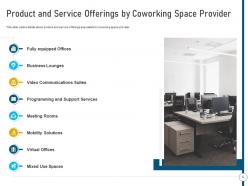
Slide 6: This slide caters to details about product and service offerings associated with co-working space providers.
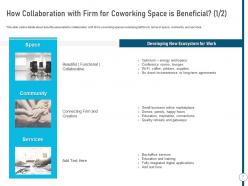
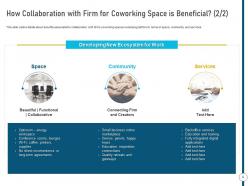
Slide 7: This slide caters to details about benefits associated with collaboration with the firm's co-working spaces revamping platform regarding space, community, and services.
Slide 8: This slide caters to the details about benefits associated with collaboration with the firm's co-working spaces revamping platform in terms of space, community, and services.
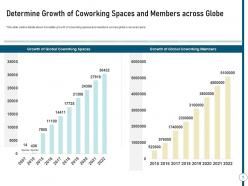
Slide 9: This slide caters to details about the incredible growth of co-working spaces and members across the globe in several years.
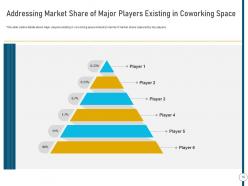
Slide 10: This slide caters to details about major players in the co-working space industry in terms of market share captured by top players.
Slide 11: This slide caters to details about key financials and the key deductions of the co-working space in terms of revenue generated and EBITDA using a dashboard representation.
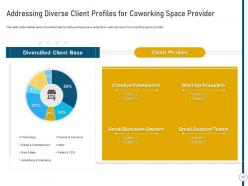
Slide 12: This slide caters to details about diversified client profiles and bases that cater to co-working space providers' services.
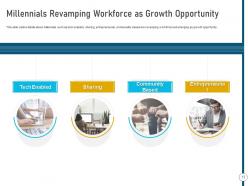
Slide 13: This slide caters to details about millennials such as tech-enabled, sharing, entrepreneurial, communality-based, revamping workforce, and emerging as a growth opportunity.
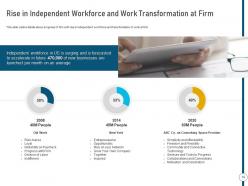
Slide 14: This slide caters to details about progress of firms with rising in the independent workforce and the transformation of work at the firm.
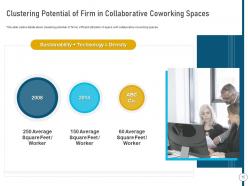
Slide 15: This slide caters to details about the clustering potential of a firm's inefficient space utilization with collaborative co-working spaces.
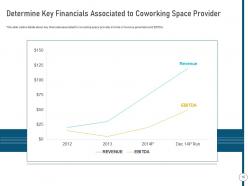
Slide 16: This slide caters to details about key financials associated with co-working space providers in terms of revenue generated and EBITDA on a single graph.
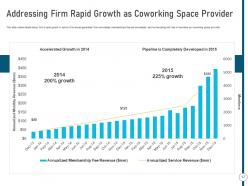
Slide 17: This slide caters to details about the firm's rapid growth in revenues generated from annualized memberships fees and annualized service fees, along with the rise in members as co-working space providers.
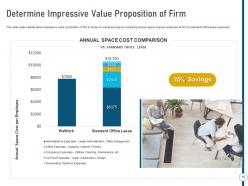
Slide 18: This slide caters to details about the impressive value proposition in terms of overall savings by comparing annual space cost per employee at the firm to standard office lease expenses.
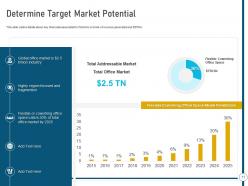
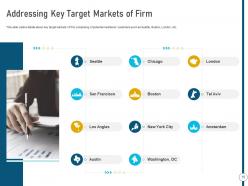
Slide 19: This slide caters to details about important target markets of firms comprising potential members/ customers such as Seattle, Boston, London, etc.
Slide 20: This slide caters to details about the firm's strong relationships with global real estate owners/ landlords allowing it to get insights about premier real estate portfolios across the globe.
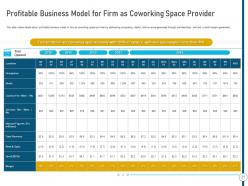
Slide 21: This slide caters to the details about the profitable business model of the firm as a co-working space provider by addressing occupancy, desks, total revenue generated through memberships, rent, and overall margins generated.
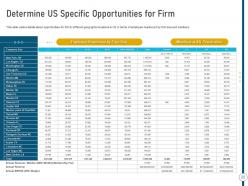
Slide 22: This slide caters to details about opportunities for firms in different geographic locations in the US in terms of employee headcount by firm size and members.
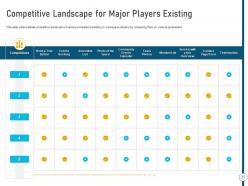
Slide 23: This slide details the competitive landscape of various competitors in the workspace industry by comparing them on multiple parameters.
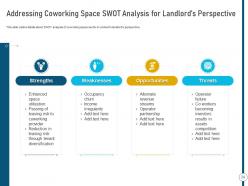
Slide 24: This slide caters to details about the SWOT analysis of the co-working space sector in context of the landlord's perspective.
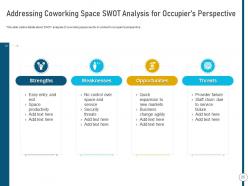
Slide 25: This slide caters to details about the SWOT analysis of the co-working space sector in context to occupier's perspective.
Slide 26: This slide caters to details about clients associated with the firm in terms of significant clients and client testimonials.
Slide 27: This slide caters to details about crucial people associated with the firm's leadership in rendering co-working spaces to clients and making strategic decisions.
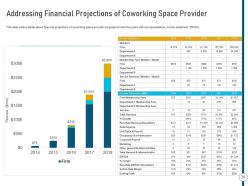
Slide 28: This slide caters to details about financial projections of co-working space provider progress for the next five years with critical assumptions, income statement, and EBITDA.
Slide 29: This slide caters to details about future initiatives by co-working space providers that will focus on leveraging connections across members/clients.
Slide 30: This slide caters to details about future initiatives by co-working space providers that will focus on leveraging connections across members/clients.
Slide 31: This is the slide to share the contact details like phone number, email id, etc.
Slide 32: This slide presents the Icons for quick accessibility and usage in this Co-working Space–Pitch Deck presentation.
Slide 33: This slide marks the beginning of additional slides that comprise the company-related morals and statistics.
Slide 34: This slide provides the mission for the entire company. This includes the vision, the task, and the goal.
Slide 35: This slide shows the key members of your team with their name, designation, and photo.
Slide 36: Here is a slide dedicated to showing the goal of your company.
Slide 37: This is the 'About Us' slide. Highlight your characteristic features, target audience, and distinct clients in this slide.
Slide 38: This slide provides a Venn diagram that can show interconnectedness and overlap between various departments, projects, etc.
Slide 39: This slide contains Post It Notes that can express any brief thoughts or ideas.
Slide 40: This slide contains the Circular metric Diagram to compare statistics.
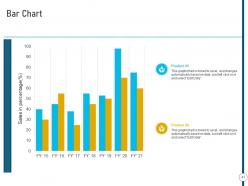
Slide 41: This slide contains a bar graph metric to compare two or more variables for various fiscals.
Slide 42: This is a timeline slide to share your growth and milestones creatively.
Slide 43: This is a Thank You slide where details such as the address, contact number, email address are added.
Coworking space pitch deck ppt template with all 43 slides:
Use our Coworking Space Pitch Deck Ppt Template to effectively help you save your valuable time. They are readymade to fit into any presentation structure.


FAQs for Coworking space pitch
Honestly, the networking alone is worth it - way better than talking to your cat all day. You get meeting rooms for client visits, decent wifi, and office equipment without buying everything yourself. Working from your couch sounds great until you realize you haven't changed out of pajamas in three days. The structure actually helps with productivity too. Plus most places do workshops and events that might lead to new projects or at least teach you something useful. I'd try a day pass first though - some coworking spaces have weird vibes and you don't want to commit to that.
Honestly, coworking spaces are pretty genius for meeting people. You'll have designers next to developers, consultants grabbing coffee with marketers - it's this whole professional mixing thing that just works. The open layout helps too since you're naturally bumping into people at the kitchen or in lounges. Most places do networking events and community stuff, which sounds cheesy but actually connects you with people you'd never cross paths with otherwise. I'd say try a day pass somewhere and see what happens. You might be surprised who you end up chatting with by the coffee machine.
Definitely check the wifi speed first - nothing worse than laggy video calls. Comfortable seating is huge, not just those awful desk chairs. Good coffee actually makes a difference (I learned this the hard way at my last place). Make sure they have clean bathrooms, bookable meeting rooms, and decent lighting. Oh and phone booths for calls are super helpful. Free snacks and events are cool bonuses but not dealbreakers. Honestly though, visit during your normal work hours first to see if you can actually focus there. Some places look great but are way too loud or have weird energy.
Honestly, coworking spaces can be great for productivity - there's something about being around other motivated people that just rubs off on you. Plus you can switch up your spot when you're feeling stuck. But here's the thing - they're definitely noisier than a regular office. If you're someone who needs total silence to concentrate, it might drive you crazy. I'd say grab a day pass first and see how you feel about all the activity around you. Oh, and the flexibility is huge too - way better than being stuck at the same desk every day.
So basically, flexibility is the name of the game now - hybrid memberships let you bounce between different locations. Community stuff is huge too, like networking events and spaces built around specific industries. The tech side has gotten pretty wild honestly - everything's app-based booking and smart building features. Some places feel more like Google's offices than coworking spaces lol. Green building materials are everywhere now since everyone's obsessed with sustainability. Oh and definitely look for flexible lease terms when you're checking places out. Strong community programming makes a massive difference in whether you'll actually want to show up every day.
Honestly, coworking spaces are perfect for startups. You get meeting rooms, decent wifi, printers - all that office stuff without crazy rent costs. The networking though? That's where it gets interesting. I've watched people strike up partnerships literally while waiting for their coffee to brew. Most places do month-to-month which is clutch when you're bootstrapping. Plus you'll have a real business address for your paperwork instead of using your apartment (learned that one the hard way). Just visit a few spots first - the vibe matters way more than you'd think.
Hey! So basically, young people drive the whole coworking thing - millennials and Gen Z are all about that flexibility over boring corporate offices. Location's huge too. You'll crush it in cities packed with freelancers and startups, but good luck in suburbia lol. The income thing's weird though - people need enough cash to afford membership but aren't necessarily making bank. Most members have college degrees and work in creative/tech stuff. Honestly, before you even think about opening one, just walk around your area first. Are there actually young remote workers around, or is it all families and retirees?
Honestly, coworking spaces are a game changer for that work-life separation thing. You get actual physical boundaries instead of your laptop just haunting you from the couch all evening. Most places have set hours too, which forces you into a routine whether you like it or not. There's this weird energy from being around other people grinding away - way better than sitting alone at home, but none of the weird office drama nonsense. Oh and you can actually "leave" work somewhere instead of it following you around your apartment. Maybe try it once or twice a week? See if having that space helps you shut off better at night.
Honestly, the tech setup makes or breaks these places. Good WiFi is non-negotiable - you'll want to test it first if possible. Most decent spaces have apps where you can book conference rooms without hunting down staff. Smart locks are pretty standard now, plus they usually have solid printing and video call setups. Oh, and there's typically some kind of member platform for networking, though I'll admit I barely use mine. The whole point is removing those annoying little friction points so you can actually get stuff done. If their app looks janky, that's usually a red flag about the rest of their tech investment.
Honestly, coworking spaces are networking goldmines. You're surrounded by freelancers, entrepreneurs, remote workers - people from everywhere. I've watched someone get a client literally while grabbing coffee because they overheard the right conversation. Most places throw events and workshops too, which makes meeting people super easy. The mix is what's crazy good about it - you'll bump into opportunities you'd never see in a regular office. My advice? Just introduce yourself in common areas. Sounds basic but it works. Oh, and don't skip the happy hours if they have them!
Dude, coworking spaces are honestly so much better for the environment! You're looking at like 25% less carbon footprint per person compared to regular offices. The whole thing works because everyone shares stuff - printers, conference rooms, kitchen areas, all that. Way less waste that way. Plus the energy use per person drops since you're not heating/cooling empty desks all day like most corporate places do. Oh and definitely check if they actually care about being green when you're looking around - most decent ones will mention it on their site if they're serious about it. Makes a real difference.
Yeah, most coworking spaces totally customize based on who they're trying to attract. Tech ones load up on crazy fast internet, whiteboards everywhere, and stay open 24/7 for those developers who code until 3am. Creative spaces? They'll have photo studios or maker workshops instead. There are even niche ones - legal spaces with secure filing, healthcare ones that are HIPAA-compliant. Pretty clever if you ask me. Oh, and don't just pick whatever's closest to your apartment. Find one that actually fits what you do - makes a huge difference in whether you'll actually want to show up.
Honestly? The hardest part is that your member base is always shifting - people come and go, work from home half the time, or just disappear into their own stuff. Then you've got introverts wanting quiet corners while extroverts are practically begging for group activities. Finding events that actually work for freelancers AND small teams is way harder than I expected when I started. Coffee chats are your friend though - seriously, start there or maybe some casual lunch talks. See who shows up consistently, then expand from there. Don't go big right away or you'll burn out fast.
Honestly, just compare what you're spending (membership, gas, whatever) to what you're saving on office rent and stuff. Track your productivity too - are you actually getting more done? The networking thing is huge though, like I've seen people land clients just from random convos by the coffee machine. Set up a basic spreadsheet with employee happiness scores and retention rates since people love flexible work. Check it monthly, then after like 6 months you'll know if it's worth it. Oh and don't sleep on those unexpected connections - they're often the best ROI.
Honestly, you'll want to mix up your seating - some open areas for teamwork, quiet spots for focused work. Lighting makes or breaks it though, get as much natural light as possible because fluorescents are soul-crushing. Sound's tricky - you want some buzz but not total chaos. Don't forget the basics either: solid wifi, comfy breakout spaces, coffee nearby (obviously). Oh and printing access - people still need that somehow. The vibe should feel intentional but not like a sterile corporate showroom. Different zones work best since everyone's energy shifts throughout the day.
-
Really like the color and design of the presentation.
-
Visually stunning presentation, love the content.
-
Design layout is very impressive.
-
Attractive design and informative presentation.