


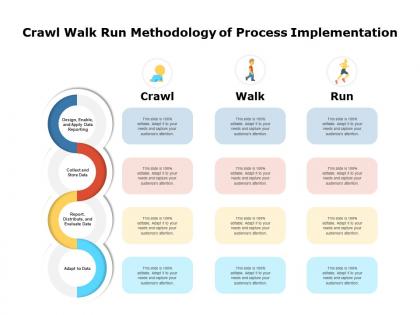
Crawl walk run methodology of process implementation




Try Before you Buy Download Free Sample Product
 Impress Your
 Audience
 100%
100% Editable
 Save Hours
 of Time


Our Crawl Walk Run Methodology Of Process Implementation are topically designed to provide an attractive backdrop to any subject. Use them to look like a presentation pro.
People who downloaded this PowerPoint presentation also viewed the following :
Crawl walk run methodology of process implementation with all 2 slides:
Use our Crawl Walk Run Methodology Of Process Implementation to effectively help you save your valuable time. They are readymade to fit into any presentation structure.

FAQs for Crawl walk run methodology
So basically crawl-walk-run breaks down like this: Start with crawl - just a small pilot to test things out and fix obvious problems. Walking means you've figured out the basics, so now expand it bit by bit. Running is when you're confident enough to go full scale. Honestly, this framework saved me from so many disasters because it stops you from jumping straight to the fancy stuff. The trick is being real about where you actually are - don't pretend you're ready to walk when you're still crawling around. For your next thing, just figure out what the smallest possible version looks like first.
So you basically start them off super basic - safety stuff, core concepts, easy hands-on work. That's the "crawl" part. Walking is where it gets interesting - real scenarios, problem-solving, less hand-holding. By "run" they're tackling the hard stuff alone. Honestly, this beats throwing people into the deep end any day. People actually remember things when they're not panicking! The tricky part is staying disciplined about it. Even when someone looks ready to skip ahead, don't let them. I've seen that backfire too many times. Test each level before moving up.
Honestly, this approach is a lifesaver when you're dealing with sketchy new markets or totally untested ideas. Most startups I've seen can't handle massive flops - the budget just isn't there. So you test small, learn fast, pivot cheap. Perfect for when customer needs are murky and you're basically guessing what people want. Complex products especially benefit since you can nail the core experience first. I'd actually skip the fancy features entirely at first - they're distracting anyway. Just pick one tiny thing you can ship this week and see what happens.
Honestly, the biggest mistake is rushing past the crawl stage because it feels stupidly basic. Leadership gets antsy and you're tempted to skip fundamentals, but that's exactly where everything falls apart later. Your walk phase shouldn't be some massive leap either - keep it actually manageable. Oh, and here's what kills me - teams always declare victory way too early then get crushed in the run phase. Actually measure your success before moving on. Set real exit criteria for each stage and stick to them, even when everyone's pressuring you to move faster. Trust me on this one.
Start simple with basic metrics - are you actually doing this stuff consistently? That's your crawl stage right there. Once you've got that down, walk phase is about efficiency - cutting cycle times, fewer screw-ups, that kind of thing. Running is when you track the fancy stuff like ROI and customer happiness scores. Honestly, most teams I know try jumping straight to the advanced metrics when they can barely do the basics. Don't be those guys. Pick maybe 2-3 easy things to track per stage and stick with it. Way better than overwhelming yourself with data you can't use yet.
Look, feedback's basically your reality check at every step. When you're crawling, it shows if you actually get the fundamentals or if you're just fooling yourself. Can't build anything solid on a wobbly base, right? Walking phase is where feedback saves your ass - tells you which skills still suck before you try scaling up. Most people totally skip this step and then act surprised when everything crashes later. Once you hit the running stage, feedback switches to fine-tuning mode. The trick is actually listening to what it's saying instead of cherry-picking the parts that make you feel good.
Honestly, visuals are perfect for the whole "Crawl, Walk, Run" thing. Simple graphics work great - even basic stick figures of someone crawling, walking, then running. Timeline arrows help people see where they're at and what's next. I always color-code each stage (red, yellow, green) because it just makes everything clearer during presentations. Oh, and don't overthink the graphics - I've seen people spend way too much time on fancy designs when simple stuff works better. The whole point is making it instantly obvious where someone is in their journey.
Honestly, manufacturing and tech companies nail this approach. They'll start with basic process improvements, add tech layers next, then boom - full automation. Software teams do it constantly too - MVP first, build features, then launch everything. Healthcare's gotten smart about it with those EMR rollouts (nobody wants their hospital system dying on launch day, obviously). The pattern works best when you're dealing with major system overhauls or getting people to change how they work. Going all-in from day one? That's usually a recipe for disaster. Most industries figure out pretty quick that the step-by-step thing just makes way more sense.
Honestly, you've gotta be super clear about what "done" actually means before anyone jumps ahead - trust me on this one. Weekly check-ins where everyone shares their real blockers (not just the pretty updates) are clutch. Dashboards help but don't overthink it. The thing is, people fill in gaps differently so you need to spell things out way more than feels natural. Oh and definitely do retrospectives after each phase. Sounds boring but you'll catch issues early instead of repeating the same mistakes. Most teams skip this part and regret it later.
Honestly, start with something like Asana or Monday for breaking down your crawl-walk-run phases. Gantt charts sound scary but they're actually clutch for seeing how everything connects timeline-wise. Simple dashboards work great for tracking success - Tableau's nice but Excel does the job too if you're not trying to get fancy. Oh, and map out your stakeholders early so everyone's on the same page about what each phase should look like. I'd pick whatever actually works with how your team operates rather than the coolest tool. You can always upgrade later once you figure out what you really need.
The crawl-walk-run thing works so well because it hits different learning styles without you having to overthink it. Visual kids see the demo first, hands-on learners get to actually do stuff in the walk phase, and auditory processors hear explanations the whole time. Quick learners can speed through while slower ones build solid foundations - which honestly makes classroom management way easier. I tried mapping my biology unit this way last month and the engagement difference was crazy obvious. You're basically covering all your bases without redoing your entire curriculum plan.
Look, executives get cranky when you talk about "crawling first" - they want results, not excuses. Map each phase to stuff they actually care about: money saved, revenue gained, risks avoided. Frame it like "Phase 1 gets us X in 3 months, then Phase 2 builds to Y impact." Show concrete timelines and budgets for everything. Here's the key part though - get them to agree upfront that you can kill the whole thing after any phase if it's not working. Honestly, that exit strategy often sells them more than the actual plan does. Make each stage prove itself before moving forward.
Honestly, start with just one department or process - whatever's easiest to digitize. Don't go crazy trying to transform everything at once (I've watched so many companies faceplant doing that). Once you nail the first one and figure out what actually works, expand it to similar areas. That's your middle phase. The final step? Roll it out company-wide, but only after you've proven it won't be a disaster. Oh, and pick your most tech-savvy team first - you'll need some early wins to keep everyone motivated. Baby steps beat big crashes every time.
So you'll want different metrics depending where you are. Start with basic stuff during Crawl - adoption rates, how engaged people actually are, basic ROI. Just prove it works, you know? Walk phase gets into efficiency gains and scaling numbers like user growth. Most teams honestly get impatient here and try jumping ahead too fast. Run phase is your advanced KPIs - competitive advantage, innovation rates, strategic impact. Keep it simple though. Maybe 3-5 key metrics per phase, then build from there as you get better at this whole thing.
So here's the thing about "crawl, walk, run" - it basically gives your team permission to mess up without everyone panicking. Starting small means people actually pitch their crazy ideas because who cares if a tiny test fails, right? Your team gets confident as they figure out what works. Then when you hit the "run" phase, they're ready to go bigger and bolder. Way better than gambling everything on some untested concept. Oh, and try this next time you brainstorm: ask "what's the tiniest version of this insane idea we could actually try?" Works every time.
No Reviews