


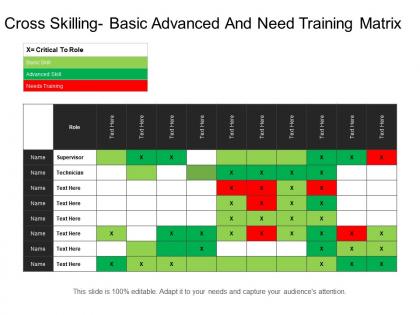
Cross skilling basic advanced and need training matrix




Try Before you Buy Download Free Sample Product
 Impress Your
 Audience
 100%
100% Editable
 Save Hours
 of Time


Identify acts of immaturity with our Cross Skilling Basic Advanced And Need Training Matrix. Advise folks to curb their emotions.
People who downloaded this PowerPoint presentation also viewed the following :
Cross skilling basic advanced and need training matrix with all 5 slides:
Feel enormously fortunate with our Cross Skilling Basic Advanced And Need Training Matrix. You will be certainly filled with glee.



FAQs for Cross skilling basic advanced and
Cross-skilling delivers enhanced operational flexibility, improved team collaboration, reduced dependency on single specialists, increased employee engagement, and stronger organizational resilience during transitions. Through strategic skill diversification, companies streamline project workflows, accelerate problem-solving capabilities, and minimize bottlenecks, with many organizations finding that cross-skilled teams adapt more effectively to market changes while delivering superior results.
Cross-skilling improves team collaboration by enabling employees to understand diverse roles, share knowledge across departments, and communicate more effectively through common skill foundations. When team members develop overlapping competencies, they break down silos, facilitate smoother project handoffs, and create stronger working relationships, ultimately delivering enhanced productivity and more cohesive organizational culture.
Healthcare, technology, manufacturing, and financial services have demonstrated significant success with cross-skilling initiatives, alongside retail and consulting sectors. These industries leverage cross-skilling to enhance operational flexibility, reduce staffing gaps, and improve service delivery, with many organizations finding that employees become more adaptable, innovative, and valuable in increasingly dynamic business environments.
Organizations identify cross-skilling priorities by analyzing future business needs, conducting skills gap assessments, and evaluating employee interests and aptitudes. Strategic workforce planning helps determine which capabilities drive competitive advantage, with many companies finding that combining technical skills with soft skills like communication and problem-solving delivers the greatest operational flexibility and employee engagement.
Companies face challenges including resistance to change from employees, resource allocation for training programs, identifying relevant skill gaps, measuring program effectiveness, and maintaining productivity during transition periods. While initial implementation requires significant investment in time and training infrastructure, organizations across sectors like healthcare and manufacturing find that structured approaches ultimately deliver enhanced workforce flexibility, improved employee retention, and stronger competitive positioning in increasingly dynamic markets.
Technology streamlines cross-skilling through learning management systems, virtual reality training modules, AI-powered skill assessments, and collaborative platforms that track progress and identify knowledge gaps. These digital tools enable personalized learning paths, simulate real-world scenarios for practice, and facilitate knowledge sharing between team members, ultimately accelerating skill development while reducing training costs and time investments.
Leadership drives cross-skilling culture by modeling continuous learning, allocating resources for training programs, and recognizing employees who develop diverse skills. Through strategic workforce planning and clear communication about career pathways, leaders create environments where cross-functional collaboration thrives, ultimately delivering enhanced organizational agility and competitive advantage in rapidly evolving markets.
Employees can be motivated through clear career advancement pathways, financial incentives like skill-based bonuses, recognition programs, and demonstrating how cross-skilling enhances job security and marketability. Organizations increasingly find that offering flexible learning schedules, mentorship opportunities, and showcasing internal success stories creates engagement, while emphasizing increased responsibilities and competitive advantages ultimately drives participation across diverse teams.
Cross-skilling effectiveness metrics include skill assessment scores, employee retention rates, internal mobility percentages, productivity improvements, and project completion times. Organizations typically track training ROI, competency gap reductions, and cross-functional collaboration frequency, with many companies finding that measuring knowledge transfer rates and employee engagement scores ultimately delivers comprehensive insights into program success and competitive advantage.
Cross-skilling enhances employee retention by providing career development opportunities, increasing job variety, and creating clearer advancement pathways within organizations. This strategic approach enables workers to explore different roles, develop diverse competencies, and feel more valued, with many companies finding that cross-skilled employees demonstrate higher engagement and loyalty.
Effective cross-skilling training methods include mentorship programs, job rotation initiatives, online learning platforms, collaborative project assignments, and skills workshops. These approaches streamline knowledge transfer by pairing experienced employees with learners, exposing staff to diverse departments, and creating hands-on experiences, ultimately delivering enhanced operational flexibility and competitive advantage across organizations.
Cross-skilling supports career advancement by expanding employees' skill portfolios, increasing their internal mobility, and making them more valuable across multiple departments and roles. Through strategic skill development, professionals enhance their problem-solving capabilities, leadership potential, and marketability, with many organizations finding that cross-skilled employees advance faster and secure higher-level positions.
Cross-skilling significantly enhances business agility and resilience by creating flexible workforce capabilities, reducing dependency on specialized roles, and enabling rapid resource reallocation during disruptions. Organizations with cross-skilled teams can pivot operations seamlessly, maintain continuity during staff shortages, and respond to market changes more effectively, ultimately delivering competitive advantage through enhanced adaptability and operational stability.
Companies ensure cross-skilling doesn't create role confusion by establishing clear role definitions, maintaining detailed responsibility matrices, and implementing structured communication protocols. Through regular team meetings and defined project hierarchies, organizations like consulting firms and healthcare systems successfully balance skill diversification with operational clarity, ultimately delivering enhanced flexibility while preserving accountability and workflow efficiency.
IBM's cross-skilling initiative retrained 100,000 employees in cloud and AI technologies, Amazon's Career Choice program upskills warehouse workers for technical roles, and AT&T invested $1 billion reskilling employees for digital transformation. These organizations demonstrate how strategic cross-skilling enhances workforce adaptability, reduces recruitment costs, and builds competitive advantage in rapidly evolving markets.
-
Wonderful templates design to use in business meetings.
-
Best way of representation of the topic.