

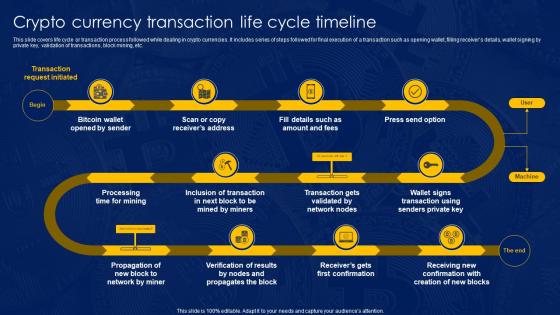
Crypto Currency Transaction Life Cycle Timeline




Try Before you Buy Download Free Sample Product
 Impress Your
 Audience
 100%
100% Editable
 Save Hours
 of Time


This slide covers life cycle or transaction process followed while dealing in crypto currencies. It includes series of steps followed for final execution of a transaction such as opening wallet, filling receivers details, wallet signing by private key, validation of transactions, block mining, etc.
People who downloaded this PowerPoint presentation also viewed the following :
Crypto Currency Transaction Life Cycle Timeline with all 6 slides:
Use our Crypto Currency Transaction Life Cycle Timeline to effectively help you save your valuable time. They are readymade to fit into any presentation structure.





FAQs for Crypto Currency Transaction
So basically when you send a transaction, it goes through a few steps. First it gets broadcast to the network, then sits in this thing called the mempool - think of it like a waiting room. Miners or validators check that everything's legit before adding it to the blockchain. Time-wise? Could be seconds, could be hours depending on how busy the network is and what fees you paid. Oh and different platforms want different numbers of confirmations before they'll actually credit you - some want just one, others are paranoid and want like six. Always worth checking that beforehand honestly.
So basically when you hit send, your transaction sits in this waiting pool until miners grab it. They'll double-check you actually have the money and that your signature's legit - can't have people spending fake coins, right? Then they bundle yours with other transactions into a block and solve some crazy math puzzle (or stake tokens if it's that type of network). Other computers verify everything checks out, and boom - it's locked into the blockchain forever. Oh, and definitely pay higher fees if you're in a rush. Miners are greedy and will process those first.
So miners are basically the people who actually make your crypto transactions go through. They compete to solve these crazy math puzzles that verify your transaction and bundle it into a block on the blockchain. It's like having digital accountants, but they're all racing against each other lol. Transaction fees and block rewards motivate them to keep everything legit. Your transaction would literally just sit there doing nothing without them. Honestly, the whole system is pretty wild when you think about it. Next time you're watching those confirmations roll in, just know someone's rig is grinding away to process your transfer.
Think of transaction fees like tipping - pay more and you'll get served first. Miners grab the highest-paying transactions because obviously they want to make money. Bitcoin can be brutal with this - I've had cheap transactions sit there for literally days when the network's busy. Ethereum's gas fees are honestly ridiculous sometimes during peak hours. Some cryptos like Nano don't charge anything at all though, which is nice. Others just use flat rates. Pro tip: check how busy the network is before sending and don't be cheap if you're in a rush.
So crypto security is actually pretty solid when you think about it. Your private keys sign every transaction - that's how the network knows it's really you sending the money. Then all these computers verify everything through consensus (proof-of-work, proof-of-stake, whatever). Each block gets this unique hash fingerprint, and once your transaction is buried under newer blocks? Good luck trying to mess with it. Honestly the whole system is kinda genius how it all connects. But here's the thing - none of this matters if you lose your private keys, so guard those with your life lol.
So transaction finality basically means your crypto payment is done and can't be undone. Pretty wild compared to credit cards where you can dispute stuff, right? Once your transaction gets enough confirmations from the network, that's it - no takebacks. Bitcoin usually needs 6 confirmations to be totally final. Ethereum's more like 12-15 blocks. Each blockchain does it differently though, so you'll want to check what yours requires. For big amounts, definitely wait for those confirmations before celebrating or whatever.
Crypto transactions can mess up in so many annoying ways. Network gets clogged? Your fees shoot up or everything moves super slow. Send to the wrong address and that money's gone forever - learned that one the hard way. Low fees mean your transaction just sits there doing nothing in the mempool. Smart contracts can bug out too, or you'll hit gas limit issues. I always triple-check addresses now because honestly, one typo will ruin your whole day. Check network status before sending anything big.
So when blockchains fork, your old transactions are usually fine if they're already confirmed. Soft forks? No worries - everything stays valid. Hard forks get messier though. You might score coins on both chains (honestly not the worst problem to have), but some transactions could get stuck if they only work on the chain that loses out. Your wallet needs to support whatever fork wins, so check that your exchange isn't being weird about it. Most of your confirmed stuff before the split should survive on whichever chain people actually end up using.
Ugh, network congestion is the worst - it's like when everyone's trying to leave a concert at the same time. Too many transactions hit the network and everything just crawls. Your crypto sits there forever waiting to get processed, and fees go crazy high. Bitcoin only handles about 7 transactions per second which is honestly pretty pathetic compared to traditional payment systems. During busy times, like when some hyped NFT drops, you might wait hours instead of the usual minutes. My advice? Either pay the premium fees or just chill and wait it out with lower fees. Lightning Network can help you dodge the whole mess too.
Bitcoin's the slowest - proof-of-work means you're waiting like 10 minutes for blocks. Ethereum switched to proof-of-stake so now it's way faster at 12 seconds, but you still need confirmations. Solana's basically instant which is nice. Oh and there's Lightning Network that skips Bitcoin's main chain completely - pretty clever actually. Honestly the whole space moves so fast I can barely keep up with all the different networks. Just double-check whatever network you're using because they all have different confirmation rules before your transaction actually goes through.
Dude, don't reuse crypto addresses - it totally screws your privacy. Anyone can link all your transactions together and see your spending patterns, wallet balance, everything. It's kinda like using one email for your bank, work, and sketchy online shopping lol. Bitcoin isn't really anonymous anyway, just pseudonymous. Reusing addresses makes it way worse. Most decent wallets will generate fresh addresses automatically for each transaction. That's exactly why they do it. Use new addresses whenever you can - your future self will thank you for not leaving a digital breadcrumb trail everywhere.
Dude, just start with blockchain explorers - they're like search engines for crypto. Blockchain.info and Blockchair work fine, but honestly Etherscan is my go-to for anything Ethereum related. You literally just paste your wallet address and boom, there's everything. If you need something fancier, CoinTracker or Koinly are pretty decent for portfolio stuff. Those expensive tools like Chainalysis? That's what the FBI uses lol, but way overkill unless you're doing serious investigation work. Try the free explorers first though - they'll probably give you what you need.
Dude, first things first - check that wallet address like three times. I'm not kidding, one wrong character and your money's gone forever. Make sure you're on the right network too (Ethereum vs Polygon etc). Gas fees are kinda tricky but most wallets suggest a reasonable amount. Once you hit send, grab your transaction hash and throw it into a block explorer - Etherscan for Ethereum stuff, or whatever your chain uses. Your wallet will show it as pending but honestly the block explorer gives you way more detail. Wait for a few confirmations before celebrating, especially if it's serious money.
Honestly, it's mostly about staying compliant and not getting screwed by taxes. The IRS treats crypto like property, so literally every trade could be taxable - super annoying but whatever. You'll need to deal with AML/KYC stuff too depending on volumes. Different countries are all over the map with this - China banned most of it, others want exchanges to have licenses. Regulations change constantly which makes it even messier. Just keep detailed records of everything (dates, amounts, all that) and if you're trading serious money, probably worth talking to a tax person who actually knows crypto.
So smart contracts basically handle all the transaction stuff automatically - no middlemen needed. They trigger payments when certain conditions are met, like escrow releases or getting multiple approvals. Honestly, it's pretty cool how fast everything settles now (minutes instead of days). Plus you're not dealing with human screwups anymore since it's all coded. Way cheaper too without all those fees. Oh, and everything's recorded permanently so there's full transparency. I'd look at whatever repetitive processes you're doing now - probably a bunch that could be automated. Makes life so much easier once you get it set up right.
-
Definitely recommend SlideTeam to all who need help with PowerPoint presentations. Their design team can create anything you need.
-
Thank you for offering such fantastic custom design services. The team is really helpful and innovative. In a very short time, I received my personalized template.