


Cultural Heritage And Planning Proposal Powerpoint Presentation Slides




Try Before you Buy Download Free Sample Product
 Impress Your
 Audience
 100%
100% Editable
 Save Hours
 of Time


Make use of our Cultural Heritage And Planning Proposal PowerPoint Presentation Slides and impress your potential clients with your creative services. As the name suggests, cultural functions are based on a particular occasion or theme. Help your clients achieve their goals by making an outstanding proposal. The combination of red and white adds a subtle charm to the proposal. Also, the culture-based images and the concise texts make the entire presentation appealing and interesting. Start your presentation with a well-designed cover letter that allows you to convey your key deliverables and services proficiently. The presentation also contains a well-formatted table of contents. Explain the essence of cultural heritage by incorporating our readily available social event PowerPoint slideshow. Take the help of this educational event PPT design to elaborate on the importance of cultural heritage and diversity. Look after your clients’ requirements and discuss the ideas and plans pertaining to the event. Highlight the programs that are a part of the cultural event by employing our religious ceremony PowerPoint template. Promise your clients to provide price-efficient packages, transparency at every step, and top-quality service by implementing our national events PowerPoint template. Detail your scope of services including planning, execution, implementation, and post-event analysis with our ready-to-use PowerPoint layout. Utilize our religious events proposal PPT graphic to dedicate the time required for completing each activity. A well-crafted investment layout exhibits the funds and money that your clients need to arrange for acquiring your services. Entice your clients by curating a budget-friendly plan and surprise them with various packages designed for their convenience. Provide your firm’s background, mission, vision, and core values innovatively with this religious ceremony PowerPoint presentation. Gain your client's trust by showcasing testimonials and past achievements in this PPT slideshow. Conclude your proposal by providing a contract and statement of work. Download this engaging presentation now!
People who downloaded this PowerPoint presentation also viewed the following :
Content of this Powerpoint Presentation
Slide 1: This slide introduces Cultural Heritage & Planning Proposal. State Client name, Submission date, User assigned.
Slide 2: This slide displays Cover Letter for Cultural Heritage & Planning Services.
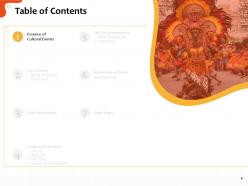
Slide 3: This slide displays Table of Contents.
Slide 4: This slide displays Table of Contents.
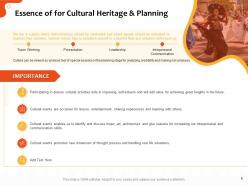
Slide 5: This slide showcases Essence of for Cultural Heritage and Planning Proposal
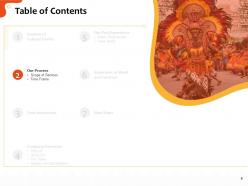
Slide 6: This slide displays Table of Contents.
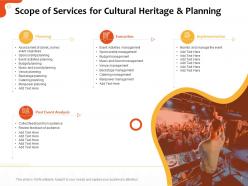
Slide 7: This slide showcases Scope of Services for Cultural Heritage and Planning Proposal
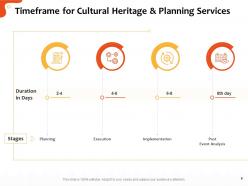
Slide 8: This slide shows Timeframe for Cultural Heritage and Planning Proposal
Slide 9: This slide shows Table of Contents.
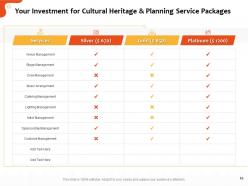
Slide 10: This slide depicts Investment for Cultural Heritage and Planning Proposal
Slide 11: This slide shows Table of Contents.
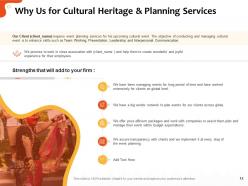
Slide 12: This slide explains Why Us for Cultural Heritage and Planning Proposal
Slide 13: This is About Us slide to showcase Company specifications.
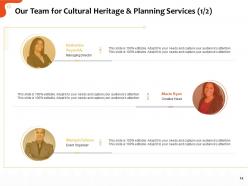
Slide 14: This is Our Team slide with Names and Designations.
Slide 15: This is Our Team slide with Names and Designations.
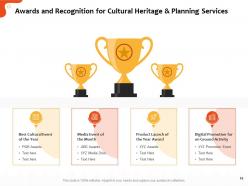
Slide 16: This slide shows Awards and Recognition
Slide 17: This slide displays Table of Contents.
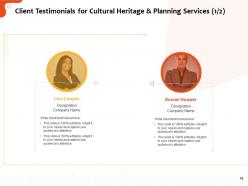
Slide 18: This slide displays Client Testimonials.
Slide 19: This slide shows Client Testimonials.
Slide 20: This slide displays Case Study.
Slide 21: This slide displays Table of Contents of the presentation.
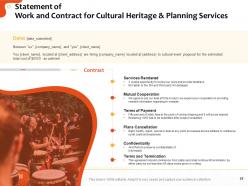
Slide 22: This slide describes Statement of Work and Contract for Cultural Heritage and Planning Proposal
Slide 23: This slide displays Table of Contents.
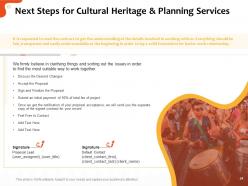
Slide 24: This slide depicts Next Steps for Cultural Heritage and Planning Proposal.
Slide 25: This is Contact Us slide with Address, Company address and Phone number.
Slide 26: This is Follow Us slide.
Slide 27: This is Icon Slide for Cultural Heritage and Planning Proposal
Slide 28: This slide is titled as Additional Slides for moving forward.
Slide 29: This slide displays Our Mission, Vision and Values.
Slide 30: This is 30,60,90 Days Plan slide.
Slide 31: This slide displays Roadmap process.
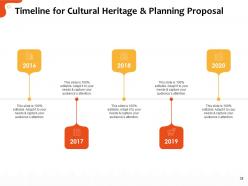
Slide 32: This slide displays Timeline process.
Cultural Heritage And Planning Proposal Powerpoint Presentation Slides with all 32 slides:





FAQs for Cultural Heritage And Planning Proposal
Ugh, so many things honestly. Money's always the biggest headache - heritage sites are constantly fighting for scraps while other stuff gets priority. Climate change is wrecking everything too. Sea levels rising, crazy storms just demolishing archaeological sites faster than anyone can fix them. Cities expanding doesn't help either - developers see old buildings and think "prime real estate!" Plus in sketchy regions you've got straight-up looting happening. My cousin works in restoration and she always says plan for weather disasters from the start, don't wait.
Honestly, globalization's kinda wild for local cultures. Sure, traditional stuff gets watered down when everyone's scrolling TikTok and copying Western trends. Younger people especially drift away from their roots. But here's what's cool - those same digital tools are helping communities fight back. People are using Instagram, YouTube, whatever to document their traditions and connect with others doing the same thing. My cousin's tribe started a whole online language program that way. Don't fight the tech wave, ride it. Use social media and digital archives to actually strengthen your cultural practices instead.
Dude, tech is seriously changing the game for preserving cultural stuff. 3D scanning creates crazy detailed digital copies of artifacts and buildings - lifesaver when originals are super fragile. VR and AR let people "visit" historical sites from their couch, which is honestly pretty mind-blowing. AI tears through huge collections way faster than humans could ever manage. Oh, and blockchain helps verify if artifacts are legit. Cloud storage backs everything up safely too. The best part? People worldwide can now access treasures they'd never see otherwise. Even basic digitization projects make a real difference, so don't overthink it.
Look, communities are the heart of keeping their culture alive - they're literally living it every day. You can't preserve heritage from some ivory tower, you know? Local people carry the real stories and know which traditions still matter versus what's just for show. They understand how things have changed over time and what might disappear if nobody pays attention. Honestly, the best preservation work happens when communities run the show themselves. Outside institutions should support them, not swoop in with their own agenda. If you're doing heritage work, just listen first - their priorities should drive everything.
Oh this is actually pretty cool stuff! So basically, don't just stick cultural heritage in history class - weave it into art, science, even business courses. Kids need to get their hands dirty with real experiences. Archaeological digs are amazing for this, or partnering with local museums. I mean, who remembers textbook facts vs. actually interviewing someone's grandma about old traditions, you know? Study abroad programs work too. Museums and cultural centers are usually dying to work with schools, so start there. The trick is making it feel relevant to students' actual lives instead of just another assignment.
Honestly, video and audio recording are your best bet - get performances, interviews with elders, traditional songs, all that stuff. Photos work great for crafts and clothing too. But here's the thing - don't just treat people like research subjects. Get the community actually involved as partners. They know way better than outsiders what's worth saving. I'd start by finding the key tradition holders in your area and building real relationships first. That's crucial. Digital archives help organize everything later, but participatory mapping where communities identify their own heritage? That's gold. Way more authentic than some outsider deciding what matters.
So governments basically need to put their money where their mouth is - actual funding for heritage stuff, plus zoning laws that keep developers from bulldozing historic areas. Tax breaks work amazing too, honestly people will maintain old buildings if it saves them cash. You'll also want heritage registries and those impact assessment things before anyone builds near cultural sites. The trick is making protection legally required, not just a suggestion. Oh, and definitely check what policies your area already has first - might save you some legwork figuring out what's missing.
Look, the biggest thing is getting actual consent from the communities - especially indigenous groups whose stuff you're trying to preserve. They should be making the decisions, not just getting asked for input after everything's planned. Way too many projects have screwed this up before and honestly just made things worse. Sacred materials need special handling, and you've got to think about who's gonna take care of everything long-term. Don't fall into stereotype traps either. Really ask yourself who's actually benefiting here - if it's just outside researchers or institutions, you're doing it wrong.
So tourism's pretty complicated for heritage sites, honestly. You get money from tickets and tourists spending locally, which helps pay for upkeep and gets people caring about preservation. But then crowds literally destroy what they came to see - think worn steps, graffiti, places losing their actual meaning when they become too touristy. I've seen it happen so many times. The trick is setting visitor limits and getting local communities involved in decision-making. That way tourism money actually helps people who live there, and they control how their culture gets presented to outsiders.
Honestly, digital stuff is amazing for promoting cultural heritage. Virtual tours and AR apps let people explore places they'll probably never visit otherwise. Social media works great too - you can tell the actual human stories behind artifacts instead of just boring facts. Younger people especially eat that up. The trick is finding where your audience already spends time online (no point posting on platforms they don't use, right?). Interactive websites are solid for deeper dives. Make it engaging first, educational second. Traditional methods just can't compete with the reach you get digitally.
Ugh, it's honestly heartbreaking what climate change is doing to these places. Venice keeps sinking faster, Mediterranean ruins are getting destroyed by crazy storms, and wildfires are just obliterating historic buildings. Rising seas literally erase sites from existence - like, gone forever. The worst part? Even gradual weather changes slowly eat away at foundations and materials over decades. A hurricane can destroy in hours what took centuries to build, which is just... devastating when you think about it. Your best move is donating to groups that are racing to digitally preserve everything before we lose it all.
So it really depends where you're talking about. Europe's all about fancy documentation and museums since they've got the cash for it. African countries do more oral tradition stuff - partly because funding's tight but also it's just how they've always done things. Japan's doing some crazy cool work earthquake-proofing old temples, mixing traditional methods with new tech. Latin America's mostly fighting off developers and climate damage. The biggest thing? Some places have official institutions running the show, others rely on local communities doing their own thing. Don't just assume the Western museum approach works everywhere - always check what locals actually prioritize first.
Your local traditions are literally the DNA of world culture. Each community's weird little customs and stories? They're irreplaceable pieces that make humanity interesting. Without them, we'd all just blend into some boring global sameness. Document whatever traditions you see around you - even the small stuff your grandma does counts. It's like being a cultural detective, honestly. These practices help people stay grounded in who they are when everything else feels so connected and fast-moving. Start paying attention to the rituals in your own community. You'd be surprised what matters.
Dude, awareness campaigns actually work really well for this stuff. You educate people about why their local heritage sites matter and suddenly they're calling in vandalism reports and showing up to fundraisers. It's wild how quickly attitudes change once people realize what they might lose. I've watched whole neighborhoods go from "eh, whatever" to super protective overnight. The trick is making it feel personal - like, how does this old building or tradition connect to their actual life? Oh and definitely figure out what your audience cares about first, then craft your message around that emotional hook. Works way better than generic appeals.
Crowdfunding's probably your best bet to start - it's easy and shows if people actually care about your project. You could also try those "adopt-a-monument" programs where folks sponsor specific pieces. Social impact bonds are interesting too - private investors fund stuff and get paid back based on results. Corporate sponsorships work if you can tie it to tourism somehow. Oh, and heritage lotteries exist apparently? NFTs are a thing but honestly I'm not convinced they'll stick around. The blockchain stuff feels gimmicky to me right now. Kickstarter's where I'd begin though - worst case you learn what doesn't resonate.
-
Content of slide is easy to understand and edit.
-
Informative design.