

Cyber Physical Systems CPS in Powerpoint und Google Slides





Try Before you Buy Download Free Sample Product
 Impress Your
Audience
 100%
Editable
 Save Hours
of Time


Diese Vorlage gibt einen kurzen Überblick über das CPS-Anbieterunternehmen und die Transformation des Unternehmensbetriebs mit cyber-physischen Systemen für eine effektive Servicebereitstellung. In dieser PowerPoint-Präsentation zu Cyber-Physical Systems haben wir die Einführung in Cyber-Physical Systems, einschließlich ihrer Funktionen und globalen Marktgröße, behandelt. Zusätzlich enthält dieses intelligente System PPT die Komponenten des CPS, wie z. B. Erfassungs- und Steuerungskomponenten, 5C-Architektur und vorgeschlagene 8C-Architektur. Außerdem umfasst die PPT-Präsentation des Computersystems der nächsten Generation die verschiedenen Arten von CPS, das Arbeiten und die Anwendung von CPS in verschiedenen Sektoren wie einem intelligenten Gewächshaus, der Fertigung, der Wasserverteilung, dem Gesundheitswesen usw. Darüber hinaus dient diese Vorlage für Collective Intelligence Systems der Sicherheit in cyberphysischen Systemen und Preisgestaltung für die CPS-Dienste. Schließlich umfasst dieses Cyber Physical Systems-Deck den 30 60 90-Tage-Entwicklungsplan, die Roadmap und die Auswirkungen nach der Implementierung auf Unternehmen. Laden Sie unsere zu 100 % bearbeitbare und anpassbare Vorlage herunter, die auch mit Google Slides kompatibel ist.
People who downloaded this PowerPoint presentation also viewed the following :
Inhalt dieser Powerpoint-Präsentation
Folie 1 : Diese Folie stellt Cyber-Physical Systems (CPS) vor. Geben Sie Ihren Firmennamen an und beginnen Sie.
Folie 2 : Diese Folie gibt die Agenda der Präsentation an.
Folie 3 : Diese Folie zeigt das Inhaltsverzeichnis für die Präsentation.
Folie 4 : Diese Folie hebt Titel für Themen hervor, die als nächstes in der Vorlage behandelt werden sollen.
Folie 5 : Diese Folie beschreibt den Überblick über das Unternehmen.
Folie 6 : Diese Folie zeigt Statistiken des CPS-Anbieterunternehmens.
Folie 7 : Diese Folie hebt Titel für Themen hervor, die als nächstes in der Vorlage behandelt werden sollen.
Folie 8 : Diese Folie stellt den Überblick über Cyber-Physical Systems dar.
Folie 9 : Diese Folie zeigt die Eigenschaften von Cyber-Physical Systems, einschließlich Selbstdokumentation, Selbstüberwachung usw.
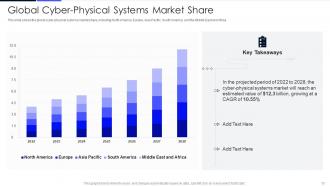
Folie 10 : Diese Folie zeigt den globalen Marktanteil von Cyber-Physical Systems.
Folie 11 : Diese Folie hebt Titel für Themen hervor, die als nächstes in der Vorlage behandelt werden sollen.
Folie 12 : Diese Folie zeigt Sensorkomponenten von Cyber-Physical Systems.
Folie 13 : Diese Folie präsentiert steuernde Komponenten von Cyber-Physical Systems.
Folie 14 : Diese Folie hebt Titel für Themen hervor, die als nächstes in der Vorlage behandelt werden sollen.
Folie 15 : Diese Folie beschreibt die Anwendungsschicht der cyber-physischen Systemarchitektur.
Folie 16 : Diese Folie beschreibt die Netzwerkschicht der cyber-physischen Systemarchitektur.
Folie 17 : Diese Folie repräsentiert die physische Schicht der cyber-physischen Systemarchitektur.
Folie 18 : Diese Folie zeigt die 5C-Architektur cyber-physischer Systeme.
Folie 19 : Diese Folie zeigt die vorgeschlagene 8C-Architektur cyber-physischer Systeme.
Folie 20 : Diese Folie präsentiert die Concept Map von Cyber-Physical Systems.
Folie 21 : Diese Folie hebt Titel für Themen hervor, die als nächstes in der Vorlage behandelt werden sollen.
Folie 22 : Diese Folie zeigt das Cyber-Physical Systems Model mit zeitgesteuerten Akteuren.
Folie 23 : Diese Folie repräsentiert das ereignisbasierte Cyber-Physical Systems Model.
Folie 24 : Diese Folie zeigt das Lattice-based Event Cyber-Physical Systems Model.
Folie 25 : Diese Folie zeigt ein Hybrid-basiertes Cyber-Physical Systems Model.
Folie 26 : Diese Folie hebt Titel für Themen hervor, die als nächstes in der Vorlage behandelt werden sollen.
Folie 27 : Diese Folie behandelt die Funktionsweise von cyber-physischen Systemen.
Folie 28 : Diese Folie beschreibt die cyber-physischen Systeme im intelligenten Gewächshaus.
Folie 29 : Diese Folie zeigt die Anwendung von CPS in der Fertigung.
Folie 30 : Diese Folie zeigt Cyber-Physical Systems in Wasserverteilungssystemen.
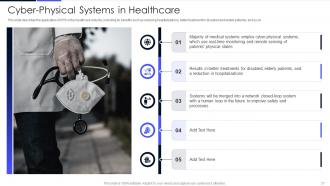
Folie 31 : Diese Folie beschreibt die Anwendung von CPS in der Gesundheitsbranche.
Folie 32 : Diese Folie zeigt die Anwendung von CPS in Claytronic, einschließlich des Zwecks, der Erstellungsmethode usw.
Folie 33 : Diese Folie repräsentiert Cyber-Physical Systems in Smart Transportation Systems.
Folie 34 : Diese Folie beschreibt den Einsatz von Cyber-Physical Systems in Smart Grids.
Folie 35 : Diese Folie hebt Titel für Themen hervor, die als nächstes in der Vorlage behandelt werden sollen.
Folie 36 : Diese Folie zeigt Sicherheitsziele in Cyber-Physical Systems.
Folie 37 : Diese Folie zeigt den Sicherheits- und Datenschutzlebenszyklus von cyber-physischen Systemen.
Folie 38 : Diese Folie zeigt den Prozess der strategischen Sicherheitsplanung für CPS.
Folie 39 : Diese Folie zeigt Schritte für den CPS-Sicherheitsstrategieplan.
Folie 40 : Diese Folie hebt Titel für Themen hervor, die als nächstes in der Vorlage behandelt werden sollen.
Folie 41 : Diese Folie zeigt die Preisgestaltung für die Entwicklung von Cyber-Physical Systems.
Folie 42 : Diese Folie hebt Titel für Themen hervor, die als nächstes in der Vorlage behandelt werden sollen.
Folie 43 : Diese Folie zeigt den 30-60-90-Tage-Plan für die CPS-Entwicklung.
Folie 44 : Diese Folie hebt Titel für Themen hervor, die als nächstes in der Vorlage behandelt werden sollen.
Folie 45 : Diese Folie zeigt die Roadmap für die Implementierung von Cyber-Physical Systems.
Folie 46 : Diese Folie hebt Titel für Themen hervor, die als nächstes in der Vorlage behandelt werden sollen.
Folie 47 : Diese Folie zeigt die Auswirkungen von Cyber-Physical Systems nach der Implementierung.
Folie 48 : Diese Folie zeigt Symbole für Cyber-Physical Systems (CPS).
Folie 49 : Diese Folie trägt den Titel „Zusätzliche Folien“, um voranzukommen.
Folie 50 : Dies ist unsere Missionsfolie mit zugehörigen Bildern und Texten.
Folie 51 : Diese Folie zeigt Haftnotizen. Posten Sie hier Ihre wichtigen Notizen.
Folie 52 : Dies ist eine Vergleichsfolie zum Vergleich zwischen Waren, Unternehmen usw.
Folie 53 : Diese Folie zeigt ein Venn-Diagramm mit Textfeldern.
Folie 54 : Dies ist unsere Zielfolie. Geben Sie hier Ihre Ziele an.
Folie 55 : Dies ist eine Timeline-Folie. Zeigen Sie hier Daten zu Zeitintervallen an.
Folie 56 : Dies ist eine Folie zur Ideengenerierung, um eine neue Idee darzulegen oder Informationen, Spezifikationen usw. hervorzuheben.
Folie 57 : Diese Folie enthält ein Puzzle mit zugehörigen Symbolen und Text.
Folie 58 : Dies ist eine Dankeschön-Folie mit Adresse, Kontaktnummern und E-Mail-Adresse.
Cyber Physical Systems CPS in Powerpoint- und Google-Folien mit allen 63 Folien:
Verwenden Sie unser Cyber Physical Systems CPS in Powerpoint und Google Slides, um Ihnen effektiv dabei zu helfen, Ihre wertvolle Zeit zu sparen. Sie sind gebrauchsfertig und passen in jede Präsentationsstruktur.
















FAQs for Cyber Physical Systems CPS In Powerpoint
So CPS are computers that directly connect to physical stuff through sensors and actuators. Your smartphone is kinda close, but real CPS systems go much deeper with constant feedback loops. They're monitoring and controlling things like factory equipment, self-driving cars, smart grids - you know, stuff that actually moves and does things in the real world. Here's the scary part though: when traditional software crashes, you just reboot it. When CPS fails? People could get hurt or equipment gets destroyed. That's why timing and reliability matter so much more than regular apps. If you're building anything like this, start worrying about safety constraints right away.
So sensors are like your system's eyes and ears - they grab real-world data (temperature, pressure, whatever) and send it to the digital side. Actuators work backwards, taking digital commands and making stuff actually happen in the physical world. Like opening valves or moving robot arms. Without them you'd just have a regular computer that can't touch anything real. It's actually pretty wild how smooth it can be when everything's working right. They're basically your bridge between the cyber and physical parts - that's what makes CPS actually useful instead of just another computer.
So CPS connects your factory floor directly to your digital systems - think sensors everywhere feeding data to AI that predicts breakdowns before they happen. Pretty neat stuff honestly. Your machines basically start talking to your software, which means you can spot issues early and cut way down on downtime. Production gets optimized automatically based on demand too. I'd start by figuring out which processes need real-time monitoring most. The whole predictive maintenance thing alone makes it worth it - saves you from those surprise equipment failures that kill your schedule.
Ugh, it's mostly those ancient industrial systems that are the nightmare. We're talking 90s control systems that suddenly got network access but zero security updates. Can't patch them easily either - and adding security might mess with real-time operations. Which is terrifying because a breach here doesn't just leak emails, it breaks actual equipment. Network teams and operational folks barely speak the same language too, which doesn't help. Honestly? Focus on network segmentation and watching for weird behavior instead of trying to bolt security onto decades-old hardware.
CPS are like the nervous system of smart cities - they link up physical stuff (traffic lights, sensors, utilities) with digital brains that crunch data and make instant calls. Traffic systems that actually adapt to rush hour? That's CPS. Same with power grids that reroute electricity when there's high demand. Cities can track air quality, predict when a water pipe might burst, respond to emergencies way faster. Honestly, it's pretty impressive when it all works together seamlessly. If you're diving into urban tech, focus on connecting real-world sensors with smart analytics to tackle actual problems people face daily.
So CPS and IoT are pretty similar, but CPS is like the smarter version that actually does stuff with the data it collects. IoT just connects things and gathers info - think your basic smart thermostat. But CPS? That's more like a whole building system that'll automatically adjust heating, lighting, everything based on how many people are around and what the weather's doing. The big difference is CPS can control things in real-time, not just watch them. Honestly, it's way cooler tech. When you're building something connected, just ask: does this thing make decisions or just collect data?
Privacy's the big one - you're basically collecting tons of personal data without people knowing. Smart streetlights tracking where everyone walks, sensors picking up conversations, that kind of stuff. Algorithmic bias is another nightmare since these systems can discriminate against certain groups. Plus you're building surveillance infrastructure that could totally be misused down the road (and trust me, it usually is). Security holes are inevitable too. Before rolling anything out, figure out what data you're actually grabbing, talk to the community first, and bake privacy protections in from the start.
So basically, ML algorithms can analyze all that sensor data to predict when stuff's gonna break before it actually does. Pretty cool, right? Your system learns from past patterns to optimize performance automatically - like adjusting energy use or scheduling maintenance. The key is starting small though. Don't try to tackle everything at once. Pick one process in your CPS and focus on getting really clean data from that first. Once you've got good data flowing, you'll start seeing fewer unexpected shutdowns and the system gets way smarter about spotting weird patterns.
Ugh, CPS regulations are such a mess right now. Most safety standards were written for standalone machines, but now you're dealing with networks that cross multiple industries. Privacy laws weren't built for real-time data sharing between physical devices either. Plus you'll hit jurisdictional chaos when systems span different states or countries - I swear the paperwork alone could kill you. FDA, FCC, and other agencies constantly have conflicting requirements too. Honestly? Map out which regulators actually control your specific use case first. Don't build anything until you know who you're answering to.
So CPS basically gives you real-time tracking of everything in your supply chain - inventory, trucks, the whole deal. AI jumps in to automatically reroute shipments and reorder stock before you even realize you're running low. Honestly, the amount of data these systems process is kinda crazy. Warehouses basically run themselves now, and your suppliers get pinged when stock's getting thin. You'll see way fewer stockouts and faster deliveries for sure. Oh, and costs drop too which is nice. I'd say start with whatever's causing you the biggest headaches right now - that's where you'll notice the difference first.
Think of interoperability as the thing that lets all your CPS components actually talk to each other. Without it, you're screwed - just a bunch of systems sitting there doing nothing useful together. Map out your interfaces first, that's huge. Then pick components supporting open protocols like OPC-UA or MQTT. Honestly, standardized data formats are non-negotiable if you want sensors, controllers, and actuators sharing info across different vendors. It's like... imagine everyone at a meeting speaking different languages. You'd get nowhere fast. Establish those common standards early or you'll hate yourself later.
Network segmentation is your first move - isolate the critical stuff. Then layer on strong authentication and encryption. These systems are weird though, they sit between digital and physical so regular IT security misses a lot. That's why penetration testing is huge here. Physical security matters too - honestly, some guy walking up to a sensor can wreck everything just as easily as a remote attack. The whole thing works best when you stop thinking cyber vs physical and treat it like one big security puzzle instead.
So CPS in healthcare is basically smart monitoring that combines physical sensors with digital analytics for real-time patient tracking. Wearable devices, smart beds, environmental sensors - they all collect vitals, movement data, room conditions automatically. AI spots concerning patterns before they turn into emergencies, which honestly saves everyone a headache. Nurses get instant alerts when something's wrong. The system can predict falls or even adjust medication dosing by itself. You're not constantly bugging patients for data either. I'd start with your biggest monitoring gaps first - that's where you'll see the most impact right away.
Dude, CPS tech is getting insane right now. AI is making these systems actually smart - they learn and adapt instead of just running basic code. Processing is moving to edge computing too, so everything responds faster and stays more secure. Healthcare's where you'll probably notice it first, plus smart cities are rolling this out everywhere. Manufacturing is already going nuts with it - my cousin works at a plant and says it's wild how automated everything's gotten. Keep watching 5G and quantum computing developments. That combo's gonna unlock some seriously crazy capabilities we can't even picture yet.
Honestly, schools really need to get their engineering departments talking to each other instead of staying in separate bubbles. CPS is all about mixing computer science with electrical and mechanical stuff - you can't learn it properly when professors never collaborate. Hands-on projects with IoT devices and real-time systems beat textbook theory every time. Partner with companies since tech changes way too fast for academia to keep up (seriously, some of my textbooks were already outdated). The best approach? Build actual systems that connect physical and digital components. Push your school for more cross-department classes - it's a game changer.
-
The Designed Graphic are very professional and classic.
-
Their professional templates are very impressive, even my manager was curious about the source. I am very grateful.