


Data AI Artificial Intelligence Data AI App IQ Taxonomy For Category Classification AI SS




Try Before you Buy Download Free Sample Product
 Impress Your
 Audience
 100%
100% Editable
 Save Hours
 of Time


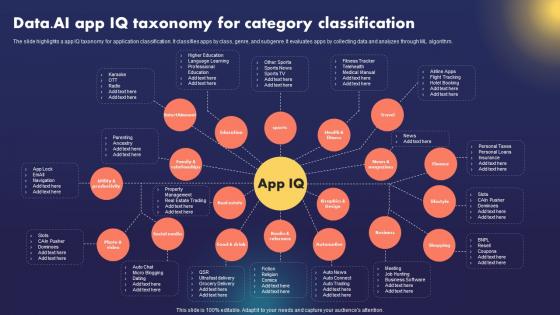
The slide highlights a app IQ taxonomy for application classification. It classifies apps by class, genre, and subgenre. It evaluates apps by collecting data and analyzes through ML algorithm.
People who downloaded this PowerPoint presentation also viewed the following :
Data AI Artificial Intelligence Data AI App IQ Taxonomy For Category Classification AI SS with all 9 slides:
Use our Data AI Artificial Intelligence Data AI App IQ Taxonomy For Category Classification AI SS to effectively help you save your valuable time. They are readymade to fit into any presentation structure.








FAQs for Data AI Artificial Intelligence Data AI App IQ Taxonomy For Category
So basically, supervised learning is when you have examples with the right answers already - like showing the algorithm emails that are already labeled "spam" or "not spam." It learns from those. Unsupervised is way cooler though - you just dump unlabeled data and let it find patterns you didn't even know existed. Like customer groups or weird anomalies. One needs a teacher, the other figures stuff out alone. Do you have labeled data for your project? That's literally the only question that matters here.
Honestly, getting your data cleaned up first is the biggest pain - way harder than the actual AI part. But once that's done, you can feed historical data from your CRM, sales records, whatever into AI models to spot patterns. Perfect for predicting stuff like customer churn or sales trends. Then automate the boring decisions - pricing changes, who to target with marketing, inventory planning. I'd probably start with just one area where your data's already decent and you know what success looks like. Don't try to boil the ocean right away.
Honestly, data is what makes AI actually work. Your algorithms can be super fancy, but they'll suck without enough quality data to train on. It's like expecting someone to be an amazing chef after only making 5 meals - just won't happen. AI needs tons of examples to learn from all the weird edge cases it'll see later. I'd focus way more on getting diverse, solid datasets first. The algorithm tweaking can wait. More data almost always beats a slightly better model with less training material. Trust me on this one.
So basically, data AI tracks how each customer behaves - what they buy, click on, even how long they browse stuff. Then it serves up recommendations that actually make sense for that person. Way better than showing everyone the same "popular items" nonsense, right? It's like how Netflix knows you're obsessed with true crime documentaries. The system gets smarter over time too. You'd start by gathering data from wherever customers interact with your business, then run ML algorithms to spot patterns. Honestly works so much better than generic suggestions - people actually buy the stuff it recommends.
Okay so bias is huge - your models will just copy whatever unfairness was already in the training data. Test for that stuff regularly across different groups. Privacy's another big one, get consent for personal data and maybe look into anonymizing things. Oh and transparency matters too, especially when your AI is making decisions about people. I mean, nobody likes being judged by a black box, right? Honestly though, the main thing is just planning for this upfront instead of scrambling later. Document your data sources and model limitations so you're not flying blind.
So neural networks basically copy how our brains work - they find patterns in data automatically through connected layers. Traditional ML is different though, you have to manually pick out features first. It's kinda like traditional algorithms need you to prep all your ingredients before cooking, but neural networks just figure out what matters while they're going. The cool thing is they can handle messy stuff like images or text without much cleanup on your end. Honestly, if you're dealing with complex data like customer reviews, I'd definitely try neural networks first. Way less headache with preprocessing.
First thing - get rid of duplicates and deal with missing data. Check for outliers too, but honestly? Sometimes those weird data points end up being gold. Normalize your numbers so everything's on the same scale, then encode your categorical stuff properly. Oh, and always keep your original dataset somewhere safe - trust me on this one. Build a cleaning pipeline you can rerun easily because you'll definitely need to tweak things. Document what you changed as you go. Data validation should happen throughout, not just at the end.
These AI visualization tools are honestly pretty amazing - they'll spot patterns in your data that you'd totally miss otherwise. Machine learning suggests which charts work best for your specific dataset. The natural language thing is what gets me though - just type "show me sales trends by region" and boom, instant charts. They handle huge datasets way better than regular tools and find weird correlations you wouldn't think to look for. Start with Tableau's Ask Data or Power BI's Q&A features on whatever data you've got lying around. They dynamically update as your data changes too, which saves tons of time.
Track stuff that actually matters to your business, not just the flashy tech metrics. Model accuracy is important, but ROI and time savings tell the real story. User adoption rates too - I've watched so many AI tools just sit there unused after launch. Cost per prediction will make or break your budget (learned that one the hard way). Are people actually using what you built? And honestly, step back sometimes and ask if you're even solving the original problem. Don't go overboard with dashboards - pick 3-4 metrics that count.
Honestly, transfer learning is a lifesaver. You grab a pre-trained model like GPT or some computer vision thing and just fine-tune it for whatever you need. Way less data required, way less compute power too. I've been seeing it everywhere lately - chatbots, image stuff, random industry apps that wouldn't have existed before. Beats training from scratch every single time, especially if you don't have massive resources (which, let's be real, most of us don't). My advice? Look around for pre-trained models in your area first. Don't reinvent the wheel.
Data quality is usually the biggest pain point - garbage in, garbage out, you know? Plus most companies aren't actually ready for AI even when they think they are. Your team probably needs new skills or fresh hires to connect the tech and business stuff. Legacy systems? Total nightmare for AI workloads. Leadership always wants results yesterday but won't invest properly upfront. I'd say audit your data first, then pick one small use case to test with instead of going all-in right away.
So basically, AI analyzes tons of network traffic and user behavior to catch weird stuff humans would totally miss. Think of it as a security guard who actually pays attention 24/7. It'll spot sketchy login attempts, suspicious file transfers, malware - all in real-time. Then it either blocks the threat or pings your security team immediately. You can even use it to predict vulnerabilities before hackers find them, which is pretty cool. I'd start with AI threat detection tools that work with whatever security setup you already have. Trust me, your response times will improve big time.
Look, data quality is everything when it comes to AI models. Bad data = bad predictions, period. You know that old saying "garbage in, garbage out"? It's literally that but worse with machine learning. Messy or biased datasets will screw you over every time. Your model might look good during testing, then completely fall apart in real situations. Honestly, I've seen this happen way too often. Clean, well-organized data is what separates models that actually work from expensive paperweights. Trust me - spend the extra time upfront cleaning your data. Way better than trying to fix everything later.
NLP turns messy text into actual useful data. Like, you can pull sentiment and key info from customer reviews or support tickets - way faster than reading through everything manually. Named entity recognition grabs people, places, products from text. Sentiment analysis shows if feedback's positive or negative. There's honestly so much hidden in unstructured text data once you dig in. I'd start simple though - just run sentiment analysis on whatever text you've got lying around and see what pops up. You'll probably find some interesting patterns you didn't expect.
Autonomous AI agents are where it's at right now - they can run entire workflows without you babysitting them constantly. Federated learning is pretty cool too, lets companies train models on sensitive data without actually sharing it. The multimodal stuff is getting insane, like AI that actually understands when you mix text, images and audio together. Edge computing for real-time decisions is blowing up, especially with all the IoT devices everywhere. Honestly, I'd mess around with some agent frameworks now before they become mainstream. Also figure out your edge strategy - that space moves fast and you don't want to get left behind.
-
SlideTeam makes creating presentations easy. Unlimited products, premium quality designs and affordable.
-
Content of slide is easy to understand and edit.