


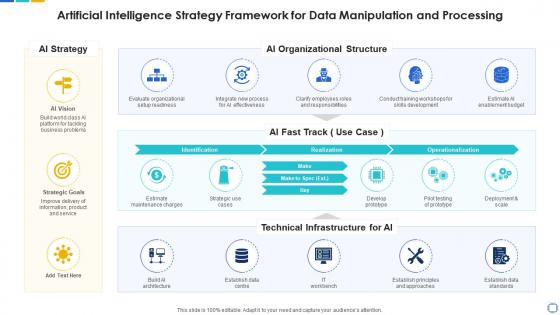
Artificial intelligence strategy framework for data manipulation and processing




Try Before you Buy Download Free Sample Product
 Impress Your
 Audience
 100%
100% Editable
 Save Hours
 of Time


Our Artificial Intelligence Strategy Framework For Data Manipulation And Processing are topically designed to provide an attractive backdrop to any subject. Use them to look like a presentation pro.
People who downloaded this PowerPoint presentation also viewed the following :
Artificial intelligence strategy framework for data manipulation and processing with all 9 slides:
Use our Artificial Intelligence Strategy Framework For Data Manipulation And Processing to effectively help you save your valuable time. They are readymade to fit into any presentation structure.








FAQs for Artificial intelligence strategy framework for data
You'll need clear business goals connected to specific AI use cases, plus a decent data strategy and governance setup. Technology infrastructure planning matters too, along with talent acquisition and training plans. Most companies totally ignore the ethics piece at first - huge mistake that comes back to haunt them. Change management is crucial since AI messes with everyone's workflows. Set up success metrics to track ROI and impact. Don't treat this like just an IT thing either. Get stakeholders from different departments on board early. Start by figuring out where you are now, then pick 2-3 high-impact use cases instead of trying to do everything at once.
Honestly, the biggest mistake I see is people getting excited about shiny AI tools without thinking about what business problem they're actually solving. Map your projects to real outcomes first - like actual revenue or cost savings, not just "efficiency gains" (whatever that means). Get your business people involved early. I can't stress this enough - don't let IT run the whole show. Track metrics that matter to the C-suite, not just technical performance. Set up governance with both sides at the table. Basically treat it like you would any major investment where you need to show ROI.
Honestly, data governance is like the foundation of your whole AI thing - skip it and you're screwed. I've watched so many companies dive headfirst into AI projects then wonder why everything's falling apart. Their data was just chaos from day one. You gotta figure out who owns what data first, plus how you'll clean it and handle privacy stuff. Can't train decent AI models on garbage data, you know? Do an audit of what you've got now and spot the problems before throwing money at fancy AI tools. Trust me on this one.
So most companies track ROI and cost savings - the obvious money stuff. But they also look at technical things like model accuracy and how fast they can deploy new models. Honestly though, the technical metrics are pretty useless if they don't actually help the business. What works best is picking 3-5 specific outcomes you want from AI first, then figuring out which metrics actually tell you if it's working. Some companies get way too obsessed with accuracy percentages when their real problem is that nobody's using the tool. Dashboards help visualize everything together.
Don't just slap ethics on at the end - weave it through everything from day one. Get diverse people on your team because echo chambers will screw you over later. Test for bias constantly while training models, set up solid governance rules, and always have humans double-checking the big decisions. Oh, and be transparent about when you're using AI on people - they deserve to know. Honestly, treating ethics like it's optional is asking for trouble. Document everything and audit regularly. It's way easier to build it in properly than fix a mess later.
Honestly? Most people jump straight into the tech without figuring out what problem they're actually solving. Huge mistake - you'll build something totally useless. I see teams get stuck endlessly tweaking models instead of just shipping something to users. Your data quality will probably suck too (garbage in, garbage out is so real). Oh and don't forget your team needs to actually want this change or they'll sabotage it. Pick one simple use case first, make it work, then expand from there.
So three main things to check out. First, audit your data - is it actually clean and usable for AI models? Most companies think they're way more ready than they actually are, tbh. Your tech infrastructure is next - can it even handle AI workloads or will you need major upgrades? And honestly the biggest issue is usually people, not tech. Do you have team members who can translate between business needs and the technical stuff? I'd seriously run a pilot project first before going all-in on some big AI strategy. Way better to test the waters.
Honestly, start with one of the big cloud platforms - AWS, Azure, or Google Cloud. They'll handle all the messy infrastructure stuff you don't want to deal with. Python's basically unavoidable in AI work (tried to escape it once, couldn't lol). TensorFlow and PyTorch are your main ML frameworks. MLflow's great for managing models, and you'll need Kubernetes when you want to scale deployments. Apache Airflow or Prefect work well for data pipelines. My take? Pick one cloud provider and stick with Python at first. You can always add more tools once you figure out what you actually need.
Start with making people feel safe to mess up - nobody's gonna try AI stuff if they're terrified of failing. Honestly, some of our coolest discoveries came from experiments that totally flopped but taught us tons. Give your most curious people time to actually play around instead of just putting out fires all day. Cross-functional teams work way better too since different viewpoints spark better ideas. Find those naturally enthusiastic folks first and let them loose with AI tools. Their excitement will spread to others pretty quickly, and boom - you've got momentum without forcing it on anyone.
Honestly, I'd start with figuring out what skills your current team is missing - do some assessments first. Then pump money into training: online courses, workshops, maybe send people to conferences. Here's the thing though - don't waste time chasing those crazy expensive ML engineers everyone wants. Build mixed teams instead. Get your domain experts working alongside the tech people. Set up some kind of internal community where teams can actually share what they're learning (this part's huge). Oh, and make sure there's a real career path for AI roles or people will just bounce to somewhere that pays better.
Honestly, map out everyone who'll be affected by your AI stuff from day one. Employees freak about losing jobs, customers worry about their data, regulators want compliance boxes checked. Different groups, totally different headaches. I've watched companies completely blow this - they build everything first, then act shocked when people push back hard. Super avoidable mistake. Start with just listening to what each group actually cares about, then keep that feedback loop going throughout the whole process. Don't treat it like some box to check at the end.
Honestly? You've gotta bake compliance right into your AI plans from the start - can't just slap it on later. Data privacy laws, transparency rules, industry-specific stuff... it all affects which AI tools you pick and when you roll them out. Yeah, it's annoying but way better than getting slammed later. Your budget's gonna take a hit too since you'll need people monitoring compliance and doing audits. Oh, and maybe rebuilding things if you mess up the first time (learned that one the hard way). Just map out what regulations hit your industry early and work around them.
Honestly, you want to pick three spots where AI actually makes a difference. Automate the boring stuff first - customer service, data entry, all that repetitive work your team hates anyway. Then get into personalizing customer experiences at scale (this one's pretty cool when it works). Predictive analytics is where things get interesting though - forecasting demand, tweaking pricing, making smarter calls across the board. Don't try to do everything at once. The companies crushing it with AI? They're laser-focused on specific problems and they're obsessed with measuring what's actually working.
Track both the nerdy stuff and business impact. Accuracy, precision, recall - how well is your model actually working? Then ROI, time saved, error rates, adoption. Pick maybe 3-5 metrics that actually matter to your goals. I learned this the hard way - don't chase metrics that just look cool in presentations. Set up dashboards so you're not stuck pulling reports manually every week (seriously, worst part of my last project). Oh and watch for model drift - that'll sneak up on you. Focus on what moves the needle for your specific use case.
Honestly, you'll want to go modular from the start – APIs that actually work together, cloud-native stuff, proper governance that won't implode when things get bigger. Vendor lock-in is basically a nightmare waiting to happen, so avoid that trap. Get your data pipelines sorted and standardized early. The architecture needs regular stress-testing against whatever scenarios you think might hit. Oh, and audit what you've got now first – find those bottlenecks before they bite you. Short version: flexible components, solid processes, don't put all your eggs in one basket.
-
Innovative and Colorful designs.
-
Great quality slides in rapid time.
-
Innovative and attractive designs.
-
Innovative and Colorful designs.