


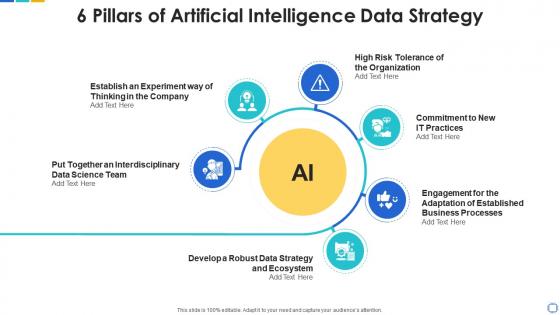
6 pillars of artificial intelligence data strategy




Try Before you Buy Download Free Sample Product
 Impress Your
 Audience
 100%
100% Editable
 Save Hours
 of Time


Our 6 Pillars Of Artificial Intelligence Data Strategy are topically designed to provide an attractive backdrop to any subject. Use them to look like a presentation pro.
People who downloaded this PowerPoint presentation also viewed the following :
6 pillars of artificial intelligence data strategy with all 9 slides:
Use our 6 Pillars Of Artificial Intelligence Data Strategy to effectively help you save your valuable time. They are readymade to fit into any presentation structure.








FAQs for 6 pillars of artificial
Honestly, you need five main things for a solid data strategy. First is governance - basically who owns what data and how it gets managed. Most companies totally bomb this part because nobody wants to deal with the politics around data ownership, but it's crucial. Then there's your tech setup, quality standards, and analytics capabilities. Oh, and change management for your people - probably the most overlooked piece. I'd start by just mapping out what data you actually have right now and who's using it. That'll expose the gaps fast and give you a real starting point.
First thing - figure out what you're actually trying to accomplish with your business. Then work backwards to see what data you'd need. Like if customer retention is the goal, you want behavior data and churn signals. Honestly, don't just hoard random data because it looks important (I've seen so many useless dashboards lol). Get your business people involved early or they'll ignore whatever you build. Oh and start small - pick maybe 2-3 things that'll actually move the needle instead of trying to do everything at once.
So governance and compliance are basically what stop your data from becoming a total mess. You need them to figure out who gets access to what and how to handle everything legally - super tedious but you can't skip it. Otherwise you'll end up with unreliable data that might get you in trouble with regulators. I learned this the hard way at my last job honestly. Governance gives you the structure for keeping data quality high and making sure people are accountable. My advice? Start with whatever compliance stuff you absolutely have to follow, then build your rules around that foundation.
You can't mess around with bad data - it'll tank everything you're trying to build. I've seen companies waste months because they skipped the boring stuff upfront. Your fanciest analytics tools become useless when they're crunching garbage numbers. Teams stop trusting the reports pretty quickly, then nobody wants to use anything data-related. It's like trying to cook with expired ingredients - doesn't matter how good your recipe is. Do yourself a favor and audit what you've got first. Set some basic standards before you start building dashboards or whatever comes next.
Honestly, you want to mix business impact with the operational stuff. Data quality scores matter, but what executives actually care about is revenue from data-driven projects - that's your golden metric right there. Time-to-insight is solid too, plus how easily teams can access what they need. I'd also track adoption rates across departments and whether your analytics are genuinely influencing decisions (not just sitting in dashboards collecting dust). Pick maybe 4-5 metrics that connect back to your original goals. Don't go crazy trying to measure everything - you'll just overwhelm yourself.
Honestly, I'd start with AI/ML for predictive stuff - that's where you'll see real ROI. Cloud platforms are great for when you need to scale storage without breaking the bank. Real-time streaming tech gives you those instant insights everyone's always asking for. Edge computing's pretty hot right now too, basically processes data right where it happens instead of sending everything back to central servers. But here's the thing - don't just grab every new tech because it sounds cool. Pick what actually fixes your problems and plays nice with what you already have. Test small first, see if it works, then expand.
Three big things to nail down: access controls, encryption, and governance. Role-based permissions first - lock down who sees what. Encrypt everything, both stored data and stuff moving around. Most teams totally mess up the governance part though, which is honestly where the real damage happens. You need actual policies for data handling, regular audits, staff training on privacy stuff. Oh and don't collect data you don't actually need - seems obvious but everyone does it. Have an incident response plan ready too. The whole thing only works if security becomes part of how your team thinks, not just some compliance thing you check off.
Honestly, the people side of this is way harder than the tech part - and I've seen so many companies mess this up. Your team needs to actually want to use data instead of just winging decisions. Leadership has to walk the walk, not just talk about being "data-driven" in meetings. Plus you'll have folks who are terrified of learning new systems. I'd figure out where everyone's head is at first before you start building dashboards nobody will touch. The culture shift is everything here.
Honestly, most people try to do way too much at once and end up totally overwhelmed. Don't be that person. Also, get your stakeholders involved from the beginning - I can't tell you how many projects I've seen die because someone built something in a vacuum. Data quality is probably messier than you think it'll be. Governance matters from day one, even though it's boring as hell. And people completely forget about change management because they're obsessed with the cool tech stuff. My advice? Start with something small that actually works and gives you a quick win. Then build from there.
Think of data visualization as translating your strategy into something people actually want to look at. Charts and dashboards beat the hell out of spreadsheets - nobody's eyes glaze over when they can see trends right away. Your team spots problems faster, leadership gets it quicker, and honestly? Pretty visuals get you budget approval way easier than a wall of numbers. Decision-making speeds up across the board. I'd start with Tableau if you can swing it, but even Excel charts work fine when you're just getting started.
Honestly, good data strategy is a game changer for decision-making. You stop relying on hunches or those ancient spreadsheets Karen from accounting sends around. Real-time insights show what's actually going down in your business. No more of that annoying thing where marketing says one thing and sales says something completely different - you know what I mean? Spotting problems early becomes way easier too. The trick is keeping everything clean and getting it to people who actually need it. Trust me, it's worth the upfront hassle.
Build your data strategy around core principles, not specific tools - way more flexible that way. Every quarter, check what's new in tech and how the market's shifting. Companies get stuck doing things the old way and it kills them (seen it happen so many times). You'll want agile infrastructure that adapts fast. Set up feedback loops with customers and do your market research. Oh, and definitely have someone tracking emerging trends - being blindsided by the next big thing sucks. Don't be scared to pivot when something's not working.
Honestly, data literacy makes or breaks everything. I've watched companies blow tons of cash on amazing tools that just sit there unused because nobody knows what they're looking at. Your team needs to actually understand how to read and question the data, otherwise they'll keep making decisions based on hunches. Which isn't always wrong, but still. Start by figuring out who on your team gets it and who doesn't. Then focus your training budget there. Best infrastructure in the world won't help if people can't interpret what it's telling them.
So basically, you gotta get all your teams talking to each other instead of hoarding their own data like dragons. Marketing, sales, finance - when they actually share info, patterns start jumping out that nobody would've caught alone. The best part? Sales can explain why customers do weird things, which helps marketing make sense of their numbers. Also prevents that super annoying situation where everyone defines "conversion" differently (ugh, been there). Short version: set up monthly cross-team meetings where people actually show their data. Game changer, trust me.
Check if the new data source matches your current quality standards and governance stuff first. Map where it goes in your architecture - trust me, this saves tons of headaches down the road. Run a pilot integration to test data flows and see what breaks downstream before you go all-in. Your team needs to understand the new data lineage, so update those docs. Oh, and set up monitoring from the start to catch problems early. I've seen too many people skip this step and regret it later. Short pilot, then scale if it works.
-
Professional and unique presentations.
-
Great designs, really helpful.
-
Colors used are bright and distinctive.
-
Unique and attractive product design.
-
The Designed Graphic are very professional and classic.
-
Enough space for editing and adding your own content.
-
Visually stunning presentation, love the content.
-
Great quality slides in rapid time.
-
Top Quality presentations that are easily editable.